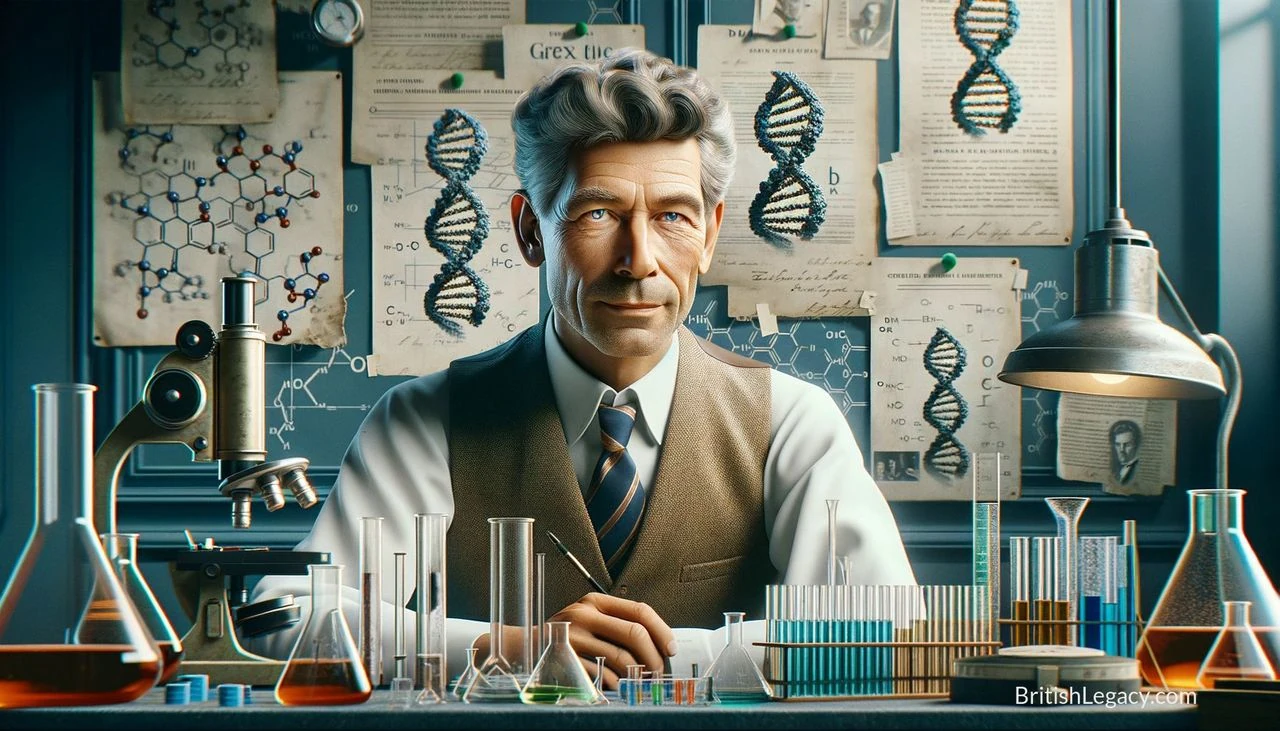
Francis Crick’s name is inseparable from the double helix, but the discovery was not a two-man effort made in isolation. Crick and James Watson built their 1953 model using experimental findings and insights from other researchers, notably Rosalind Franklin and Maurice Wilkins. The model offered a way to understand how DNA could carry hereditary information and be copied. Crick’s contribution belonged to a larger scientific enterprise—and it was the beginning, rather than the end, of his work on biology.
From Northampton to wartime research
Francis Harry Compton Crick was born on 8 June 1916 in Weston Favell, then a village near Northampton. His father and uncle ran the family’s boot and shoe factory. His grandfather, Walter Drawbridge Crick, was an amateur naturalist who studied local single-celled organisms. As a boy, Crick was drawn to science and books; an uncle also introduced him to practical experiments, glass-blowing and photographic printing.
After attending Northampton Grammar School, Crick won a scholarship to Mill Hill School in London, where he studied mathematics, physics and chemistry. He went on to University College London (UCL), graduating with a Bachelor of Science degree from the University of London in 1937. His doctoral research in physics was interrupted by the Second World War. At the Admiralty Research Laboratory, he worked on magnetic and acoustic mines, including the design of a mine intended to defeat German minesweepers.
After the war, Crick changed direction. In 1947, aged 31, he began studying biology, joining the movement of physical scientists into biological research. He worked at Cambridge’s Strangeways Research Laboratory before moving to the Cavendish Laboratory, where he joined Max Perutz and John Kendrew. There he developed expertise in X-ray crystallography, the analysis of patterns produced when X-rays pass through crystals, and began applying a physicist’s approach to biological problems.
Building a model of DNA
Crick began working with Watson at the Cavendish in 1951. Their shared problem was how hereditary information might be stored in a molecule. The pair used model-building and theoretical reasoning alongside experimental results, including evidence produced by researchers elsewhere. Crick’s work on the mathematics of helical diffraction helped him interpret the kind of structure that could fit the available data.
Franklin’s and her student Raymond Gosling’s X-ray diffraction work provided important evidence about DNA’s helical form and structural features. Wilkins, working at King’s College London, also contributed experimental findings and shared information with the Cambridge researchers. Other evidence mattered too: Erwin Chargaff’s observations about the relative quantities of DNA bases helped Watson and Crick see how adenine could pair with thymine, and guanine with cytosine. The resulting model placed the sugar-phosphate backbones on the outside, with paired bases at the centre.
Crick and Watson’s paper describing the double-helical model appeared in Nature on 25 April 1953, alongside papers from King’s College researchers. The arrangement of complementary bases suggested how DNA could be copied: the two strands could separate, with each serving as a template for a new strand. The model connected molecular structure to the possibility of hereditary information being transmitted between generations. Its significance did not erase the contributions of Franklin, Gosling and Wilkins, whose experimental work helped make the model possible.
From molecular structure to genetic information
Crick’s interest quickly moved from what DNA looked like to how information in it might direct the production of proteins. He developed ideas about the flow of biological information and used the phrase “central dogma” to summarise a proposed direction of transfer between nucleic acids and proteins. He also considered how short sequences of nucleotides might correspond to amino acids, and proposed the idea of adaptor molecules that could help connect the two. These concepts helped frame questions that experimental biologists went on to test.
Crick was primarily a theoretical molecular biologist, but his ideas were closely connected to laboratory findings. Work by Crick and Sydney Brenner contributed to the study of the genetic code; other researchers, including Marshall Nirenberg, established important details through experiments. Crick’s broader contribution was to help set out the problems clearly: how information is stored, how it is read and how it can guide the construction of proteins.
In 1962, Crick shared the Nobel Prize in Physiology or Medicine with Watson and Wilkins for discoveries concerning the molecular structure of nucleic acids and its significance for information transfer in living material. He was elected a Fellow of the Royal Society in 1959 and later received the Royal Medal and Copley Medal. In 1991 he was appointed to the Order of Merit. His honours recognised work that extended beyond the celebrated model of DNA.
A new field of inquiry
After three decades at Cambridge, Crick moved to California in 1976, joining the Salk Institute for Biological Studies in La Jolla. He had long been interested in the brain, and by the 1980s he was concentrating on neuroscience and the scientific study of consciousness. Rather than treating consciousness as an inaccessible mystery, he argued that it could be investigated through the brain’s physical activity. His work with Christof Koch focused particularly on visual awareness and how the brain might produce conscious experience.
This change of subject grew from a recurring interest in fundamental questions, not from a break with scientific explanation. Crick had moved from physics to biology after the war; later he carried that willingness to cross disciplines into the study of the mind. He also worked with Mitchison on a proposal about the possible function of dreaming and REM sleep, known as “reverse learning”. These were theoretical ideas, part of an effort to make difficult questions about the brain open to scientific investigation.
Crick died of colon cancer in La Jolla on 28 July 2004, aged 88. His career had by then spanned physics, molecular biology and neuroscience. The Francis Crick Institute in London, a biomedical research centre established in partnership by research and university organisations, carries his name. Other commemorations include the Francis Crick Medal and Lecture, established in 2003 to recognise biological science, with a stated preference for younger researchers.
Why Francis Crick deserves a place in British Legacy
Crick’s place in British scientific history rests on work conducted within institutions that connected theory, experiment and collaboration. Educated at UCL and trained in wartime research at the Admiralty Research Laboratory, he later worked at Cambridge’s Cavendish Laboratory. There, his partnership with Watson contributed to a model of DNA that showed how a molecule’s structure could help explain the storage and copying of hereditary information. The account should include the wider team: Franklin’s and Gosling’s X-ray work, Wilkins’s contributions and other researchers’ findings were part of the evidence from which the model was built.
The consequences of that insight extend well beyond one celebrated paper. Crick went on to help shape questions about how genetic information is translated into proteins, while his later research at the Salk Institute brought a theoretical biologist’s attention to consciousness and visual awareness. His career demonstrates the value of moving between disciplines and of making difficult questions precise enough to investigate. The London institute and the lecture established in his name continue that public connection between his work and scientific research. For British Legacy, Crick matters not as a solitary discoverer, but as an English scientist whose work in British laboratories helped change the study of life—and whose curiosity continued to reach into new fields.
Sources
Francis Crick (Wikipedia, revision 1378851650)
Adapted in part from Francis Crick by Wikipedia contributors, under CC BY-SA 4.0. Text has been edited and combined with the existing article; this adapted text is shared under the same licence. Contributor history.