
Stella McCartney has built an international fashion business around a choice that sets her work apart: her designs use no leather or fur. The London-born designer has taken that commitment from her early collections into a global label, long-running sportswear collaborations and a career that has included creative leadership at Chloé, the Team GB Olympic kit and independent ownership of her fashion house. Her record brings together two strands of British fashion: a recognised design education and the effort to make ethical principles part of a commercial enterprise.
Learning the work of fashion
Stella Nina McCartney was born in Camberwell, London, on 13 September 1971. Her parents were musician Paul McCartney and photographer and activist Linda McCartney. As a child, she travelled with her family and their band, Wings. Her parents sought to give their children an ordinary upbringing despite their public profile, and Stella and her siblings attended state schools in East Sussex, including Bexhill College. She has spoken of being bullied at school and has also acknowledged bullying others.
McCartney began making clothes as a teenager: she created her first jacket at 13. At 16, she interned with the French couturier Christian Lacroix, contributing to a haute couture collection. She later worked with Edward Sexton, her father's Savile Row tailor. These early experiences exposed her to both couture and the traditions of British tailoring before she pursued formal design training.
She completed foundation studies at Ravensbourne College of Design and Communication, now Ravensbourne University London, then studied fashion design at Central Saint Martins in the early 1990s, graduating in 1995. Friends and models Naomi Campbell, Yasmin Le Bon and Kate Moss wore her graduation collection at the college's runway show. The presentation was accompanied by a song, “Stella May Day”, written for the occasion by her father.
From Chloé to her own fashion house
In 1997, McCartney became creative director of Chloé, the Paris-based fashion house, a position she held until 2001. She began her own label that year, presenting its first collection in Paris. The fashion house was established as a joint venture with the Gucci Group, now Kering. This sequence matters: her own business followed several years of professional experience and a prominent creative role, rather than marking the beginning of her fashion career.
McCartney's animal-welfare position has been central to her design practice. A lifelong vegetarian, she does not use leather or fur in her designs. Some pieces have made that position visible through printed messages, including an Adidas jacket carrying the words “suitable for sporty vegetarians”. Her choice of alternatives has not made the environmental question simple: synthetic materials can have their own ecological costs. That tension is part of the challenge of turning a stated principle into choices about materials and production.
The label expanded beyond ready-to-wear. McCartney launched her first perfume, Stella, in 2003, and introduced the organic skincare line CARE in 2007. A lingerie line followed in 2008, and a children's collection in 2010. In 2016 she presented her first menswear collection, with athleisure and pyjama-inspired casual clothing; she cited her father and the comedian Jethro as influences. These ventures broadened the business while keeping the designer's name at its centre.
Sport, public design and ownership
McCartney's collaboration with Adidas began in 2004 with a women's sports-performance collection and developed into a long-term partnership. In 2010, Adidas appointed her creative director for Team GB's clothing at the 2012 Olympic and Paralympic Games. The appointment marked the first time a leading fashion designer had created apparel for a country's athletes across all competitions at both Games. The kit was unveiled in 2012, and McCartney continued in the role for the 2016 Summer Olympics.
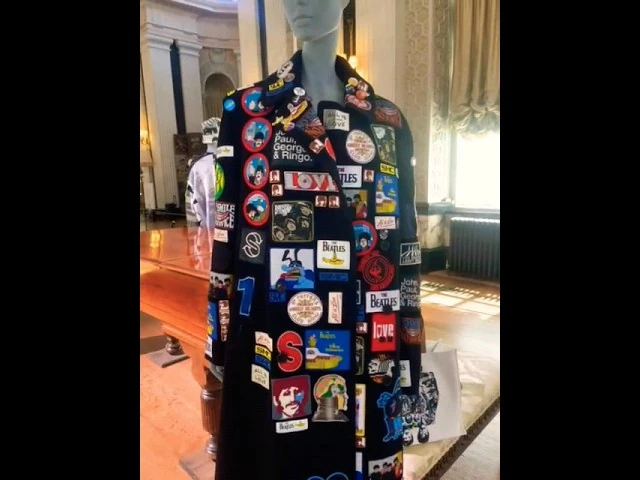
Her work has also entered public life through other collaborations. In 2018 she designed the wedding-reception dress worn by Meghan Markle and subsequently made 46 replicas for a “Made With Love” capsule collection. In 2012 she contributed to The Sustainable Fashion Handbook. Later that year, she was among the British cultural figures selected by artist Peter Blake for a new version of the cover of the Beatles' Sgt. Pepper's Lonely Hearts Club Band.
Business ownership shifted more than once. In April 2018, after 17 years of partnership with Kering, McCartney bought the group's stake in her company and took full control of the fashion house. In 2019 she entered a strategic partnership with LVMH. In January 2025, she repurchased the minority stake held by LVMH, returning the company to full independent ownership. The group said she would continue to advise its executive team on sustainability as a global ambassador. The changes show how she has sought both partners for a large fashion business and control over the company bearing her name.
Recognition and causes beyond the collections
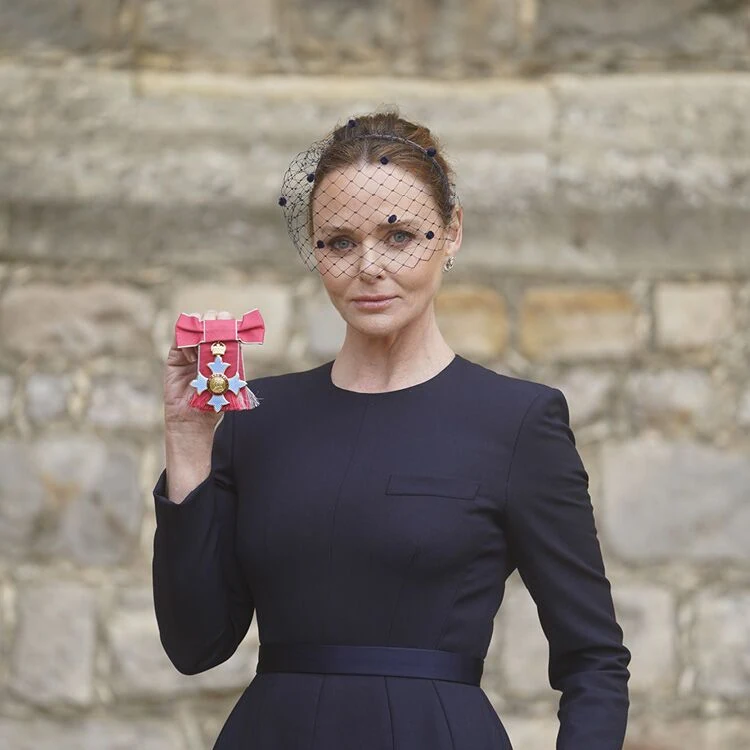
McCartney has received recognition in fashion in Britain and abroad. She won the VH1/Vogue Designer of the Year award in 2000, and the British Fashion Council presented her with its Red Carpet Award in 2011. In 2012 she won the Fashion Awards for Designer of the Year and Designer Brand. The following year she was appointed an Officer of the Order of the British Empire for services to fashion. In 2022 she became a Commander of the Order of the British Empire for services to fashion and sustainability.
In 2018 she launched the Stella McCartney Cares Foundation, a breast-cancer charity established in memory of her mother, Linda, who died in 1998. The foundation set out to donate 1,000 post-operative mastectomy compression bras to women undergoing treatment. In 2023 McCartney performed a spoken-word piece at the Coronation Concert for Charles III and Camilla. Her public activity has therefore extended beyond the design studio, while remaining connected to fashion, health and cultural life.
McCartney's influence has also been recognised through international honours. She featured in Time magazine's 100 in 2009, received the British Fashion Council's Special Recognition Award for Innovation in 2017, and was named PETA's Person of the Year in 2024 for her work with animal-friendly materials. Such awards offer different measures of her profile: fashion-industry recognition, public visibility and the animal-welfare position that has informed her design choices.
Why Stella McCartney deserves a place in British Legacy
Stella McCartney deserves a place in British Legacy because her career connects British fashion education and tailoring with an international business whose identity rests on a clear design principle. She studied at Ravensbourne and Central Saint Martins, learned from Savile Row tailor Edward Sexton, and went on to lead Chloé before establishing her own house. Her work for Team GB brought fashion design into the presentation of British athletes at Olympic and Paralympic competitions. These are concrete links to Britain's design institutions and public culture, not simply a claim that a globally recognised designer represents the country.
Her legacy also lies in making animal welfare a continuing part of a luxury label's identity. McCartney's refusal to use leather or fur is a specific commitment, while the environmental questions raised by substitute materials show why ethical design involves difficult choices rather than easy declarations. Her Adidas partnership carried her work into sportswear; her fashion house and its changing ownership have tested how that identity can be sustained within a large commercial enterprise. The 2018 breast-cancer foundation added a charitable dimension in memory of her mother. Taken together, these achievements show a British designer working across fashion, sport and public causes, and using an independent company to keep her principles connected to the products it makes.
Sources
Stella McCartney — revision 1365195318
Adapted in part from Stella McCartney by Wikipedia contributors, under CC BY-SA 4.0. Text has been edited and combined with the existing article; this adapted text is shared under the same licence. Contributor history.
.jpg)