
Jane Goodall’s research began with close attention to the everyday lives of wild chimpanzees. At Gombe Stream in Tanzania, she recorded tool use, hunting, social bonds and conflict, findings that challenged the idea that several behaviours belonged uniquely to humans. She went on to build conservation and youth programmes around the protection of animals and their habitats. Born in London, educated at Cambridge and honoured in Britain for her work, Goodall became an internationally recognised scientist and campaigner whose career joined patient observation to sustained public advocacy.
A childhood ambition, and a route into research
Valerie Jane Morris-Goodall was born in London on 3 April 1934. Her interest in animals and Africa took shape early. As a young woman she travelled to Kenya in 1957, where she found work as a secretary. A meeting with the archaeologist and palaeontologist Louis Leakey changed the direction of her life: he was seeking a researcher to study chimpanzees and encouraged her to take on the work.
Before beginning field research, Goodall studied primate behaviour with Osman Hill and primate anatomy with John Napier in London. On 14 July 1960 she travelled to Gombe Stream National Park, then in Tanganyika, accompanied by her mother. The presence of her mother helped meet the chief warden’s concerns about the safety of a young woman working in the area. Goodall later credited her mother with supporting her ambitions in a field where women were not readily accepted.
Leakey subsequently arranged for her to study for a doctorate at the University of Cambridge, despite her not having first completed a bachelor’s degree. Goodall became the eighth person permitted to pursue a Cambridge PhD on that basis. Her thesis, completed in 1966 under the supervision of Robert Hinde, drew on her first five years studying free-living chimpanzees. The combination of long-term field observation and formal academic study helped establish the foundation for her work in ethology, the study of animal behaviour.
What Gombe revealed
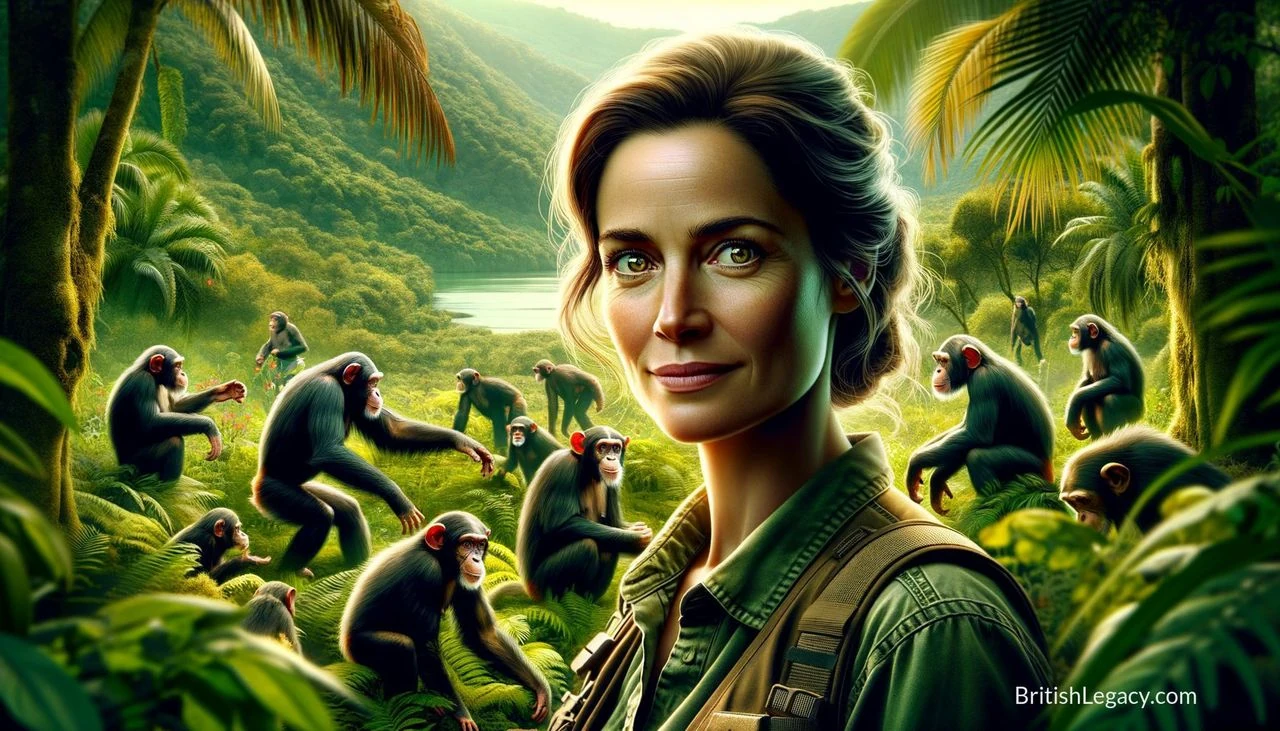
At Gombe, Goodall followed the lives of chimpanzees in the Kasakela community. She documented lasting social bonds, family relationships, cooperation and emotional behaviour. Her observations also challenged two influential assumptions: that only humans made and used tools, and that chimpanzees ate no meat.
One of her best-known findings began at a termite mound. Goodall watched a chimpanzee place grass stalks into holes, then pull them out with termites clinging to them. She also recorded chimpanzees stripping leaves from twigs to make them more effective. These observations showed not simply the use of objects, but their modification for a purpose. Leakey’s response was that the findings meant people must redefine either humans, tools or chimpanzees.
Goodall also observed chimpanzees hunting and eating other primates, including colobus monkeys. Their diet and hunting behaviour added a further challenge to the belief that chimpanzees were vegetarians. Her field notes recorded more than feeding: she documented social relationships and episodes of aggression, including the prolonged conflict between groups at Gombe known as the Gombe Chimpanzee War, which took place from 1974 to 1978.
Her approach differed from a convention that favoured assigning animals numbers to limit the risk of researchers becoming emotionally attached. Goodall gave the chimpanzees names, and wrote about their personalities, moods and relationships. That approach drew criticism from some scientists, who considered such descriptions anthropomorphic. It also made the animals’ individual histories more accessible to readers beyond the research community. The arguments around method and interpretation formed part of the debate prompted by her work; the observations themselves helped make chimpanzee behaviour a subject of wider scientific and public interest.
From field research to conservation
Goodall established the Jane Goodall Institute in 1977 to support research at Gombe and protect chimpanzees and their habitats. The organisation developed community-centred conservation and development programmes, linking the future of wildlife to the needs of people living near its habitat. In 1992, she founded the Tchimpounga Chimpanzee Rehabilitation Centre in the Republic of Congo to care for chimpanzees orphaned through the bush-meat trade.
Her conservation work also addressed the conditions that make habitats vulnerable. In 1994, she founded the Lake Tanganyika Catchment Reforestation and Education project, known as TACARE or “Take Care”. It aimed to restore hills around Gombe and to work with neighbouring communities on sustainability and agriculture. The programme also supported girls’ access to reproductive-health education and college scholarships. These strands of work show how her conservation efforts connected forest protection with education and local opportunity.
Goodall’s response to the 1986 Understanding Chimpanzees conference helped shift her attention from observation alone towards animal and human conservation. She campaigned for the ethical treatment of animals used in research, farming and captivity, and spoke publicly about environmental threats, including climate change and deforestation. Her advocacy took different forms over the years, from opposing experiments on animals to supporting efforts to protect chimpanzees’ habitats. Her positions were not always identical to those of organisations with which she was associated; she resigned as president of Advocates for Animals in 2008, citing her busy schedule.
Roots & Shoots and a public life
Goodall launched Roots & Shoots in 1991 after meeting a group of teenagers in Dar es Salaam who wanted to discuss problems affecting their communities. The programme encourages young people to take practical action for animals, the environment and their local communities. It grew into an international network, extending the educational side of her work beyond universities, laboratories and conservation organisations.
Her writing also brought her research to a broad audience. Her first book-length account, In the Shadow of Man, appeared in 1971 and was later translated into 48 languages. She wrote scientific and popular books, including The Chimpanzees of Gombe: Patterns of Behavior and Through a Window, as well as works for children. More than 40 films have featured her or her work. Lectures, books and film helped carry observations made in a Tanzanian forest into conversations about science, animal welfare and conservation around the world.
In 2002, Goodall was named a United Nations Messenger of Peace. She continued travelling and speaking in support of conservation and climate action. Her honours included the Kyoto Prize, the Tyler Prize for Environmental Achievement and the Templeton Prize. In Britain, she was appointed a Commander of the Order of the British Empire in 1995 for services to zoology, then appointed Dame Commander in 2003 for services to the environment and conservation. The investiture took place at Buckingham Palace in 2004. She also received honorary recognition from British universities, including Cambridge and the Open University.
Her final years and lasting influence
Goodall died aged 91 on 1 October 2025 in Beverly Hills, California, while on a speaking tour in the United States. Her career had taken her far from her birthplace, but the British institutions that educated and honoured her remained part of its history. She combined that connection with work rooted in Tanzania and conservation initiatives extending across national borders.
The reach of her influence can be seen in several distinct legacies: a long-running body of research on wild chimpanzees; institutions and projects intended to protect animals and habitats; and a youth programme built around practical local action. Her work also altered the terms in which scientists and the public discussed animal behaviour. Tool-making, complex social bonds and aggression could no longer be treated as traits that neatly separated humans from other animals.
Why Jane Goodall deserves a place in British Legacy
Jane Goodall belongs in British Legacy not because her achievements were confined to Britain, but because a British-born researcher, trained at Cambridge, changed the international study of animal behaviour. Her observations at Gombe showed that chimpanzees use and modify tools, hunt for meat and form enduring social relationships. By following individual animals over time, she made the complexity of their lives difficult to dismiss as a matter of instinct alone. The resulting debates expanded public understanding of primates and helped establish long-term field research as an essential way to study social behaviour.
Her contribution also reached beyond scientific findings. Through the Jane Goodall Institute, Tchimpounga, TACARE and Roots & Shoots, she connected wildlife protection with habitat restoration, community needs and young people’s ability to take action. That combination matters: conserving animals requires attention both to the places they live and to the people who share those landscapes. Her books, lectures and films brought those questions to audiences far beyond the research community. The honours she received in Britain recognised a career whose work was international in reach, while her path from London and Cambridge to Gombe gives that career a clear British connection. Her legacy is therefore both scientific and practical: changed knowledge, lasting conservation work and tools for a new generation to participate.
Sources
Jane Goodall — Wikipedia revision 1379077940
Adapted in part from Jane Goodall by Wikipedia contributors, under CC BY-SA 4.0. Text has been edited and combined with the existing article; this adapted text is shared under the same licence. Contributor history.
_(2)_(cropped_2).jpg)