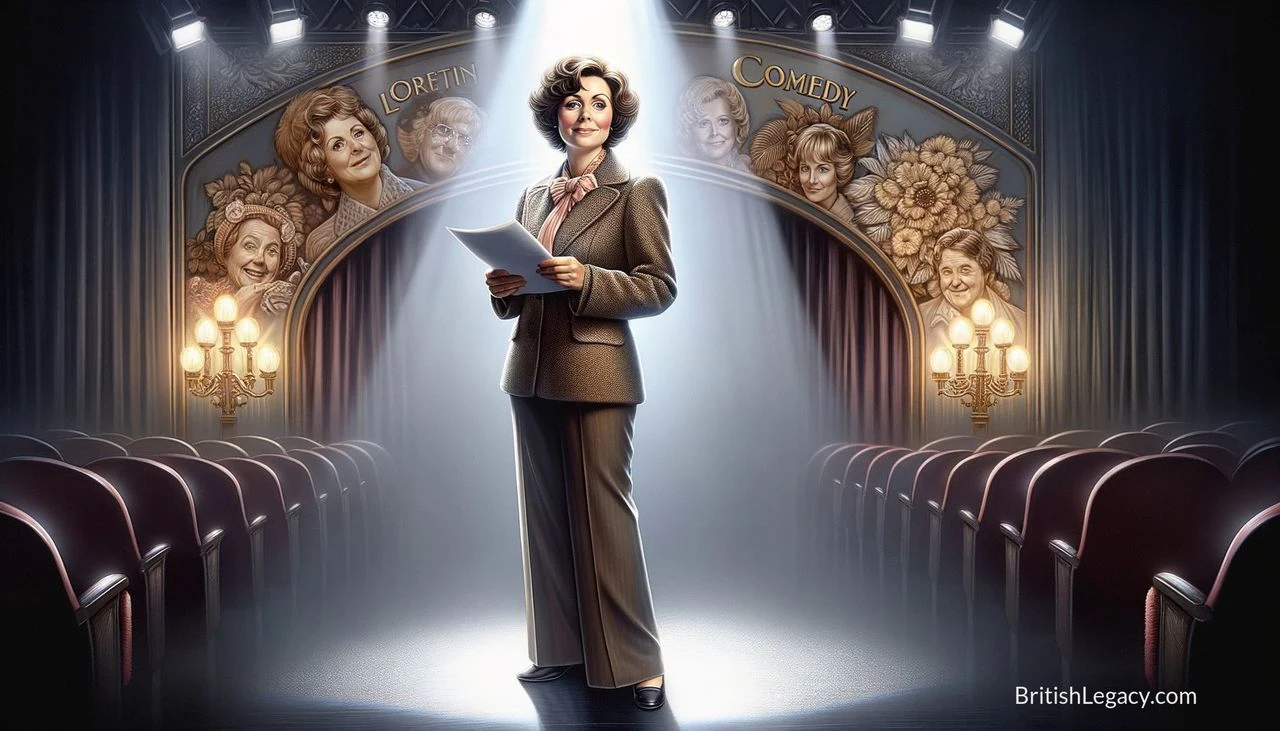
Victoria Wood built a distinctive body of work from the things people say, the roles they are given and the small absurdities of daily life. A comedian, actress, writer, musician and director, she moved between live performance, television, plays and musicals, often making room for comedy and sadness in the same scene. Her best-known creations include Victoria Wood: As Seen on TV, its mock soap opera Acorn Antiques, and the sitcom dinnerladies. Across them, her writing made ordinary settings and recognisable characters the material for ambitious comedy.
Finding her footing
Wood was born in Prestwich, Lancashire, on 19 May 1953, and grew up in nearby Bury. Her father, Stanley, worked as an insurance salesman and also wrote songs, a musical play and, part-time, for Coronation Street. Wood attended Fairfield County Primary School and Bury Grammar School for Girls. She later described finding the move to grammar school difficult and feeling isolated. A piano, given to her by her father for her fifteenth birthday, became part of a period in which she read, wrote and practised music.
In 1968 she joined Rochdale Youth Theatre Workshop, where she found a setting for her interest in performing and writing. She went on to study drama and theatre arts at the University of Birmingham. While an undergraduate, she appeared on the television talent show New Faces in 1974 and won. The appearance led to further work, including The Summer Show, a programme featuring winners of the competition.
Wood’s early career took shape through theatre as well as television. She met Julie Walters in 1971, when she applied to the Manchester School of Theatre; they met again in the 1978 revue In at the Death. Wood’s play Talent, first staged in 1978, brought her an award for promising new writing. Granada Television adapted it, with Walters in the lead and Wood reprising her stage role. Wood followed it with further plays, including Nearly a Happy Ending, Happy Since I Met You and Good Fun. The work established a pattern that would continue: writing parts for performers she knew well, while keeping her own voice at the centre.
Sketches, songs and a television hit
Wood’s first major television work came at Granada, where she and Walters appeared in Wood and Walters. In 1984 she moved to the BBC, seeking greater creative control. The result was Victoria Wood: As Seen on TV, first broadcast in 1985. Wood selected a company of performers that included Walters, Duncan Preston, Celia Imrie, Susie Blake and Patricia Routledge. The series combined sketches and songs, and ran for two series and a Christmas special between 1985 and 1987.
Its most enduring creation was Acorn Antiques, a deliberately inept soap-opera parody. The sketch made comic capital of wobbling sets and clumsy camera work; Walters played the put-upon Mrs Overall, while Imrie’s Miss Babs delivered a different kind of knowing deadpan. Wood’s writing drew humour from the form as well as the characters, turning the visible shortcomings of television production into part of the joke.
The programme also gave audiences one of Wood’s best-known songs, “The Ballad of Barry and Freda (Let’s Do It)”. Performed at the piano, it tells of Freda’s frank desire for sex and Barry’s anxious reluctance, using a string of suggestive allusions without naming the acts themselves. The song illustrates Wood’s particular musical-comedy skill: rhythm, character and the choice of what not to say all carry the joke. Music was not an ornament to her live performances; it was one of the ways she shaped a story and its voice.
She remained a major live performer as well as a television writer. Her solo show Lucky Bag began at the King’s Head Theatre in Islington in 1983 before transferring to the West End and touring. Later tours played to large audiences around the country, including repeated runs at the Royal Albert Hall. In 1988, her ITV performance An Audience with Victoria Wood won a BAFTA for Best Entertainment Programme. She returned to the road for a final stand-up tour, Victoria Wood at It Again, which finished in 2002.
From the canteen to the drama
In the 1990s Wood increasingly worked in longer, self-contained stories. The television series Victoria Wood (1989) presented separate pieces, while Pat and Margaret (1994) cast Wood and Walters as sisters whose lives had taken very different paths. These works kept her comedy’s attention to social behaviour but gave characters more room to change and to reveal what lies behind a joke.
Her sitcom dinnerladies, broadcast from 1998 to 2000, brought that approach to a factory canteen. Wood wrote and starred as Brenda “Bren” Furlong, working alongside a largely female cast whose characters met over meals, shifts and conversation. The canteen gave the series a naturally contained setting, but its concerns extended beyond workplace banter: friendship, family, disappointment and affection all surfaced in the exchanges. Wood’s comedy did not depend on making its characters ridiculous from a distance. It let their habits and speech provide the humour, while allowing the difficulties of their lives to remain visible.
In 2005 she adapted Acorn Antiques for the stage as Acorn Antiques: The Musical!, which opened at the Theatre Royal Haymarket and was later revived and toured. The project returned a television creation to live performance, where the theatre itself could become part of the parody. Wood continued to move between comic and serious work. Her television drama Housewife, 49 (2006), adapted from Nella Last’s diaries, follows a Lancashire woman who finds new confidence and friendships during the Second World War. Wood wrote the screenplay and played Last. She won BAFTA awards for both acting and writing for the drama.
Later projects included the musical That Day We Sang, which she wrote, composed and directed for the Manchester International Festival in 2011, and a television adaptation she directed in 2014. She also wrote and presented documentaries, including Victoria Wood’s Nice Cup of Tea, and continued to take acting roles. Her final screen acting role was in the 2015 television adaptation of Fungus the Bogeyman.
Recognition and remembrance
Wood’s work earned awards across comedy, theatre and television. She received a BAFTA for Victoria Wood: As Seen on TV in 1986 and another for An Audience with Victoria Wood in 1989. The 2006 drama Housewife, 49 brought her two further BAFTA television awards, for acting and writing. She was appointed OBE in 1997 and CBE in 2008. In 2005 she received a special BAFTA at a tribute evening.
Wood was married to stage magician Geoffrey Durham from 1980; they had two children and later divorced. She died at her home in Highgate, London, on 20 April 2016, aged 62, after being diagnosed with oesophageal cancer. Tributes and retrospectives followed, including the BBC series Our Friend Victoria in 2017. In 2019 a statue of Wood was unveiled in Bury, the town where she grew up. The Old Laundry theatre in Windermere, where she had been a trustee, was renamed the Victoria Wood Theatre in her memory.
Why Victoria Wood deserves a place in British Legacy
Victoria Wood’s place in British cultural history rests on more than a handful of familiar characters or catchphrases. Her work showed how comedy could be built from the speech, expectations and routines of everyday life, and how close observation could make people funny without reducing them to a joke. In As Seen on TV, she made the conventions of television themselves part of the comedy; in dinnerladies, she gave a workplace ensemble both comic life and room for sadness. Her songs added another dimension to that writing, using music and carefully shaped language to turn a character’s desires and anxieties into performance.
She also maintained unusual control across her work as writer, performer and, increasingly, director and composer. That breadth is visible in the different forms her career took: stage plays, live tours, sketch shows, sitcoms, television drama and musical theatre. The BAFTA awards for Housewife, 49 recognised a dramatic achievement as well as the comic work for which she was widely known. Her legacy is also present in the lasting public remembrance of her: the statue in Bury and the theatre named for her reflect a connection to places where her life and work took shape. For British Legacy, Wood matters as a creator who made British social detail not a backdrop but the substance of her art, and who could make that detail generous, sharply funny and emotionally complex.
Sources
Victoria Wood — Wikipedia revision 1378365315 · Victoria Wood — Wikipedia
Adapted in part from Victoria Wood by Wikipedia contributors, under CC BY-SA 4.0. Text has been edited and combined with the existing article; this adapted text is shared under the same licence. Contributor history.