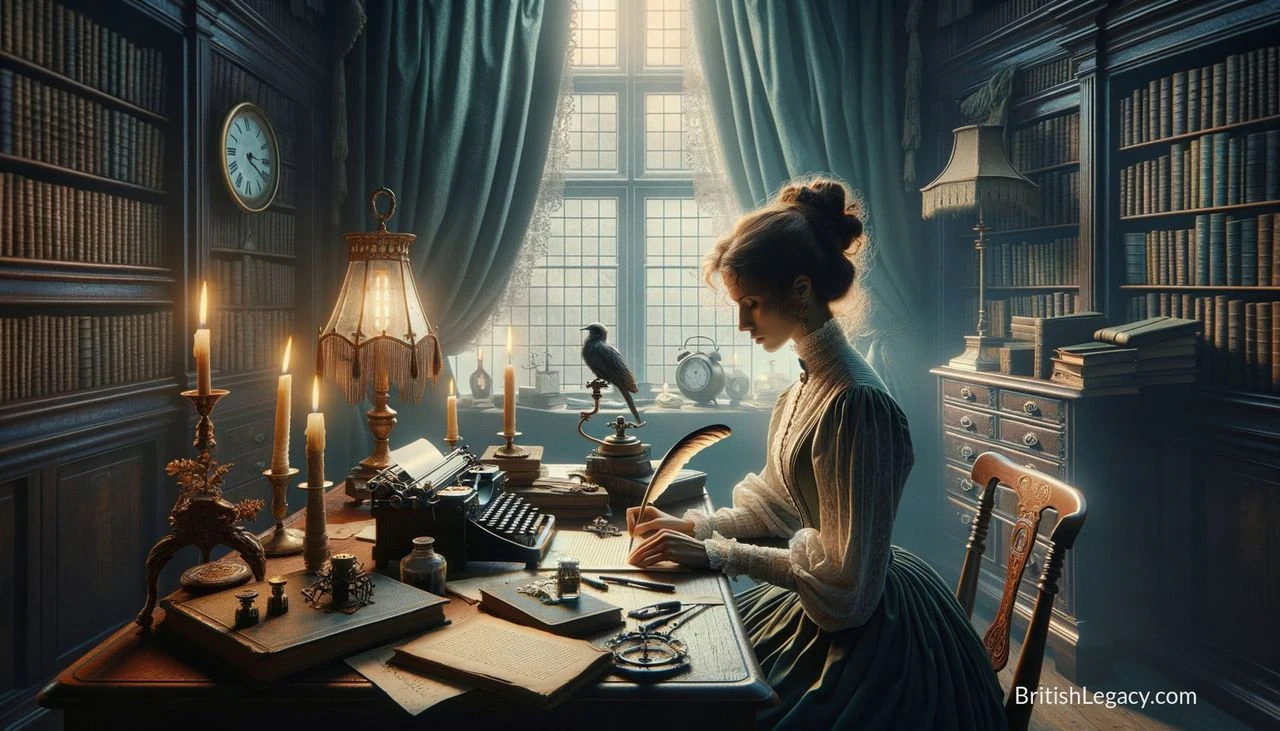
George Eliot’s novels make private hopes answerable to public life. In Middlemarch, the ambitions and disappointments of Dorothea Brooke and Tertius Lydgate unfold within a whole provincial community; in Silas Marner, a weaver’s isolation is changed by his bond with a child. The writer behind those books was Mary Ann Evans, born in Nuneaton, Warwickshire, in 1819. Her career ranged well beyond fiction: she translated European philosophy, edited a campaigning journal and wrote criticism before establishing herself as one of the leading novelists of the Victorian era.
Learning beyond the classroom
Evans was born at South Farm on the Arbury Hall estate, where her father, Robert Evans, managed the estate. The family moved to Griff House, between Nuneaton and Bedworth, in early 1820. She attended schools in Attleborough, Nuneaton and Coventry, but her formal education ended when she was 16. Access to the library at Arbury Hall helped sustain her reading and self-education. Her familiarity with the estate and the differences between the landowner’s wealth and the lives of poorer local people would later inform her attention to the varied circumstances of rural communities.
When Evans was 16, her mother died and she returned home to keep house for her father. After her brother Isaac married, she and her father moved to Foleshill, near Coventry. There she met Charles and Cara Bray, whose home brought her into contact with radical and free-thinking ideas. Her religious doubts deepened. The Brays’ circle included writers and thinkers such as Robert Owen, Harriet Martineau and Ralph Waldo Emerson, and gave Evans an intellectual life beyond her schooling.
After her father’s death in 1849, Evans travelled to Switzerland and then settled in London in 1850, intent on becoming a writer. In 1851 she joined the staff of the Westminster Review, the campaigning journal recently acquired by publisher John Chapman. She became assistant editor and did much of the work of producing it, contributing essays and reviews on society, religion and contemporary ideas. She also attended mathematics classes at the Ladies College in Bedford Square. Her work at the Review helped shape the critical voice she would bring to her fiction.
Translation, criticism and a literary name
Translation was among Evans’s first major achievements. She completed an English translation of David Friedrich Strauss’s The Life of Jesus, Critically Examined in 1846, and later translated Ludwig Feuerbach’s The Essence of Christianity. She also translated Baruch Spinoza’s Ethics, completing the work in 1856. It was not published in her lifetime. These demanding philosophical works introduced her to arguments about religion and morality that would continue to matter in her writing.
Evans adopted the name George Eliot as she turned towards fiction. The name offered distance from her established work as a translator, editor and critic, and helped her avoid the expectations attached to women’s writing. In her 1856 essay “Silly Novels by Lady Novelists”, she criticised what she saw as implausible plots in contemporary fiction by women, while elsewhere arguing for realism. The first story published as George Eliot, “The Sad Fortunes of the Reverend Amos Barton”, appeared in 1857; the three stories of Scenes of Clerical Life were issued as a book in 1858. Their reception prompted speculation about the author’s identity.
Her first full novel, Adam Bede, appeared in 1859 and quickly succeeded. Curiosity about its author intensified, and Evans eventually acknowledged that she wrote as George Eliot. She continued with The Mill on the Floss (1860), Silas Marner (1861), Romola (1863) and Felix Holt, the Radical (1866). The books differ in setting and subject, but repeatedly attend to the pressures that family, community and social position place on individual choice.
A shared life and a widening body of work
In 1854 Evans began living with the philosopher and critic George Henry Lewes, who was already married. They regarded their relationship as a marriage, and Evans called him her husband. Their choice to live together defied social convention and attracted disapproval. The relationship also gave Evans encouragement and stability as she developed her career in fiction. The couple were eventually introduced to Princess Louise in 1877, a sign of their growing acceptance in society.
Silas Marner (1861) follows a weaver whose life has narrowed after loss and betrayal. When Eppie, an orphaned child, enters his home, their attachment draws him back into the life of Raveloe. The novel sets individual change within a close-knit community and contrasts that village world with the pressures of industrialising society. Its account of redemption depends not on an isolated act of will but on relationships and the responsibilities people accept towards one another.
Middlemarch, published in parts in 1871–72 and subtitled A Study of Provincial Life, brings a larger society into view. Set in a fictional English town around the period of the Reform Bill of 1832, it interweaves the fortunes of numerous inhabitants. Dorothea Brooke’s idealism and Lydgate’s professional ambition meet social constraints, political change and the everyday claims of family life. Eliot’s interest in moral choice does not separate character from circumstance: aspirations take shape, and often come to grief, within relationships and institutions.
Her final novel, Daniel Deronda, appeared in 1876. She also wrote poetry and works including the verse drama The Spanish Gypsy. Alongside creative writing, her essays and reviews show a sustained interest in social questions and the craft of fiction. Her earlier training as a translator and editor was not a preliminary phase she left behind: it formed part of a broad literary career in which close reading, argument and storytelling developed together.
Marriage, death and remembrance
Lewes died in 1878. Evans spent the following months preparing his final work, Life and Mind, for publication, and found companionship in her longtime friend and adviser John Walter Cross. In May 1880 she married Cross and changed her name to Mary Ann Cross. She became ill with a throat infection, alongside kidney disease from which she had suffered for several years, and died in Chelsea on 22 December 1880, aged 61.
Because of her rejection of Christian belief and her relationship with Lewes, she was buried not in Westminster Abbey but in Highgate Cemetery, among political and religious dissenters and agnostics. Lewes was buried beside her. Her name and work are commemorated in and around Nuneaton, including a statue, a museum display and local institutions named in her honour. In 1980, a memorial stone was placed for her in Poets’ Corner, Westminster Abbey. These memorials reflect the continuing presence of both the novelist and the Warwickshire landscape associated with her early life.
Why George Eliot deserves a place in British Legacy
George Eliot deserves a place in British Legacy because her writing made the lives of provincial people central to ambitious literature. In Middlemarch, political reform and social position are not distant background: they help determine what characters can attempt, what their choices cost and how their lives affect one another. In Silas Marner, a weaver’s recovery from isolation depends on care, kinship and community. These novels offer more than portraits of particular places. Their close attention to motives and consequences gives readers a way to consider how private decisions are shaped by social conditions.
Her British significance also lies in the range of work behind the novels. Evans was a journalist and editor, a translator of influential philosophical texts, a critic of contemporary fiction and a writer of poetry as well as prose. Adopting the name George Eliot allowed her to pursue fiction while challenging assumptions about women’s authorship and the kind of writing women could produce. Her career therefore connects literary achievement with questions of education, public debate and professional identity. Born in Warwickshire and attentive to English rural life, she made the complexities of local communities part of a literature read well beyond Britain. Her legacy rests not on a claim that she single-handedly changed social attitudes, but on the enduring precision and reach of the work she created.
Sources
George Eliot — Wikipedia revision
Adapted in part from George Eliot by Wikipedia contributors, under CC BY-SA 4.0. Text has been edited and combined with the existing article; this adapted text is shared under the same licence. Contributor history.