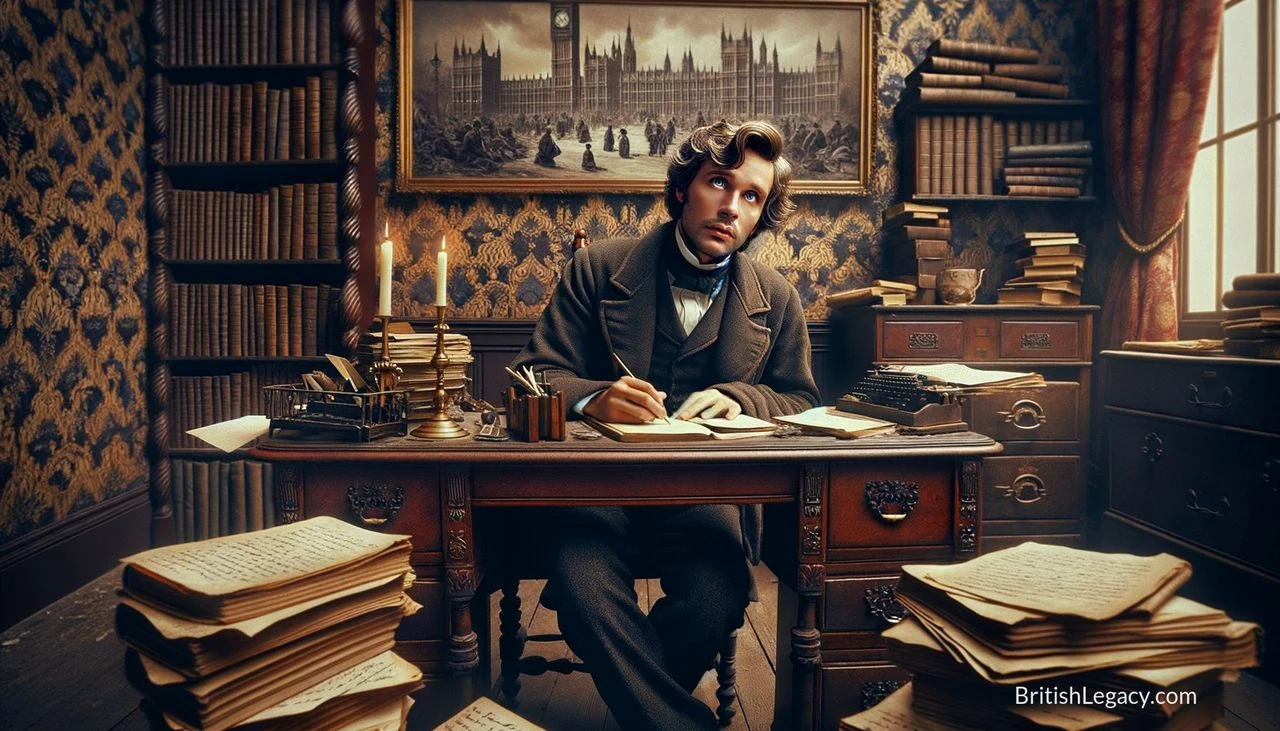
Charles Dickens turned the pressures and contradictions of Victorian Britain into stories that reached an unusually broad audience. His novels gave readers memorable characters, but their serial form mattered too: instalments created suspense, kept books affordable and let Dickens respond to the public as a story unfolded. From the workhouse and the Marshalsea debtors’ prison to the courts and the streets of London, his fiction made social institutions part of popular reading.
A childhood interrupted
Charles John Huffam Dickens was born in Portsmouth on 7 February 1812, the second of eight children of Elizabeth and John Dickens. His father worked as a clerk in the Royal Navy Pay Office. The family moved between Portsmouth, London and Kent during Dickens’s childhood; he spent formative years in Chatham, where he read widely and received some schooling. Financial trouble brought an abrupt change. In 1824, John Dickens was imprisoned in the Marshalsea in Southwark for debt.
Charles was 12 when he left school to work at Warren’s Blacking Warehouse, pasting labels on pots of boot blacking for six shillings a week. His mother and younger siblings joined his father in the prison, while Charles lodged elsewhere. His father was released after receiving an inheritance, and the family left the Marshalsea, but Charles’s time at the warehouse left a lasting impression. He later drew on both the experience of child labour and his family’s debt for scenes and themes in his writing. The prison itself became a setting in Little Dorrit; the autobiographical echoes of his childhood are especially apparent in David Copperfield.
Dickens returned to school and, as a young man, worked as a junior clerk in a law office. He learned shorthand and became a freelance reporter, covering legal proceedings and parliamentary debates. He also travelled to report on election campaigns for the Morning Chronicle. Journalism gave him direct experience of public life and a working knowledge of the legal world—material that would later inform his novels and social criticism.
From “Boz” to a serial sensation
In 1833 Dickens published his first story, “A Dinner at Poplar Walk”. His sketches and other pieces appeared under the name “Boz”, a nickname derived from a family name for his younger brother. They were collected as Sketches by Boz in 1836. That year, publishers Chapman and Hall asked him to write text to accompany illustrations for a monthly publication. The project became The Pickwick Papers.
Its early instalments were not an immediate sensation. The introduction of Sam Weller in the fourth episode changed the novel’s fortunes, and the final instalment sold 40,000 copies. Pickwick-inspired products followed, from playing cards and china figures to joke books and boot polish. The episode showed Dickens’s feel for comic character and for the commercial possibilities of serial fiction. His success depended not only on what he wrote, but also on how readers encountered it: instalments kept the story in public conversation and made anticipation part of the experience.
He continued to publish much of his fiction in weekly or monthly parts, later collected as books. Regular cliff-hangers encouraged readers to return, while the form allowed him to develop stories over time. Dickens sometimes adjusted plots and characters in response to readers and trusted advisers. The episodes could be bought more cheaply than a complete volume, widening access to his work. The format helped make him an international literary celebrity within a few years of his debut.
Oliver Twist, first published in instalments in 1837, made a child the centre of a Victorian novel and confronted readers with the workhouse, poverty and the treatment of orphaned children. It was followed by works including Nicholas Nickleby, The Old Curiosity Shop and Barnaby Rudge. Dickens also wrote and edited journals, including Household Words and All the Year Round, combining fiction with journalism and commentary.
Fiction with institutions in its sights
Dickens’s social criticism took different forms across his career. Oliver Twist challenged complacent accounts of poverty and criminality. Hard Times attacked the reduction of industrial workers to “Hands”, as if they were merely parts of machines. In Bleak House, the prolonged Chancery case of Jarndyce and Jarndyce turns legal delay into the engine of a novel about a system that consumes the lives and resources of those caught in it. The book’s attack on the courts has been associated with a reform movement that culminated in legal changes in England in the 1870s.
His reporting and campaigning also went beyond fiction. Dickens edited the liberal Daily News briefly in 1845, hoping to promote education and civil and religious liberty. He helped Angela Burdett Coutts establish Urania Cottage, a home for working-class women, and managed it for ten years. In 1858 he raised money for Great Ormond Street Hospital through public readings; one performance raised £3,000. His practical involvement in these causes sits alongside, rather than proving the direct effect of, his fiction: Dickens’s stories made hardship visible, while his journalism and charitable work addressed particular needs in other ways.
His view of society was not without limits or contradictions. Dickens condemned slavery in American Notes, but his responses to racial inequality were inconsistent. He supported criticism of the East India Company after the Indian Rebellion of 1857, yet expressed violent hostility towards Indians. A rounded account of his social criticism must include these positions as well as his attacks on poverty and institutional injustice.
Readers, performers and a changing reputation
Dickens’s public identity extended beyond the books. He gave readings across Britain, and his performances of his own work brought vocal impersonation and theatre to a large audience. The readings were both an artistic outlet and a source of income. In the later 1850s, they absorbed much of his time; in 1867–68 he toured the United States again, giving 76 readings. His fame was matched by a readership that crossed social boundaries, from people who heard instalments read aloud to Queen Victoria, who read his early novels.
A Christmas Carol, published in 1843, became one of his best-known works. Its story of Scrooge, Tiny Tim and the Christmas spirits has been repeatedly adapted, while its language helped popularise phrases such as “Merry Christmas” and “Bah! Humbug!”. The tale contributed to the Victorian revival of Christmas as a family-centred festival associated with generosity. The characters and phrases travelled beyond the book into popular culture; “Scrooge” remains a byword for a miser.
Dickens’s standing among critics has shifted over time. Some reviewers found the darker social novels of the 1850s heavy or wearisome, even as the public continued to read him. Twentieth-century critics reassessed the later works, including Bleak House, Little Dorrit and Great Expectations. The range of response is part of his literary history: popularity did not prevent debate about sentimentality, characterisation or the structure of his novels.
Final work and lasting presence
In 1865 Dickens was travelling back from Paris with Ellen Ternan when the train was involved in the Staplehurst rail crash in Kent. He helped tend to the injured and dying before returning to his carriage for the unfinished manuscript of Our Mutual Friend. The experience later informed his ghost story “The Signal-Man”. In 1869, after suffering a stroke and collapsing during a reading tour, he cancelled the remaining performances and began work on The Mystery of Edwin Drood, which he left unfinished.
Dickens died at Gads Hill Place in Kent on 9 June 1870, aged 58. He was buried in Poets’ Corner at Westminster Abbey, despite having expressed a preference for a private, unostentatious burial. His novels remained central to his remembrance: in his will, he asked that his country remember him through his published works rather than through a monument.
That request has not prevented the creation of museums and commemorations. The Charles Dickens Museum occupies his former London home in Doughty Street, and a museum at his birthplace in Portsmouth marks his origins there. His manuscripts and related material are held in collections including the Victoria and Albert Museum. His image also appeared on a Bank of England £10 note issued from 1992 to 2003, and the Royal Mail marked the bicentenary of his birth with stamps in 2012.
Why Charles Dickens deserves a place in British Legacy
Dickens belongs in British Legacy not simply because he wrote famous novels, but because his career shows how British literature became a mass public event. Through serial publication, he built suspense across instalments and brought fiction to readers who might not have bought a complete book. His work with publishers and journals, and his performances before live audiences, made the author a prominent public figure. The popularity of The Pickwick Papers and the continuing adaptations of A Christmas Carol illustrate how stories written in Victorian Britain could keep finding new readers and forms.
His importance also lies in the subjects he placed before those readers. Dickens drew on childhood poverty and his father’s imprisonment to write about debt, vulnerability and institutions; novels such as Oliver Twist, Hard Times and Bleak House gave those concerns distinctive characters and memorable settings. He did not rely on fiction alone: he campaigned through journalism, helped establish Urania Cottage and raised substantial funds for Great Ormond Street Hospital. Those actions do not erase the limits in his views, particularly his hostility towards Indians, but they make his record more than a simple tale of literary virtue. His British legacy is a lasting combination of popular storytelling, social observation and public engagement, alongside contradictions that deserve to remain visible.
Sources
Charles Dickens — revision 1377987760 · Charles Dickens
Adapted in part from Charles Dickens by Wikipedia contributors, under CC BY-SA 4.0. Text has been edited and combined with the existing article; this adapted text is shared under the same licence. Contributor history.