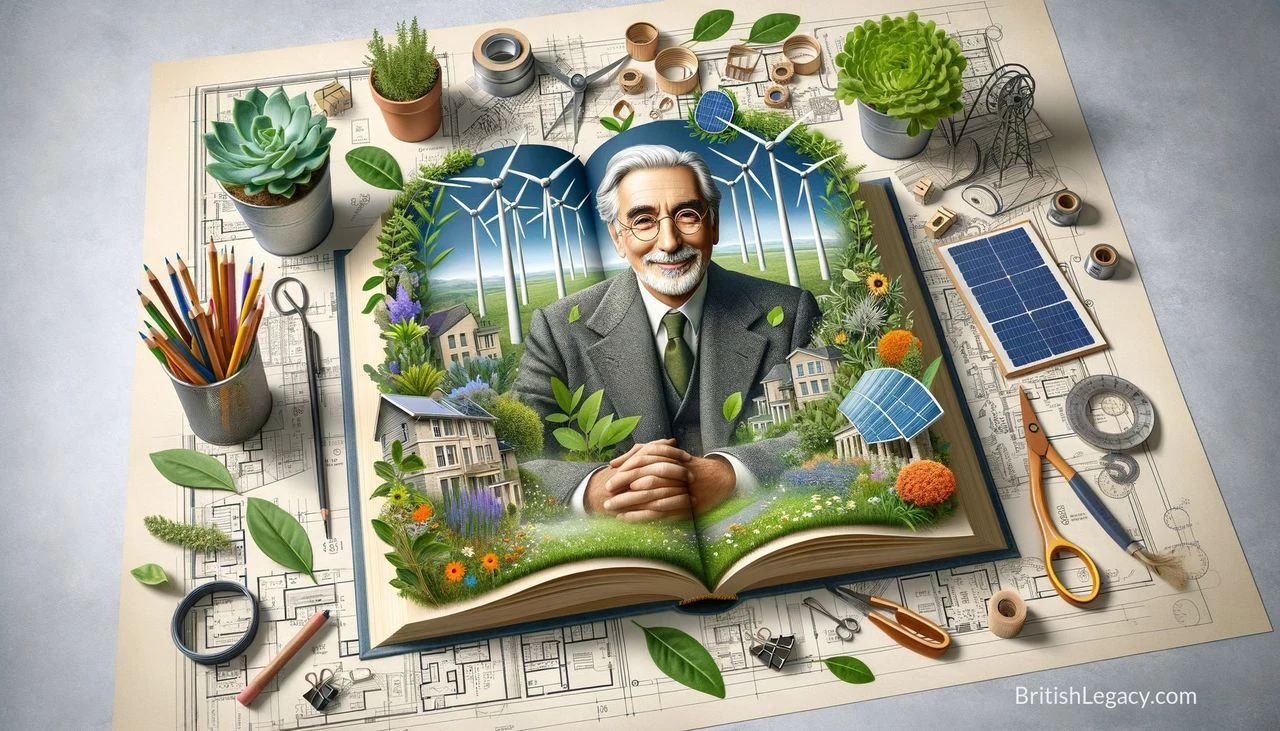
Ian McHarg’s central question was practical: how should people build and plan in a landscape without ignoring the systems that make it work? In Design with Nature, published in 1969, he set out an ecological approach to land use, using maps of features such as soil, climate and water to assess where different kinds of development were suitable. The method helped bring environmental considerations into planning and landscape architecture. McHarg was born in Scotland, but much of his professional life unfolded in the United States, where he taught, led a university department and helped shape major planning projects.
Scotland, war and a return home
McHarg was born in Clydebank on 20 November 1920. His father worked first as a manager and later as a salesman in Glasgow’s industrial economy. McHarg showed an early aptitude for drawing, and was advised to consider landscape architecture. The contrast between Glasgow’s industrial urban landscape and the surrounding countryside became an important influence on how he thought about the relationship between people and nature.
During the Second World War, McHarg served with the Royal Engineers and in the Parachute Regiment, including service in war-stricken Italy. After the war he travelled to the United States and studied at Harvard University’s Graduate School of Design. He completed professional degrees in landscape architecture and city planning in 1949.
He then returned to Scotland, intending to contribute to the work of rebuilding after the war. He worked on housing and new-town programmes before an invitation from G. Holmes Perkins, dean at the University of Pennsylvania, drew him back to the United States. McHarg joined the university and developed its landscape architecture department. In 1957, he introduced a course called Man and Environment, bringing students into contact with scholars discussing subjects that ranged from ethics and values to entropy and plate tectonics.
Making ecology part of planning
McHarg’s teaching and public communication helped him put environmental questions before a wider audience. In 1960, he hosted the CBS television programme The House We Live In, inviting theologians and scientists to discuss humanity’s place in the world. His work offered more than an argument for respecting nature: it proposed a way to make environmental knowledge useful in decisions about development.
That approach was set out most fully in Design with Nature. Published in 1969, the book described how planners could examine a region’s characteristics—including its soil, climate and hydrology—and use that analysis to identify suitable uses for the land. Transparent map overlays made it possible to compare different layers of information and see where their combined qualities favoured, or constrained, development. Rather than treating land as an empty surface for construction, McHarg argued that its natural conditions should inform the design.
The book is associated with the development of the concepts that later informed geographic information systems. Its influence also reached beyond landscape architecture and land-use planning: environmental impact assessment, coastal management, river-corridor planning and new-community development are among the fields in which its ideas have been influential. McHarg’s ecological approach was not simply a call to preserve scenery. It offered a planning process for considering human needs alongside the conditions and limits of a place.
Plans put into practice
In 1963, McHarg and his University of Pennsylvania colleague David A. Wallace founded Wallace and McHarg Associates. The firm, later known as Wallace McHarg Roberts & Todd, became involved in American environmental planning and urbanism. Its early work included plans for Baltimore’s Inner Harbor and Baltimore County’s valleys, as well as a plan for Lower Manhattan developed between 1963 and 1965. The practice later worked in cities including Minneapolis, Denver, Miami, New Orleans and Washington, DC, and prepared environmentally based master plans for Amelia Island Plantation and Sanibel Islands in Florida.
One particularly clear example of McHarg’s approach was The Woodlands, a community north of Houston, Texas. Hired by developer George P. Mitchell, McHarg was an original co-designer of its plans. He identified water management as the site’s critical issue, in part because of the risk of flooding. The firm’s natural drainage system limited runoff and was less expensive than a conventional drainage system. McHarg later described The Woodlands as an example of his ideals, while recognising that the work was carried out by a large team and continued after his involvement.
Not every plan came to fruition. In 1975, the firm began work on Pardisan, a proposed environmental park in Tehran intended to represent Iranian heritage and the world’s major ecosystems. The Shah’s overthrow left the firm with substantial project-related debt, and McHarg’s designs were never implemented. The contrast between The Woodlands and Pardisan underlines the practical as well as intellectual demands of environmental planning: ideas must contend with finance, institutions and changing political circumstances.
Later work and recognition
McHarg left the firm in 1980, after which it took the name Wallace Roberts & Todd. He continued to write and speak about the relationship between people and the environment. His books included A Quest for Life, an autobiography published in 1996, and To Heal the Earth, a collection of selected writings published in 1998. He also contributed to environmental task forces for the Kennedy, Johnson, Nixon and Carter administrations and was instrumental in the founding of Earth Week.
His honours included the 1990 National Medal of Arts, the Thomas Jefferson Foundation Medal in Architecture and the Japan Prize in city planning, awarded in 2000. Heriot-Watt University awarded him an honorary doctorate in 1992. McHarg died on 5 March 2001, aged 80, from pulmonary disease. In 2017, the University of Pennsylvania’s Stuart Weitzman School of Design launched an interdisciplinary centre in his honour; its public launch took place in 2019 alongside the Design with Nature Now event, exhibition and book project.
Why Ian McHarg deserves a place in British Legacy
McHarg’s British connection begins in Clydebank and runs through his Scottish experience of industrial Glasgow and its surrounding landscape. After serving in the Second World War and studying in the United States, he returned to Scotland to work on housing and new-town programmes. Those parts of his life matter alongside his later career in America: they place his development as a planner in a Scottish landscape and in the post-war work of rebuilding. His career crossed national borders, but the questions that drove it—how communities should grow and what the land can sustain—were not confined to one country.
His lasting contribution was to make ecological analysis a working part of planning. Design with Nature translated the principle of working with natural systems into a process: examine the land’s characteristics, map them, and let that evidence shape decisions about use. His teaching helped establish landscape architecture at the University of Pennsylvania, while his practice took environmental planning into real projects, including The Woodlands’ approach to drainage. The ideas associated with his work influenced fields from environmental impact assessment to coastal and river-corridor planning. McHarg’s British legacy is therefore not a claim that his whole career was British, nor a generic celebration of environmentalism. It is the specific achievement of a Scottish-born planner whose methods connected landscape knowledge to the choices made about communities and development.
Sources
Ian McHarg — Wikipedia revision 1376222246
Adapted in part from Ian McHarg by Wikipedia contributors, under CC BY-SA 4.0. Text has been edited and combined with the existing article; this adapted text is shared under the same licence. Contributor history.