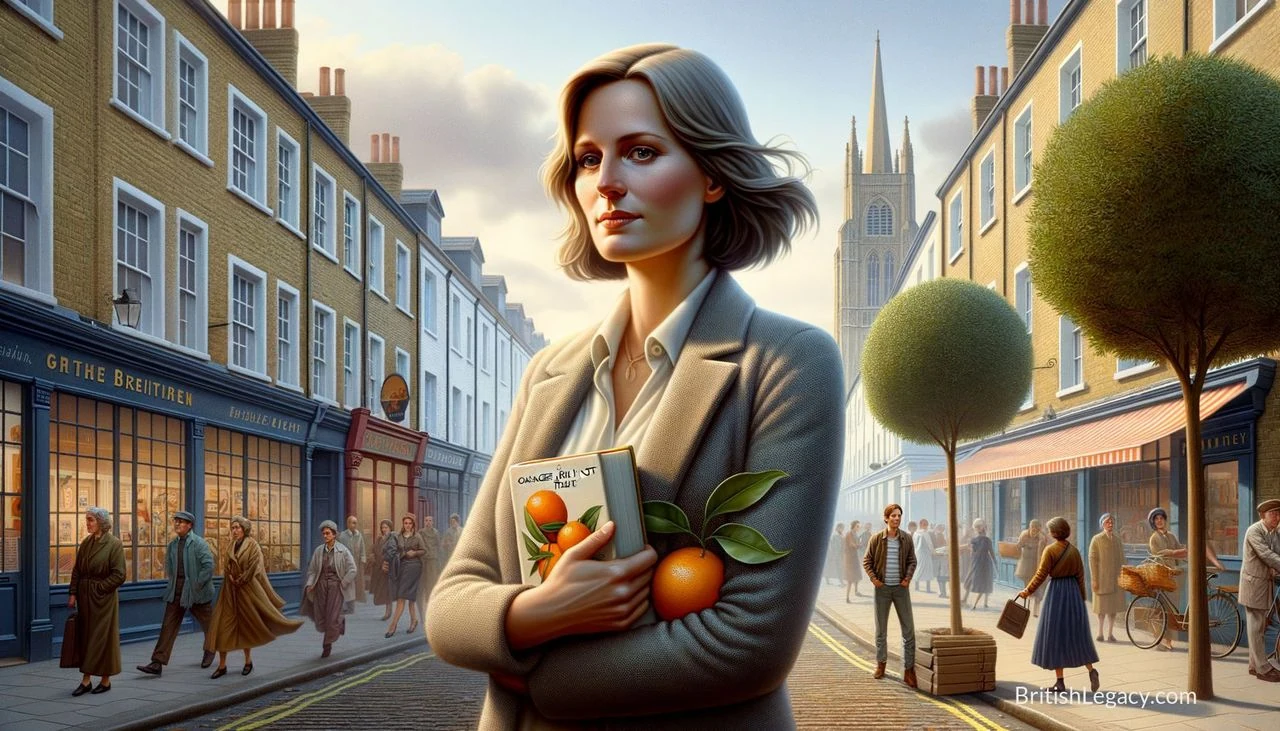
Jeanette Winterson’s first novel begins with a young girl being raised in an English Pentecostal community; its form, however, refuses to follow a simple path from childhood to adulthood. In Oranges Are Not the Only Fruit, published in 1985, remembered experience is joined to fable and biblical echoes. The book won the Whitbread Prize for a First Novel and established a writer who would continue to test the boundaries between autobiography, history and invention.
Accrington, Oxford and a first novel
Born in Manchester on 27 August 1959, Winterson was adopted as an infant by Constance and John William Winterson and grew up in Accrington, Lancashire. Her adoptive parents were Pentecostal evangelical Christians, and she was brought up in the Elim Pentecostal Church. She has described the Bible as an early source of storytelling: her adoptive mother taught her to read through the Book of Deuteronomy. With few other books available at home, Winterson read in secret and later discovered English literature at Accrington public library.
As a teenager, she was expected to become a Christian missionary. At 16, after her adoptive mother discovered her relationship with another girl, Winterson left home. She supported herself through further study with a succession of jobs, including driving an ice-cream van and working at a funeral parlour and a mental health hospital. From 1978 to 1981 she studied English literature at St Catherine’s College, Oxford, supporting herself with other work.
After moving to London, Winterson took theatre work, including at the Roundhouse, and applied for a job at the newly founded feminist publisher Pandora Press. Its founder, Philippa Brewster, published Oranges Are Not the Only Fruit in 1985. The semi-autobiographical novel follows a girl named Jeanette growing up in a Pentecostal community. It draws on the pressures of religious belonging and sexual identity without presenting fiction as a literal record: Winterson later gave the central character a different name, Jess, in her television adaptation partly to discourage that assumption.
The BBC adaptation, released in 1990, was a three-part drama scripted by Winterson and directed by Beeban Kidron. It won BAFTA awards for best drama and film sound; Winterson also received recognition for the screenplay at Cannes. The book and television series carried the story well beyond its original readership, while its mixture of personal material and invented narrative established an approach that would recur throughout her work.
History remade, stories opened out
Winterson’s second novel, The Passion (1987), moves into Napoleonic Europe. Its central figures are Henri, a French soldier, and Villanelle, a Venetian woman with webbed feet who knows the city’s canals. Historical setting meets the fantastical, and the novel won the John Llewellyn Rhys Prize. In later fiction, Winterson continued to shift time, voice and genre rather than settle into one recognisable mode. Sexing the Cherry (1989), for example, received the E. M. Forster Award.
Her books range from children’s fiction to science fiction and from novels to essays and memoir. The King of Capri (2003) and Tanglewreck (2006) were written for her godchildren. In The Stone Gods (2007), science-fiction form lets her explore human beings and technology. Frankissstein: A Love Story (2019) begins with Mary Shelley writing Frankenstein before moving to a contemporary story involving a transgender doctor and questions of artificial intelligence and transhumanism. Her recurring interest in what makes a person, and how stories shape that understanding, links books that otherwise take markedly different routes.
Winterson’s 2011 memoir, Why Be Happy When You Could Be Normal?, returns to adoption, family and the experiences behind her first novel. It is not a complete account of the intervening years: the book leaves out a substantial period of her life between her first year at Oxford and 2007. Her work in other forms includes the ghost-story collection Night Side of the River (2023) and the 2025 book One Aladdin Two Lamps, which brings memoir, history, philosophy and politics together.
Writing, teaching and public life
Winterson has written for newspapers, broadcast on radio and television, and spoken publicly about the political purpose she sees in writing. Her work as a teacher has also kept her connected to new writers. In 2012 she succeeded Colm Tóibín as Professor of Creative Writing at the University of Manchester, teaching undergraduate and master’s students.
She has adapted other writers as well as her own work. The Gap of Time (2015), her retelling of Shakespeare’s The Winter’s Tale, was published as part of the Hogarth Shakespeare series. Her novel The Daylight Gate (2012) draws on the Pendle witch trials of 1612. These projects place her imaginative writing in conversation with British literary and historical traditions, but do not confine it to a single period or genre.
Her distinctions include the Whitbread Prize for a First Novel, the John Llewellyn Rhys Prize, the E. M. Forster Award and a BAFTA for the television adaptation of Oranges Are Not the Only Fruit. She was appointed OBE in 2006 for services to literature and received a CBE in 2018 for the same service. She is a Fellow of the Royal Society of Literature. In 2018 she delivered the Richard Dimbleby Lecture, marking the centenary of women’s suffrage in the UK.
Why Jeanette Winterson deserves a place in British Legacy
Winterson’s place in British literary life rests on more than the success of a debut. Oranges Are Not the Only Fruit brought a story of growing up in an English Pentecostal community into prominent literary and television culture, and its Whitbread Prize and BAFTA-winning adaptation mark distinct achievements in both forms. The work’s semi-autobiographical method matters too: rather than simply reproduce experience, Winterson reshaped it, making room for myth, memory and invention. That formal choice helped establish a voice capable of examining religious authority and sexual identity without reducing a complicated life to a single explanatory label.
Across a career extending from The Passion to Frankissstein, Winterson has carried that appetite for formal change into historical fiction, children’s books, science fiction, memoir and retellings of Shakespeare. Her professorship at the University of Manchester adds teaching to a record that already spans novels, broadcasting and journalism. These achievements give her British connection a specific grounding: she writes from and about English places and histories, has been recognised by British literary and broadcasting institutions, and has contributed to the education of writers at a British university. Her work invites readers to reconsider how stories can make room for identities and experiences that conventional narratives may leave out.
Sources
Jeanette Winterson — revision 1378816271
Adapted in part from Jeanette Winterson by Wikipedia contributors, under CC BY-SA 4.0. Text has been edited and combined with the existing article; this adapted text is shared under the same licence. Contributor history.