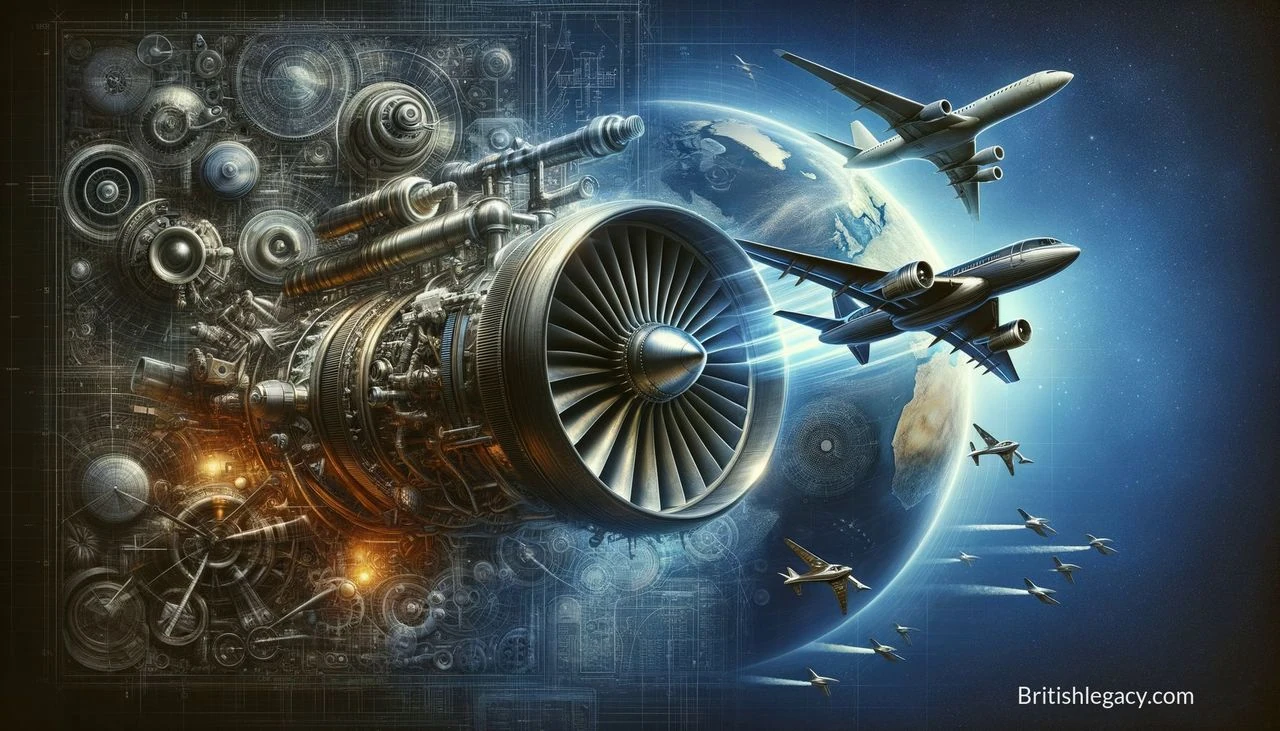
Before the jet age, faster flight was not simply a matter of fitting an aircraft with a larger propeller or a more powerful piston engine. As propeller blades approached the speed of sound, their efficiency fell. Frank Whittle, an English engineer and Royal Air Force officer from Coventry, proposed another approach while still a cadet at RAF College Cranwell: compress air, burn fuel in it and use the resulting stream of hot gases to produce thrust.
Whittle filed his first patent in January 1930. Turning the design into a working engine, and an engine into an aircraft, took years of technical work and financial uncertainty. He was not the only pioneer: Hans von Ohain developed a turbojet independently in Germany. Whittle’s contribution was to help establish a practical British route into jet propulsion, a technology that transformed military aviation and civilian travel. Its development was not the work of one man alone, but the story of a demanding idea being tested, financed and carried into flight.
Beyond the limits of the propeller
A conventional propeller produces thrust by moving air backwards, while a piston engine provides the power to turn it. At higher speeds, compressibility effects near the tips of the blades reduce the propeller’s efficiency. Whittle’s alternative was to have an engine produce a fast-moving stream of gas, generating thrust directly rather than relying on a propeller.
The idea came from a young airman with practical experience as well as technical ambition. Whittle had served as an apprentice mechanic before training as a pilot. At Cranwell, he wrote a thesis on jet propulsion and the gas turbine as an aircraft power plant. The combination of service experience and technical imagination was important to the proposal: he was not simply speculating about faster flight, but considering how an aircraft might be powered.
His 1930 patent set out a design, not a completed engine ready for production. A principle had to be expressed clearly enough to develop, then tested against the demands of weight, heat, materials and manufacture. Whittle’s achievement began with a coherent proposal for using a gas turbine to power an aircraft. Making that proposal reliable and suitable for flight required a further, substantial engineering effort.
A basic turbojet works through a sequence of compression, combustion and expansion. Air enters the engine and is compressed; fuel is added and burned. Hot gases pass through a turbine, which takes enough energy to keep the compressor turning. The remaining energy leaves through a nozzle as a fast jet, producing thrust. The principle can be described briefly, but making its components work together within the constraints of an aircraft was a formidable task.
Building an engine against the odds
Whittle’s proposal attracted little early commitment from the authorities and the aviation industry. In 1936, after private backing had been assembled, Power Jets was formed to develop and manufacture his engine designs. The company gave the work an organisation and a route towards building and testing engines. Progress was not straightforward: an idea that had been patented still needed investment, engineering capacity and time.
A practical turbojet required more than a promising drawing. Compressors had to deliver reliable pressure; combustion had to remain stable; turbines had to withstand intense heat while extracting enough energy to keep the compressor operating. The complete machine also had to be light enough to fly. These were interdependent problems: it was not enough for one part to work if the engine as a whole could not operate reliably.
The supplied accounts describe different engine-test milestones. The current article says Whittle’s first gas-turbine engine began ground tests in 1937, while the original import dates the first successful turbojet test to 1941. The material does not explain precisely how those descriptions relate, so the distinction should not be treated as settled. What is clear from the supplied account is that engine development preceded the British prototype’s first flight in 1941.
Whittle’s early designs moved towards a centrifugal compressor, a practical route for the engines then being developed. Later generations of jet engines would generally favour axial-flow compressors, which offered advantages in size and efficiency. Early British engines were bulky by later standards, but they could be tested, improved and flown. Their significance lay not in resembling today’s engines, but in showing that a difficult engineering principle could be made to work in an aircraft.
Power Jets also illustrates why the date of a patent cannot tell the whole story of an invention. Whittle’s design needed people and backing to develop it, along with sustained work on problems of compression, combustion, heat and weight. The supplied accounts describe a slow and underfunded path, rather than a smooth progression from conception to success. The work involved private risk and, eventually, wider recognition of the British programme.
From Cranwell to the first British jet flight
The Gloster E.28/39 provided a visible demonstration that the British programme could put a jet aircraft into the air. Powered by Whittle’s W.1 engine, it made its first flight from RAF Cranwell on 15 May 1941. The supplied current account records a 17-minute flight by test pilot Gerry Sayer and states that the aircraft reached 370 miles per hour at 25,000 feet. Jet propulsion had moved beyond a patent and the test stand.
This was a British milestone, not the first jet aircraft flight anywhere. The supplied accounts state that Hans von Ohain’s independent work in Germany led to the Heinkel He 178, which flew in August 1939, before the British prototype. Whittle’s historical importance does not depend on claiming that he alone conceived jet propulsion. It rests on his part in a practical British programme that helped shape wartime and post-war aviation.
The next step was operational service. The Gloster Meteor, developed from experimental work involving Whittle-powered engines, entered RAF service in July 1944. It became the only Allied jet aircraft to see combat during the Second World War. Its arrival did not determine the course of the conflict: jet fighters entered service too late to rewrite the whole air campaign. It did mark a change in what military aircraft could do and what designers could pursue.
Once a turbojet had been demonstrated in flight, aircraft design could proceed on new assumptions about speed, altitude and climb performance. Manufacturers and military planners had a new kind of power plant to develop. Whittle’s contribution mattered not only because an engine flew, but because it helped expand what others could attempt. Aircraft design and the work of other engineers were essential to putting that technology into service.
From military experiment to civilian travel
War accelerated jet development, but its broader civilian significance became clear in peacetime. The de Havilland Comet first flew in 1949 and entered service with BOAC on 2 May 1952. It was the world’s first commercial jet airliner. The move from experiment to passenger service took place within a relatively short period, but depended on a wider chain of engineering and aviation work.
The Comet was not Whittle’s aircraft, and it would be misleading to assign every British jet achievement to him. Its place in this story is as part of the wider development of British jet aviation. Whittle helped establish a British jet-engine programme; the Comet’s design and operation involved other people and organisations. That is a consequential connection, not a claim that he designed the airliner or directed its entry into service.
Modern passengers generally fly behind turbofans rather than the early turbojets associated with Whittle’s work. A turbofan moves a greater mass of air and is generally more efficient and quieter. It belongs to the same gas-turbine family, however. The underlying sequence—compressing air, burning fuel, using a turbine to drive the compressor and producing thrust—remains recognisable in the technology Whittle helped make practical.
Jet propulsion became central to military aviation and civilian air travel. The expansion of air transport, freight and international movement followed many developments, and cannot be attributed to Whittle alone. His work belongs among the foundations that made the Jet Age possible: an early British design programme helped establish a technology later generations of engineers adapted for different aircraft and uses.
The consequences reached beyond the performance of individual aircraft. Jet propulsion changed the possibilities available to military planners and aircraft designers, while commercial jet services offered a new form of passenger travel. It would be too simple to say that one engine or one inventor created modern global movement. The more precise point is that Whittle helped develop a British route into a technology that became important to both military and civilian aviation.
Recognition and a shared achievement
Whittle was knighted in 1948 and retired from the RAF that year with the rank of Air Commodore. Those honours marked recognition of his contribution, but his longer inheritance is also found in the aircraft and engine designs that followed. His achievement was not merely imagining another kind of propulsion: it was helping to carry a British design programme towards an engine capable of powering an aircraft.
The story belongs to a network of people and institutions. Whittle’s RAF training and Cranwell work, private backing for Power Jets and the development of Gloster aircraft all formed part of the British effort. The Meteor carried jet propulsion into RAF service; the Comet later introduced commercial jet travel. None of those steps was Whittle’s alone. Together, they show how a technical idea can pass through research, financing, manufacture and use.
Jet propulsion became an international technology, and the parallel work of von Ohain belongs in its history. Britain’s place in that story does not require a claim of exclusive ownership. Whittle was a British pioneer whose work helped his country develop a practical turbojet programme when the technology was uncertain and difficult to realise. That distinction recognises both his contribution and the wider history of independent development.
Why Frank Whittle deserves a place in British Legacy
Frank Whittle deserves a place in British Legacy because his work joined technical imagination to the difficult business of engineering. At Cranwell, he proposed using a gas turbine to power an aircraft and filed a patent in 1930. The ensuing programme was neither immediate nor assured: early backing was limited, private investment helped establish Power Jets, and a practical engine required solutions to problems of compression, combustion, heat and weight. The route from proposal to flight shows the difference between imagining a technology and making it usable.
The British connection is specific. Whittle came from Coventry and served as an RAF officer; his Cranwell work led into a British engine programme, and the Gloster E.28/39 demonstrated that programme in flight. The Meteor carried jet propulsion into RAF service, while the Comet later opened the era of commercial jet airliners. These are connected achievements, not the work of one man alone. The independent development of jet propulsion elsewhere, including von Ohain’s work in Germany, belongs in the same account.
The benefits extended beyond the aircraft of Whittle’s lifetime. Jet and later turbofan engines became central to military aviation and civilian air travel, changing the speed and reach of transport. Whittle did not create modern global movement by himself, but his work helped make one of its essential technologies practical in Britain. Remembering him honours a major engineering contribution while recognising the wider chain of people, companies and institutions that turned an uncertain idea into a lasting part of modern life.