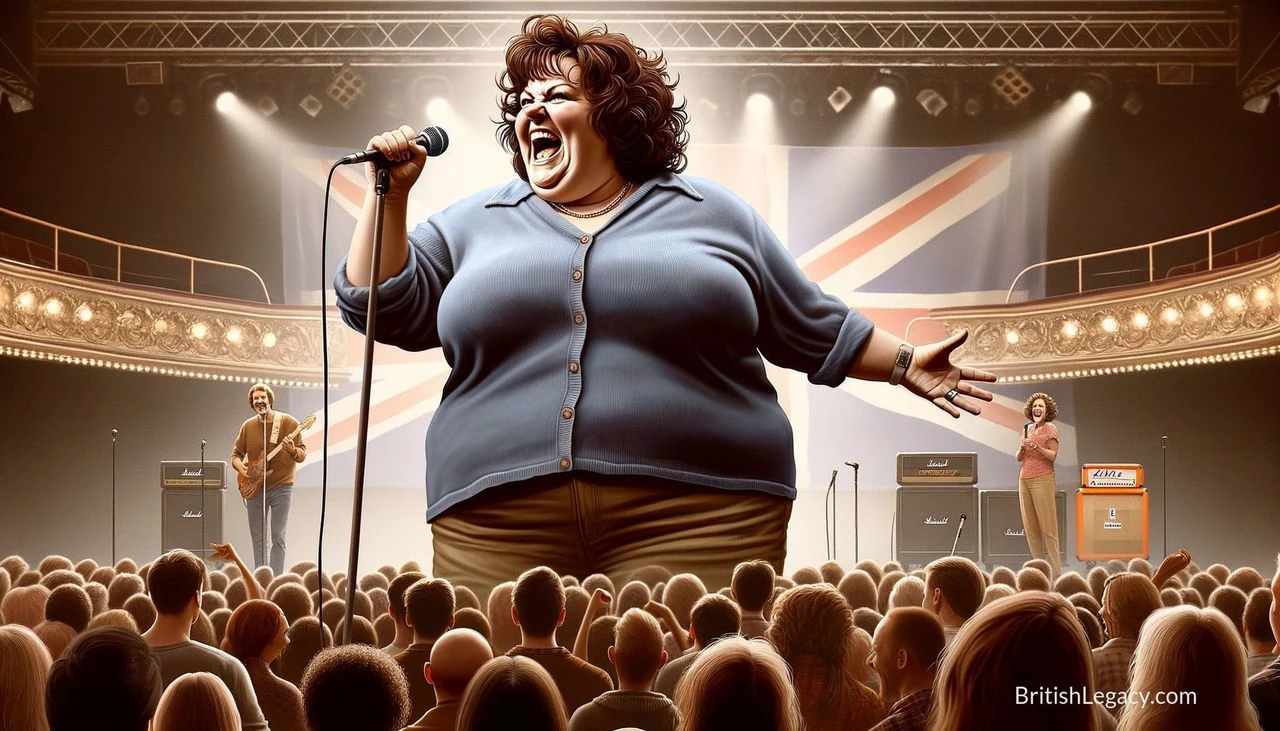
Jo Brand’s route into comedy began after a decade in psychiatric nursing. She brought to the alternative stand-up scene an unhurried, deadpan delivery and an interest in the absurdities of ordinary life. From early appearances on Saturday Live to writing and starring in the hospital sitcom Getting On, Brand built a career that spans stand-up, television, radio, film and books.
From nursing wards to the comedy circuit
Brand was born in Clapham, London, on 23 July 1957, and grew up in Hastings, East Sussex. Before comedy, she worked in a pub, for Barnardo’s and as a nursing assistant in a residential unit for adults with learning disabilities. She studied social science at Brunel University alongside training for a Registered Mental Nurse qualification, then worked as a psychiatric nurse for ten years. Her posts included South London’s Bethlem and Maudsley hospitals and Cefn Coed Hospital in Swansea.
By the mid-1980s, Brand was performing in London’s alternative comedy clubs. She used the stage name “the Sea Monster” and became part of a comedy movement that offered a different setting from conventional club stand-up. Her early television appearances included Saturday Live. On stage, her measured delivery—jokes spoken in a bored monotone, often with pauses between them—became a recognisable part of her act. Its observational humour drew on popular culture and public figures as well as everyday experience.
Brand’s career moved on from the clubs without leaving stand-up behind. She became a panellist on BBC television’s The Brain Drain in 1993 and fronted the Channel 4 series Jo Brand Through the Cakehole. She went on to appear on programmes including Have I Got News for You, QI and Would I Lie to You?, as well as BBC Radio 4 shows such as The News Quiz and Just a Minute. These roles gave her room to bring her comic timing to panel and discussion formats as well as a solo routine.
Writing comedy about a hospital
Brand’s experience of healthcare found a creative outlet in Getting On, the BBC Four sitcom she co-created, co-wrote and starred in with Joanna Scanlan and Vicki Pepperdine. Set on a geriatric ward, the series used workplace comedy and satire to examine the NHS and the routines of hospital life. Brand played nurse Kim Wilde. Rather than treating her earlier nursing career as a footnote, the programme made the world of care its setting and subject.
The series ran from 2009 to 2012. Brand’s performance earned her the 2011 BAFTA for Best Female Performance in a Comedy Role. Her television work also included Damned, which she co-wrote and starred in as Rose Denby, and the later series Going Forward. She has presented and appeared in a wide range of programmes, from Jo Brand’s Big Splash to Jo Brand’s Cats & Kittens, and competed on Taskmaster.
In 2014, Brand began presenting The Great British Bake Off: An Extra Slice, a companion programme to the baking competition. She remained its presenter through 2025, bringing her panel-show manner to conversations about the week’s challenges and results. Her television career also included presenting charity editions of The Great British Bake Off and taking part in fundraising programmes for Comic Relief and Sport Relief. The variety of these appearances reflects the breadth of a career that has not been confined to a single format or comic role.
Books, broadcasting and public work
Brand’s writing extends beyond television scripts. Her books include the novels Sorting Out Billy, It’s Different for Girls and The More You Ignore Me, as well as two autobiographies, Look Back in Hunger and Can’t Stand Up for Sitting Down. She adapted The More You Ignore Me for film and wrote the screenplay. Her work has also included books about men and women in history, adding non-fiction to a varied list of writing credits.
Her professional history has informed public work around mental health and nursing. Brand received an honorary doctorate from the University of Glamorgan in 2007 for her work as a psychiatric nurse. The university’s recognition cited the way her experiences had brought attention to mental health nursing and supported awareness of conditions including Alzheimer’s disease. In the same year, she received a lifetime achievement award from the Journal of Psychiatric and Mental Health Nursing. She later received honorary degrees from the University of Suffolk and Canterbury Christ Church University.
Brand has also taken part in fundraising and charity work. In 2016, she walked 150 miles across Britain for Sport Relief, completing the journey in Liverpool; the walk was the subject of the television documentary Jo Brand’s Hell of a Walk for Sport Relief. Her other charity work has included support for ActionAid and fundraising for BBC Children in Need. These activities sit alongside, rather than replace, the central achievement of her comedy career: making her own voice and experience useful across different kinds of public work.
Why Jo Brand deserves a place in British Legacy
Jo Brand deserves a place in British Legacy for the range and particularity of her contribution to British comedy. She arrived in stand-up from psychiatric nursing, rather than from a conventional route through entertainment, and developed a manner that did not depend on speed or theatrical polish. Her dry, deliberate delivery and observational material helped establish a distinctive comic presence in the alternative comedy scene of the 1980s. In later years, her work across panel shows, radio, presenting and scripted television made that presence familiar to audiences beyond the club circuit.
Getting On is an especially telling example of how her two careers met. Co-created and co-written by Brand, the sitcom brought a hospital ward and the work of care into the centre of a comedy, drawing on a professional world she knew. Its BAFTA recognition for Brand’s performance also marked her achievement as an actor, not only as a stand-up. Her books, television writing and sustained work on mental health awareness extend that record. The British connection is not simply where she was born or where she worked: it lies in a career shaped by British comedy and broadcasting, and in bringing experiences of nursing and public services into widely seen cultural work.
Sources
Jo Brand (revision 1378540123)
Adapted in part from Jo Brand by Wikipedia contributors, under CC BY-SA 4.0. Text has been edited and combined with the existing article; this adapted text is shared under the same licence. Contributor history.