Joan Collins’s career began on the London stage and in British films, but its most famous role belonged to American television. As Alexis Colby in Dynasty, she turned a struggling soap opera into an international phenomenon and became inseparable from the sharp suits and dramatic glamour of 1980s television. The success was not an overnight reinvention: by the time she joined the series in its second season, Collins had already spent decades working across film, television and theatre on both sides of the Atlantic.
A London childhood and an early start
Joan Henrietta Collins was born in Paddington, London, on 23 May 1933, and grew up in Maida Vale. Her mother, Elsa, was a dance teacher; her father, Joseph William Collins, worked as a talent agent. His clients later included Shirley Bassey, the Beatles and Tom Jones. Collins attended the Francis Holland School and appeared on stage in Henrik Ibsen’s A Doll’s House at the age of nine. At 16, she began training at the Royal Academy of Dramatic Art (RADA), and at 17 she signed with the British Rank Organisation.
Her first screen work came in British films. She appeared as a beauty contestant in Lady Godiva Rides Again (1951), then took smaller parts in The Woman’s Angle and Judgment Deferred (both 1952). A more prominent role in I Believe in You helped establish her early screen image. Rank-era films included Cosh Boy, Turn the Key Softly and Our Girl Friday, alongside returns to the London stage.
In 1954, American director Howard Hawks cast Collins as Princess Nellifer in Land of the Pharaohs. The film’s reception was initially disappointing, but her performance brought her to the attention of 20th Century Fox, which signed her to a contract. In 1955, she appeared in The Virgin Queen and starred as Evelyn Nesbit in The Girl in the Red Velvet Swing. Roles in films including The Opposite Sex, Sea Wife, Island in the Sun and The Bravados followed. After Esther and the King (1960), she left her Fox contract and continued working in American, British and European productions.
Working between Britain and Hollywood
Collins returned to London in the early 1960s and took roles in films such as The Road to Hong Kong. Her work during that decade ranged from thrillers to television guest appearances, including Edith Keeler in the Star Trek episode “The City on the Edge of Forever”. From 1970, she again worked in Britain, appearing in films including Revenge, Quest for Love, Tales from the Crypt and Fear in the Night. She continued to take screen roles in the United States and elsewhere, rather than following a single national or genre path.
Two British projects helped raise her profile at home in the late 1970s. From 1978 to 1983, she appeared with Leonard Rossiter in a popular series of Cinzano advertisements. She also starred in The Stud (1978), adapted from a novel by her sister, Jackie Collins. The film was followed by The Bitch (1979). Collins published her autobiography, Past Imperfect, in 1978, and returned to the West End in The Last of Mrs Cheyney.
By then, her career had included work in British film, American studio productions, television advertising, autobiography and live theatre. In 1981, that breadth of experience became an asset when she joined Dynasty, then a struggling American primetime soap opera, for its second season.
Alexis Colby and the reach of Dynasty
Collins played Alexis Colby, the formidable former wife of oil magnate Blake Carrington. The role placed her at the centre of the series’ rivalries and gave her a character whose sharpness and ambition matched the show’s extravagant world. Dynasty became a major international success; by 1985 it was the highest-rated programme in the United States. Collins’s performance was widely associated with the series’ rise, and in 1983 she received a star on the Hollywood Walk of Fame.
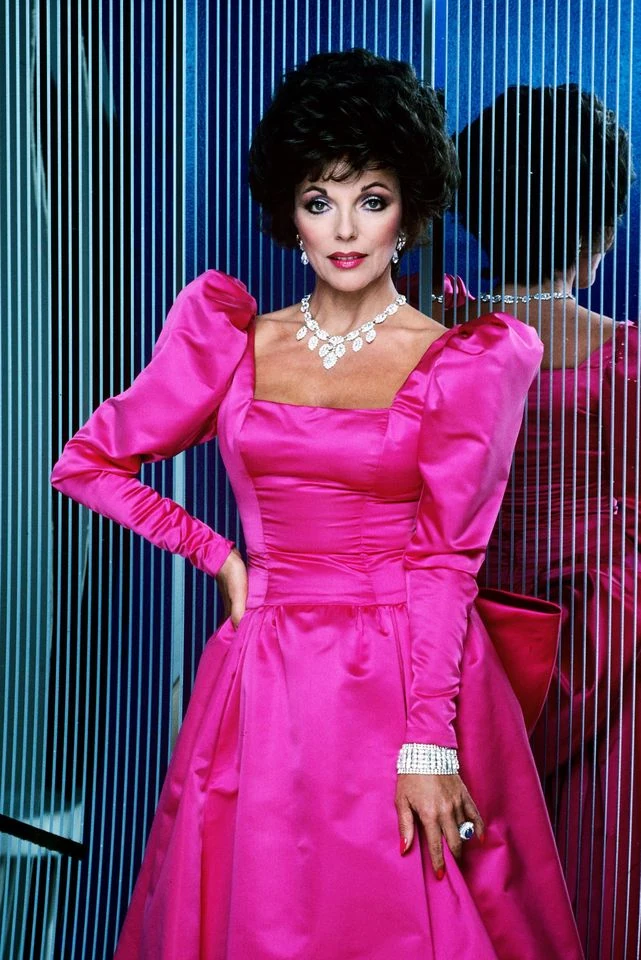
The clothes were part of the character’s public identity. Designed by Nolan Miller, Alexis’s gowns and sharply structured suits used bold shoulders, sequins and dramatic shapes. The wardrobe helped make the character’s appearance a distinctive feature of the series, while becoming a lasting reference point for 1980s television fashion. Collins’s portrayal earned her repeated Golden Globe nominations and the award for best actress in a television drama series in 1983. She was also nominated for a Primetime Emmy in 1984.
Her work did not stop with the series. During the 1980s she appeared in television films and miniseries, including Sins and Monte Carlo, and later returned to theatre. After Dynasty ended in 1989, she played Amanda in Noël Coward’s Private Lives, in productions in Britain and on Broadway, and appeared in a BBC series of Coward plays. Film and television parts continued through the following decades, alongside touring one-woman shows. Later roles included Eva De Wolffe in the British series Footballers’ Wives, Crystal Hennessy-Vass in Benidorm and appearances in The Royals and American Horror Story: Apocalypse.
Books, charitable work and honours
Writing became another substantial part of Collins’s working life. Alongside memoirs, she wrote novels and books on beauty and lifestyle. Her books include Past Imperfect, Second Act, Prime Time and Behind the Shoulder Pads. She has also written columns and diary pieces for British newspapers and magazines. This work extended her public voice beyond roles written for the stage and screen, and placed her in a different relationship with readers: as a memoirist, novelist and columnist.
Her charitable activity has included support for children and people with learning disabilities, breast-cancer awareness, Fight for Sight and the children’s hospice Shooting Star Chase. In 1982 she spoke before the US Congress in support of funding for neurological research. Her involvement with children’s causes also included patronage of the International Foundation for Children with Learning Disabilities and support for foster children in India. These activities provide context for the honours she received: she was appointed an Officer of the Order of the British Empire in 1997 for services to drama and made a Dame Commander in 2015 for services to charity.
Collins’s career has kept moving between British and American work, between screen and stage, and between performance and writing. Her roles after Dynasty included British productions as well as American television and independent films. On stage, she toured in An Evening with Joan Collins and later Joan Collins Unscripted. Her work in these different forms has kept her public identity connected not only to Alexis Colby, but also to a continuing career as an actor and author.
Why Joan Collins deserves a place in British Legacy
Joan Collins belongs in British Legacy because her career shows how a performer formed in British theatre and film could build an international career without leaving those beginnings behind. She trained at RADA, entered the profession through the Rank Organisation and worked in British films before moving into Hollywood productions. Her later career continued to cross borders: she returned to British film and television, performed in the West End and on Broadway, and took roles in productions made for audiences in several countries. Her success as Alexis Colby was a landmark in that story, but it was not its starting point or its only achievement.
Collins also made a distinct contribution beyond acting. The visual force of Alexis’s wardrobe helped give Dynasty a recognisable style, while Collins’s books and columns built a parallel career in writing. Her charitable work, particularly her support for children’s causes and breast-cancer awareness, gives a specific basis for her 2015 damehood. Taken together, these strands make her more than a star remembered for one television role: she is a British-trained performer whose work travelled internationally, an author with a long publishing career and a public figure who used her standing to support charitable causes. That combination, and the durability of her work across several generations of popular entertainment, is the substance of her place in British cultural history.
Sources
Joan Collins — Wikipedia revision 1379248946
Adapted in part from Joan Collins by Wikipedia contributors, under CC BY-SA 4.0. Text has been edited and combined with the existing article; this adapted text is shared under the same licence. Contributor history.