John Betjeman made the overlooked particulars of English life — a railway station, a church, a suburban street — subjects for poetry and public attention. His verse could be comic and sharply observant, while his writing and broadcasting reflected a lasting interest in the buildings and places being swept aside by redevelopment. Appointed Poet Laureate in 1972, he reached audiences well beyond literary circles; as a conservation campaigner, he helped make the case for Victorian architecture when it was often unfashionable.
School, Oxford and a first career in journalism
Betjeman was born in London on 28 August 1906 into a family of Dutch descent. His father, Ernest, was a furniture maker, and the family business produced ornamental household furniture and gadgets. During the First World War, the family changed its name from Betjemann to Betjeman. John attended Byron House and Highgate School before boarding at the Dragon School in Oxford and Marlborough College in Wiltshire.
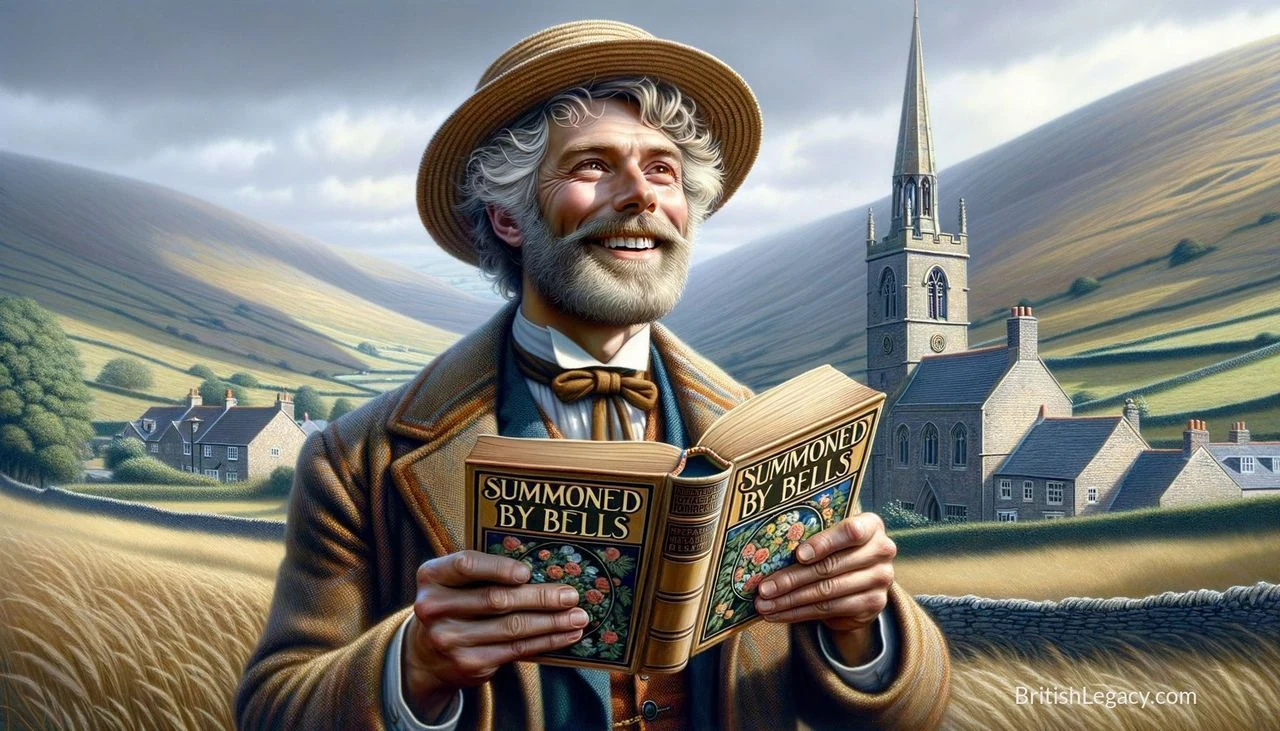
At Magdalen College, Oxford, he studied English but did not graduate. His departure was not, as a story he helped perpetuate suggested, simply the result of failing the compulsory divinity examination: he passed it on his third attempt, but failed the Pass School after achieving a satisfactory result in only one of its three papers. His academic experience was difficult, though Oxford remained important to him. His blank-verse autobiography, Summoned by Bells, published in 1960, drew on his school and university years.
After leaving Oxford, Betjeman worked as a private secretary and schoolteacher, and as a film critic and contributor to the Evening Standard. From 1930 to 1935 he was assistant editor of the Architectural Review, a period that helped develop his knowledge of buildings and architectural writing. He also worked on the Shell Guides, which offered motorists routes through Britain’s counties and historic sites. He wrote the guides to Cornwall and Devon; a later guide to Shropshire was made with his friend John Piper.
Poems rooted in places and ordinary things
Betjeman’s first book of poems, Mount Zion, appeared in 1932. Continual Dew followed in 1937, and his books brought together humour, melancholy and close observation of changing English places. Rather than treating daily life as beneath poetry, he wrote about its familiar objects and habits: Ovaltine, bicycle gears, marmalade and lampshades sit alongside churches, streets and railway lines. His subjects helped give his verse a strong sense of time and place.
Summoned by Bells is an autobiographical poem in blank verse, shaped by memories of his early life. Its scenes and characters give readers a personal route through the landscapes of his youth, while its conversational manner helped make it accessible. Betjeman’s work could also be satirical. In “Slough”, published in Continual Dew, he expressed dismay at the town’s pre-war industrial development; he later regretted writing the poem.
His interest in places extended to film and broadcasting. He became a familiar television figure, using his public profile to draw attention to architecture and landscape. The 1973 BBC documentary Metro-Land, directed by Edward Mirzoeff, explored the culture and spirit of the Metropolitan Railway’s outer reaches. The pair followed it with A Passion for Churches, a documentary filmed in the Diocese of Norwich. These programmes joined his poetry and guidebooks in making local places subjects of shared interest.
A public poet and a conservation campaigner
Betjeman became Poet Laureate in 1972, succeeding Cecil Day-Lewis, and held the post until his death. His traditional metres and rhymes, comic voice and attention to familiar settings helped bring his poetry to a broad audience. He was also a broadcaster and recording artist: among his albums were Banana Blush and Late Flowering Love (both 1974), Sir John Betjeman’s Britain (1977) and Varsity Rag (1981), with readings set to music by Jim Parker.
His conservation work was practical as well as literary. A founding member of the Victorian Society and of the Friends of Friendless Churches, Betjeman argued for buildings that many people then regarded as outdated. He campaigned unsuccessfully to save the Euston Arch, but was instrumental in the campaign to protect St Pancras railway station from demolition. He also campaigned for Holy Trinity, Sloane Street, and supported preservation efforts in Bath, where he served as a trustee of the Bath Preservation Trust for more than 20 years. His work on churches included editing and writing substantial parts of The Collins Guide to English Parish Churches (1958).
He wrote about architecture in books including First and Last Loves (1952) and London’s Historic Railway Stations (1972). His attention to buildings did not stop at praise: he criticised redevelopment that he believed ignored architectural quality and damaged historic settings. At Leeds, he spoke against the impact of a modern office building on City Square, while praising Leeds Town Hall. His television work and writing made conservation an accessible public concern, not solely a matter for specialists.
Later years and remembrance
Betjeman married Penelope Chetwode in 1933. They had two children, Paul and Candida, and separated in 1972. He spent much of his later life in Cornwall, where he died at his home in Trebetherick on 19 May 1984, aged 77. He had suffered from Parkinson’s disease during his final decade and was buried at St Enodoc’s Church nearby.
His honours included the Queen’s Medal for Poetry in 1960, appointment as a Commander of the Order of the British Empire that year, and a knighthood in 1969. His work and conservation interests have also been remembered through a Society for the Protection of Ancient Buildings award for the repair and conservation of places of worship in England and Wales. A statue by Martin Jennings was unveiled at St Pancras in 2007, linking the poet’s memory to a station he had helped defend.
Why John Betjeman deserves a place in British Legacy
Betjeman’s place in British cultural history rests on the way he connected poetry with places people could recognise. His comic, observant verse made everyday objects, provincial towns and familiar routines worthy subjects, while works such as Summoned by Bells turned personal memories of school and Oxford into a public literary experience. As Poet Laureate, broadcaster and recording artist, he carried that approach beyond the page. Programmes such as Metro-Land invited viewers to look closely at the changing landscapes around them; his writing and guidebooks similarly encouraged attention to the character of towns, churches and railway stations.
His conservation work gave that attention practical consequence. Betjeman helped defend St Pancras from demolition and campaigned for churches and other Victorian buildings at a time when their architectural value was not universally accepted. His involvement with the Victorian Society and Friends of Friendless Churches, alongside his writing on historic buildings, connected public enthusiasm with organised efforts to preserve them. That work benefited more than the buildings themselves: it kept distinctive public spaces and architectural history in view for future generations. Betjeman’s legacy is therefore not just a body of popular poems, but a demonstrated relationship between cultural expression and civic action. He helped readers and viewers notice what was at risk, and made the case that ordinary places and unfashionable buildings deserved both attention and care.
Sources
John Betjeman — Wikipedia, revision 1377823983
Adapted in part from John Betjeman by Wikipedia contributors, under CC BY-SA 4.0. Text has been edited and combined with the existing article; this adapted text is shared under the same licence. Contributor history.