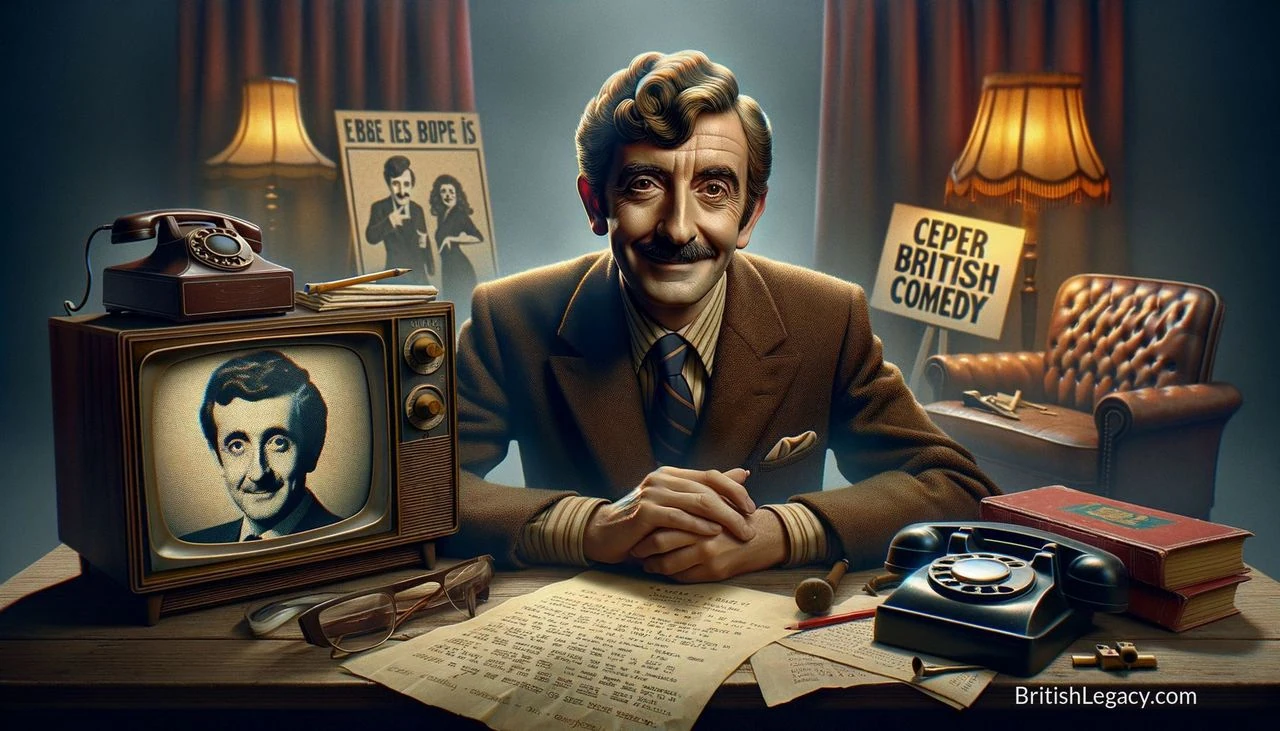
John Cleese’s comedy often begins with a figure who appears to command a room: a bureaucrat, a hotelier or a customer insisting that a plainly absurd situation is perfectly serious. The authority does not last. In Monty Python’s sketches and Fawlty Towers, Cleese made self-importance, irritation and social embarrassment engines of comic disorder. His career grew from Cambridge student revue and BBC writing rooms into some of British television’s most enduring comedy, alongside films, books and charitable performances.
Cambridge, comedy and the route to television
John Marwood Cleese was born in Weston-super-Mare, Somerset, on 27 October 1939, the only child of insurance salesman Reginald Francis Cleese and Muriel Evelyn Cleese. He attended Clifton College before studying law at Downing College, Cambridge. At Cambridge he joined the Footlights, writing and performing in student revues; he graduated in 1963. His early work soon took him beyond university stages: the revue Cambridge Circus moved to London’s West End and toured New Zealand and Broadway, with members of its cast also appearing in sketches on The Ed Sullivan Show.
Cleese’s early television work brought him into contact with several of the writers and performers who would define British comedy in the following decade. He and Graham Chapman wrote for The Frost Report, where Cleese also performed. The programme’s famous “Class” sketch set him between Ronnie Barker and Ronnie Corbett, using the performers’ different heights and social positions as part of its joke. Cleese and Chapman also wrote for At Last the 1948 Show and the television comedy Doctor in the House. These jobs helped establish both his screen presence and his collaborative writing practice before Monty Python began.
In 1969 Cleese joined Chapman, Terry Gilliam, Eric Idle, Terry Jones and Michael Palin to make Monty Python’s Flying Circus for the BBC. The series mixed surrealism, satire and abrupt changes of scene rather than following the familiar shape of a conventional sketch show. Cleese was especially effective as an officious authority figure whose composure became increasingly untenable. His roles included the civil servant in “The Ministry of Silly Walks” and Mr Praline, the customer who tries to return a dead Norwegian Blue parrot.
Python’s sketches and the Basil Fawlty years
Cleese and Chapman formed a close writing partnership. They often built sketches around articulate arguments over trivial matters, as in “Argument Clinic” and the dead-parrot routine. The latter began as a complaint about poor customer service; Chapman’s suggestion of a Norwegian Blue helped turn the premise into one of Python’s best-known comic encounters. Cleese’s clipped delivery and capacity for contained anger suited characters who tried to impose order on a world that would not cooperate.
Monty Python’s Flying Circus ran from 1969 to 1974. Cleese left after its third series, having become dissatisfied with the working process and the direction of the scripts, but continued collaborating with the group on film. He co-wrote and acted in Monty Python and the Holy Grail (1975), Monty Python’s Life of Brian (1979) and Monty Python’s The Meaning of Life (1983). The troupe’s work crossed from television into cinema and stage performances, while its characteristic mixture of argument, absurdity and social observation gave Cleese room to develop comic characters beyond the original series.
His most sustained television role was Basil Fawlty, the volatile hotel owner in Fawlty Towers. Cleese co-wrote the sitcom with Connie Booth, who also played waitress Polly. The programme’s two series, first broadcast in 1975 and 1979, comprised 12 episodes in total. Its small scale left little room for a routine to outstay its welcome: the comedy depends on Basil’s attempts to manage his guests, staff and temper, each of which makes his supposed control less convincing. Prunella Scales played his wife Sybil and Andrew Sachs the waiter Manuel.
The BBC series later became a prominent fixture in British television retrospectives. It topped the British Film Institute’s 2000 list of the 100 greatest British television programmes, and Basil ranked second in a 2001 Channel 4 poll of television characters. Cleese received the 1980 BAFTA Television Award for Best Entertainment Performance for the role. These honours register the programme’s reputation, but its staying power also rests on the precision of its construction: escalating misunderstandings are anchored by a recognisable character whose confidence repeatedly outruns his judgement.
Beyond the hotel: film, writing and public work
Cleese’s screen career continued across film and television. In 1986 he starred in Clockwise as a headmaster whose fixation on punctuality complicates a journey. Two years later, he wrote and starred in A Fish Called Wanda, alongside Jamie Lee Curtis, Kevin Kline and Michael Palin. The film brought him nominations for major awards for both its screenplay and his performance. He later appeared in a wide range of films, including Time Bandits, Silverado, Mary Shelley’s Frankenstein and the James Bond films The World Is Not Enough and Die Another Day.
His work was not confined to entertainment for its own sake. Cleese co-founded Video Arts, a production company that made business training films using comedy; titles included Meetings, Bloody Meetings and More Bloody Meetings. He also helped initiate The Secret Policeman’s Ball benefit shows, which raised funds for Amnesty International. The events brought together Python colleagues and other performers, turning comic performance into a vehicle for support for human-rights work.
Cleese wrote with psychiatrist Robin Skynner on relationships, publishing Families and How to Survive Them and Life and How to Survive It as dialogues. His other writing included the memoir So, Anyway... and Creativity: A Short and Cheerful Guide. From 1970 to 1973, he served as rector of the University of St Andrews. During his tenure he changed the traditional arrangement for the rector’s assessor, making the role a student-elected position and giving students direct representation at important meetings.
Cleese’s honours and public recognition include a BAFTA Film Award for A Fish Called Wanda and an Emmy for his guest performance in Cheers. His work has also crossed into less expected forms: a lemur species was named Avahi cleesei, reflecting his interest in lemurs and support for conservation efforts in Madagascar. These episodes belong to a career that moved between performance, writing, teaching and public activity, rather than remaining within one television persona.
A comic method built on authority and its collapse
Across Python and Fawlty Towers, Cleese repeatedly played people convinced that their position or expertise should settle a matter. The joke comes when events expose the gap between that conviction and reality. In “The Ministry of Silly Walks”, a government office lends bureaucratic weight to an absurd premise; in the dead-parrot sketch, a customer-service dispute becomes a battle of increasingly elaborate assertions. Basil Fawlty’s attempts to preserve the hotel’s dignity follow a similar pattern, with each effort making the situation more chaotic.
That technique depended on performance as well as writing. Cleese’s height, stillness and controlled delivery helped him establish an imposing figure before allowing irritation or physical movement to break the pose. His collaborations mattered too: Chapman’s writing partnership, the ensemble structure of Python and Booth’s contribution to Fawlty Towers all shaped the work. The result was not simply a collection of catchphrases, but a set of comic situations built around status, language and the failure of people to behave as they claim they should.
Why John Cleese deserves a place in British Legacy
John Cleese deserves a place in British Legacy because his work became part of the history of British television comedy through identifiable programmes, characters and creative collaborations. Monty Python’s Flying Circus challenged the expected form of the television sketch, combining surreal ideas with satire and abrupt shifts in tone. Cleese’s performances as officious figures, especially in “The Ministry of Silly Walks” and the dead-parrot sketch, helped give that approach a memorable human focus. His writing and acting with Graham Chapman also show how the work was made: through partnership, revision and the transformation of an ordinary grievance into an elaborate comic argument.
Fawlty Towers extended that achievement into the sitcom. Its 12 episodes established Basil Fawlty as a character whose attempts to control others continually undo him, and the programme’s standing in British television polls and awards confirms its place in the national screen record. Cleese’s contribution also reaches beyond those celebrated roles. Video Arts applied humour to workplace training; The Secret Policeman’s Ball connected performers with fundraising for Amnesty International; and his service as rector at St Andrews included a change that strengthened student representation. Together, these accomplishments show a British career in comedy that joined performance and writing with institutional and charitable work, leaving a record that can be understood through what he made and the practical effects of those projects.
Sources
John Cleese — Wikipedia revision 1378880996
Adapted in part from John Cleese by Wikipedia contributors, under CC BY-SA 4.0. Text has been edited and combined with the existing article; this adapted text is shared under the same licence. Contributor history.