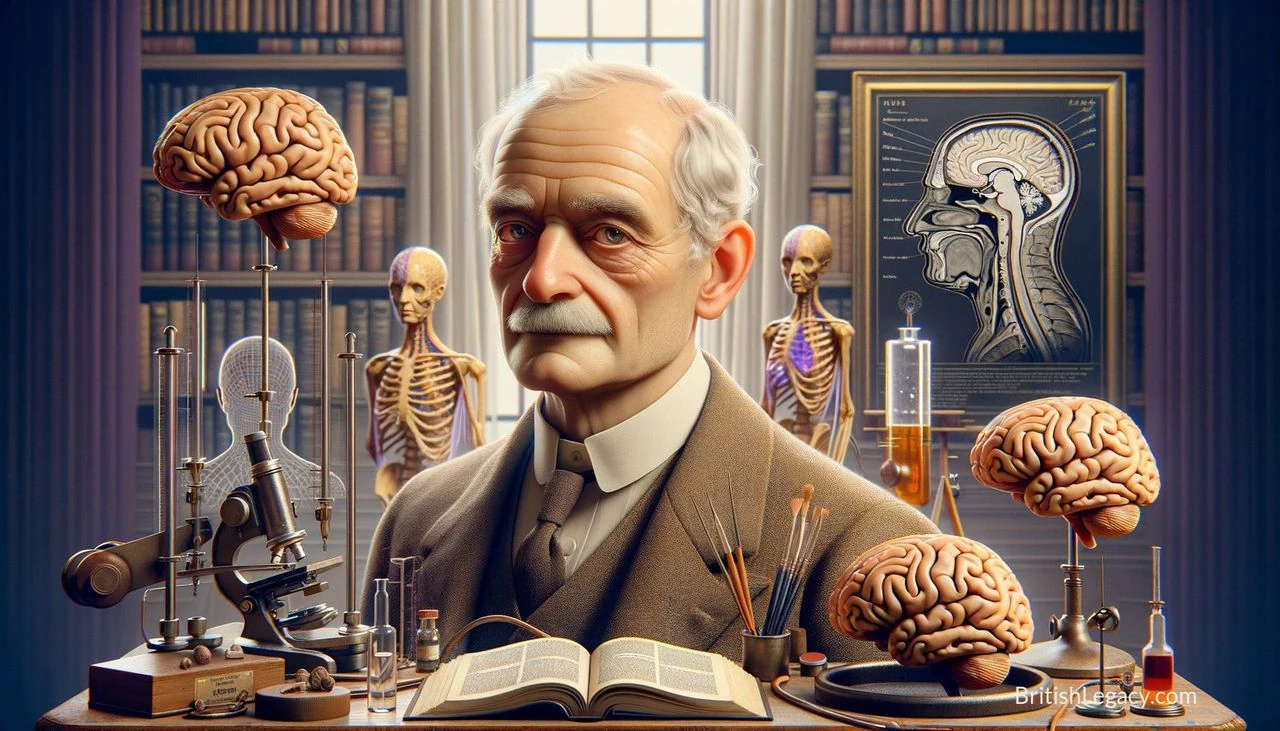
John Hughlings Jackson built his account of the nervous system from what he could observe: how a seizure moved through a patient’s body, what kinds of speech survived brain injury, and how symptoms changed when different levels of the nervous system were affected. In an era before modern investigative technology, he used clinical observation, deductive reasoning and autopsy evidence to develop ideas that helped make neurology a more systematic study of brain and behaviour.
From Yorkshire to London medicine
Jackson was born on 4 April 1835 at Providence Green, in Green Hammerton, Yorkshire. He was the youngest son of Samuel Jackson, a brewer who also owned and farmed land, and Sarah Hughlings, whose father was a Welsh revenue collector. Sarah died a little over a year after his birth. Jackson had three brothers and a sister; his brothers later emigrated to New Zealand, while his sister married a physician.
He was educated at Tadcaster in Yorkshire and Nailsworth in Gloucestershire before studying at the York Medical and Surgical School. After qualifying at St Bartholomew’s Hospital in 1856, he became house physician to the York Dispensary. In 1859 he returned to London, working at the Metropolitan Free Hospital and the London Hospital. These appointments brought him into a developing metropolitan medical world in which close attention to patients could generate questions about the workings of the brain.
In 1862 Jackson became assistant physician at the National Hospital for Paralysis and Epilepsy in Queen Square, later becoming its full physician in 1869. The institution is now the National Hospital for Neurology and Neurosurgery. He also became a physician at the London Hospital in 1874. His work at these hospitals established his reputation as a neurologist, and in 1878 he was elected a Fellow of the Royal Society.
Reading the course of a seizure
Jackson is particularly associated with his clinical work on epilepsy. The name Jacksonian march is attached to a pattern in focal motor seizures in which symptoms progress through parts of the body. The sequence mattered: it offered a way to reason from the course of a patient’s symptoms towards the organisation of the nervous system, rather than treating an episode as an unexplained event. The name also endures in descriptions of psychomotor seizures of temporal-lobe origin, sometimes called a “dreamy state”.
His writing on these episodes was notable for its descriptive detail and analysis of the relationship between psychomotor epilepsy, forms of automatic behaviour and other mental and behavioural disorders. Jackson’s approach was not based on equipment unavailable in his day. He relied on observation, logic and post-mortem evidence. That method helped make the careful description of symptoms a central part of neurological inquiry, while leaving later researchers to test and revise particular explanations.
Levels, language and the nervous system
Jackson’s ideas reached beyond the description of seizures. He proposed that nervous activity was organised at lower, middle and higher levels. In his account, simpler movements were represented at lower levels associated with the medulla and spinal cord; the motor area of the cortex formed a middle level; and higher motor levels were associated with the prefrontal area. He argued that higher centres inhibited lower ones. Damage to a higher centre could therefore remove a function, producing what he called a “negative” symptom, or release lower activity, producing a “positive” symptom. He termed this process “dissolution”, borrowing the word from Herbert Spencer.
These were theoretical proposals, not a final map of the brain. Jackson’s distinction between positive and negative symptoms was later taken up in other contexts, including discussions of schizophrenia in the 1980s. His work also addressed aphasia. He noted that some children with aphasia could sing despite losing voluntary speech, and examined how language loss after left-brain injury could affect different forms of expression, including familiar phrases such as “Good bye” and “Oh, dear.” Such observations helped frame language disorders as varied patterns requiring close description, rather than a single undifferentiated loss.
Jackson’s theories did not go unchallenged. Some later British neurologists criticised aspects of his concepts. A remark by Sir Francis Walshe in 1943 nevertheless captured the continuing interest in his work: after obsolete or irrelevant material was set aside, he said, a rich body of physiological insight remained. The value of Jackson’s writing lies not in treating every proposal as settled, but in the questions his clinical descriptions enabled others to pursue.
Publishing and professional influence
Jackson was a prolific writer and helped establish institutions through which neurological ideas could be discussed. With Sir David Ferrier and Sir James Crichton-Browne, he was one of the founders of Brain, a journal devoted to the relationship between experimental and clinical neurology. Its first issue appeared in 1878, and the journal continues to be published.
In 1892 he was among the founders of the National Society for the Employment of Epileptics, alongside Sir William Gowers and Sir David Ferrier. The organisation is now the National Society for Epilepsy. He also delivered several major professional lectures: the Goulstonian in 1869, the Hunterian Oration in 1872, the Croonian in 1884 and the Lumleian in 1890. His election to the Royal Society and these invitations reflect the standing he achieved among the medical and scientific communities of his time.
Jackson died in London on 7 October 1911, aged 76, and was buried at Highgate Cemetery. The Hull York Medical School building at the University of York bears his name. His ideas also travelled beyond Britain: continental psychiatrists and psychologists including Théodule Ribot, Pierre Janet, Sigmund Freud and Henri Ey were influenced by his theoretical work. Neurologist Oliver Sacks later cited Jackson as an inspiration.
Why John Hughlings Jackson deserves a place in British Legacy
Jackson’s place in British medical history rests on more than an eponym. His descriptions of focal motor seizures gave clinicians a memorable account of how symptoms can progress through the body, while his work on psychomotor epilepsy connected detailed observation with questions about behaviour and brain function. He also examined how language could be affected in different ways after brain injury. These contributions show a neurologist making careful use of the evidence available in his own period, rather than claiming certainty where observation could not provide it.
His wider significance lies in the method and institutions that carried neurological inquiry forward. Jackson tried to explain symptoms through an organised nervous system, proposed a hierarchy of levels and distinguished between lost functions and the release of lower activity. Later researchers criticised parts of his theory, but his clinical descriptions continued to offer material for debate. His role in founding Brain helped sustain exchange between experimental and clinical neurology, while his participation in establishing the National Society for the Employment of Epileptics connected medical work with an organisation focused on people with epilepsy. Together, these achievements make his British legacy both intellectual and practical: he helped shape how neurological problems were described, discussed and investigated.
Sources
John Hughlings Jackson — Wikipedia revision 1372023602 · John Hughlings Jackson — Wikipedia
Adapted in part from John Hughlings Jackson by Wikipedia contributors, under CC BY-SA 4.0. Text has been edited and combined with the existing article; this adapted text is shared under the same licence. Contributor history.