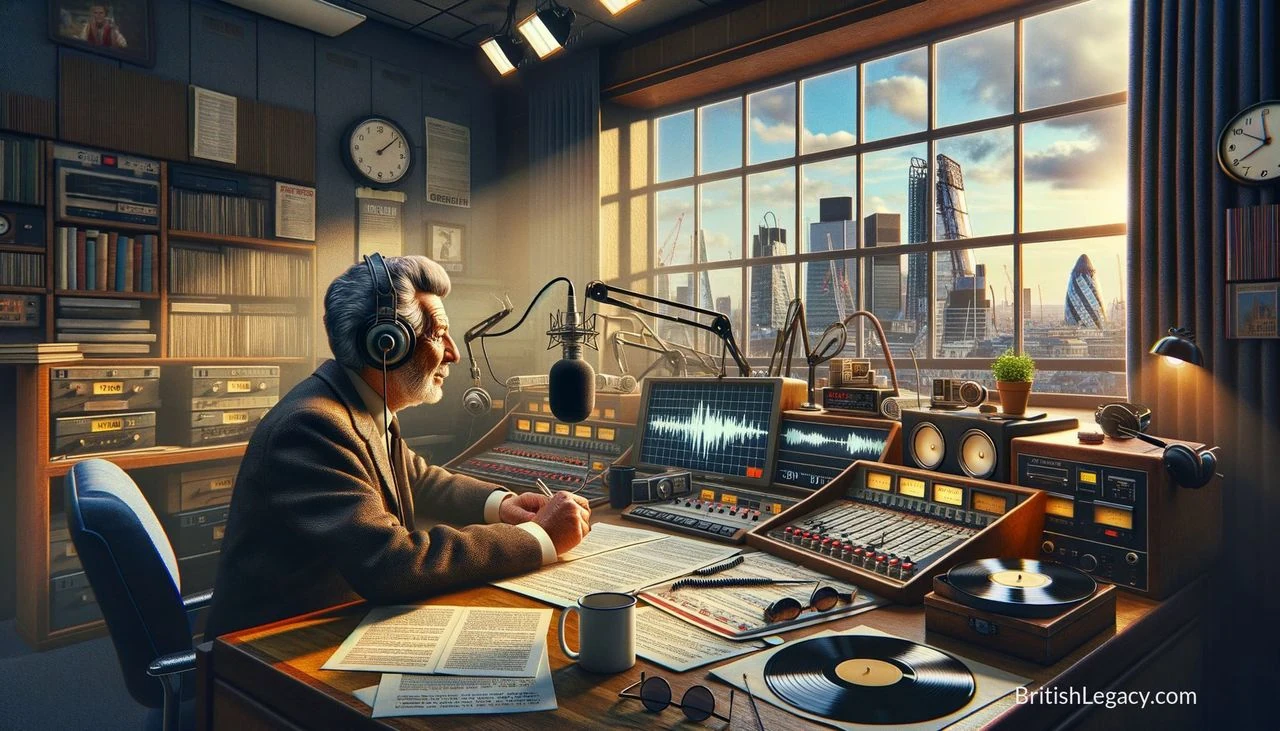
John Peel’s radio career was built around the possibility that the next record need not sound like the last. Across decades of broadcasting, he moved between blues, folk, psychedelia, punk, reggae, electronic music and sounds that resisted easy labels. His BBC Radio 1 sessions gave musicians the chance to record in the corporation’s studios and brought many later-famous acts to a national audience. Peel did not simply reflect changing musical tastes; his programmes made space for listeners to encounter them.
From Heswall to the airwaves
Born John Robert Parker Ravenscroft in Heswall, Merseyside, on 30 August 1939, Peel grew up in nearby Burton. He attended Shrewsbury School and became an avid radio listener and record collector. After national service in the Royal Artillery, he worked at a mill in Rochdale. In 1960 he went to the United States, where he held several jobs, including work as an insurance salesman. He also began in radio, working unpaid at WRR in Dallas before presenting programmes at stations in Dallas, Oklahoma City and California. At KMEN in San Bernardino, he used his birth name, John Ravenscroft.
Peel returned to England in early 1967 and joined the offshore station Radio London. His late-night programme, The Perfumed Garden, became a meeting point for underground music and conversation. He played blues, folk and psychedelic rock, with particular interest in new music from Los Angeles and San Francisco. Letters, poems and records sent in by listeners helped give the show an unusually personal, two-way character. Peel also wrote a column with the programme’s title for the underground newspaper International Times.
When Radio London closed in August 1967, Peel joined the BBC’s new music station, Radio 1, which began broadcasting the following month. He first shared presentation of Top Gear, then took sole charge in 1968. The programme ran until 1975. His BBC work was not confined to one sound: Night Ride ranged across rock, folk, blues, classical and electronic music, with poetry and interviews alongside the records. Its unpredictable mix did not find favour with the BBC hierarchy, and it ended in 1969.
Sessions that opened a door
The Peel Sessions became one of the clearest expressions of his approach. BBC rules and agreements limited the playing of commercial recordings, so musicians were brought into the studios to record music for broadcast. A typical session consisted of four tracks recorded and mixed in a day. The results could feel rough-edged, closer to a working band than a polished studio production. During Peel’s 37 years on Radio 1, more than 4,000 sessions were recorded by over 2,000 artists.
Those sessions offered new and less-established musicians a distinctive form of exposure. The range reflected Peel’s willingness to move between scenes: punk and post-punk sat alongside reggae, electronic and dance music, indie rock, extreme metal and UK rap. The sessions often gave bands that later achieved fame their first major national coverage. Their value lay not only in Peel’s taste, but in a repeatable opportunity for musicians to perform and be heard.
Peel’s support for music outside the mainstream could put him at odds with the station’s hierarchy. When Radio 1 controller Derek Chinnery asked Peel’s producer whether the programme was playing punk, the reply was that it had played little else in recent weeks. Peel later recalled discovering the Ramones’ first album in 1976. After listeners wrote in demanding that he stop playing it, he played more. The episode reflects a characteristic part of his broadcasting: resistance to an unfamiliar sound was not necessarily a reason to retreat from it.
Listeners also helped shape his programmes. The annual Festive Fifty counted down records chosen by the audience, turning a year-end chart into another way to discover what listeners valued. Its history was not entirely smooth. The 1991 chart was cancelled and later broadcast in instalments; a lack of airtime led to a shorter version in 1997. After Peel’s death, the tradition continued on Radio 1 and later through Dandelion Radio.
Beyond the music programmes
Peel’s broadcasting extended beyond the programmes most closely associated with new music. He appeared intermittently on television, including as a presenter of Top of the Pops, and often presented the BBC’s television coverage of the Glastonbury Festival. On Radio 4, he presented Offspring, about children, before it developed into Home Truths. The later programme centred on stories from everyday family life rather than celebrity interviews. This was a different subject from the music on Radio 1, but it also made room for voices and experiences outside the usual spotlight.
He also tried his hand at releasing records. In 1969, Peel founded Dandelion Records, named after his pet hamster, to release the debut album by Bridget St John, which he produced. The label issued 27 albums by 18 artists before folding in 1972. It was not a financial success, but it allowed Peel to release music he liked without making commercial performance the sole test. In the 1980s, he and Clive Selwood established Strange Fruit Records to release material recorded for the BBC sessions.
Peel married Sheila Gilhooly in 1974. They lived at Peel Acres, a cottage in Great Finborough, where he later broadcast many of his programmes from a home studio. His wife and children were sometimes involved or mentioned on air. His autobiography, Margrave of the Marshes, was unfinished when he died; Gilhooly and journalist Ryan Gilbey completed it, and it was published in 2005. Peel was appointed OBE in 1998 for services to British music and received a number of broadcasting honours, including Sony Broadcaster of the Year in 1993.
Death and remembrance
Peel died of a heart attack in Cusco, Peru, on 25 October 2004, aged 65, while on a working holiday. Radio 1 cleared its schedule the following day for tributes. More than 1,000 people attended his funeral in Bury St Edmunds, including many of the artists he had championed. The service ended with the Undertones’ “Teenage Kicks”, a song Peel had often praised.
Commemorations have connected his national broadcasting career to particular places and communities. The John Peel Centre for Creative Arts opened in Stowmarket in 2013 as a live venue for music and performance and a community meeting point. Blue plaques recognising his contribution were unveiled at two former recording studios in Rochdale in 2009 and in Great Finborough in 2017. The first John Peel Day, held in 2005, saw more than 500 gigs in Britain and overseas; further events followed in 2006 and 2007.
Why John Peel deserves a place in British Legacy
John Peel deserves a place in British Legacy because his broadcasting helped change what British radio could make audible. He joined the BBC in the year Radio 1 began, but his contribution was not simply a long career at a national station. Through programmes including The Perfumed Garden, Top Gear and his later Radio 1 shows, he made room for music that familiar formats and commercial expectations might have left unheard. The Peel Sessions gave more than 2,000 artists the chance to record for broadcast. Their scale—over 4,000 sessions—shows how a commitment to discovery became a sustained part of radio practice.
That work mattered in practical ways to musicians and listeners. A session could give a band national exposure before it was established; a listener could hear unfamiliar styles alongside records they already knew. The Festive Fifty gave listeners’ choices a place in the broadcast, while Peel’s later Radio 4 work showed that his interest in overlooked voices extended beyond music. The John Peel Centre in Stowmarket and the plaques in Rochdale and Great Finborough connect his national career to specific communities. His legacy is therefore not only a reputation for eclectic taste. It includes opportunities for artists to be heard, unfamiliar sounds brought into circulation and local spaces that continue to support music and performance.
Sources
John Peel — Wikipedia revision 1379198645
Adapted in part from John Peel by Wikipedia contributors, under CC BY-SA 4.0. Text has been edited and combined with the existing article; this adapted text is shared under the same licence. Contributor history.