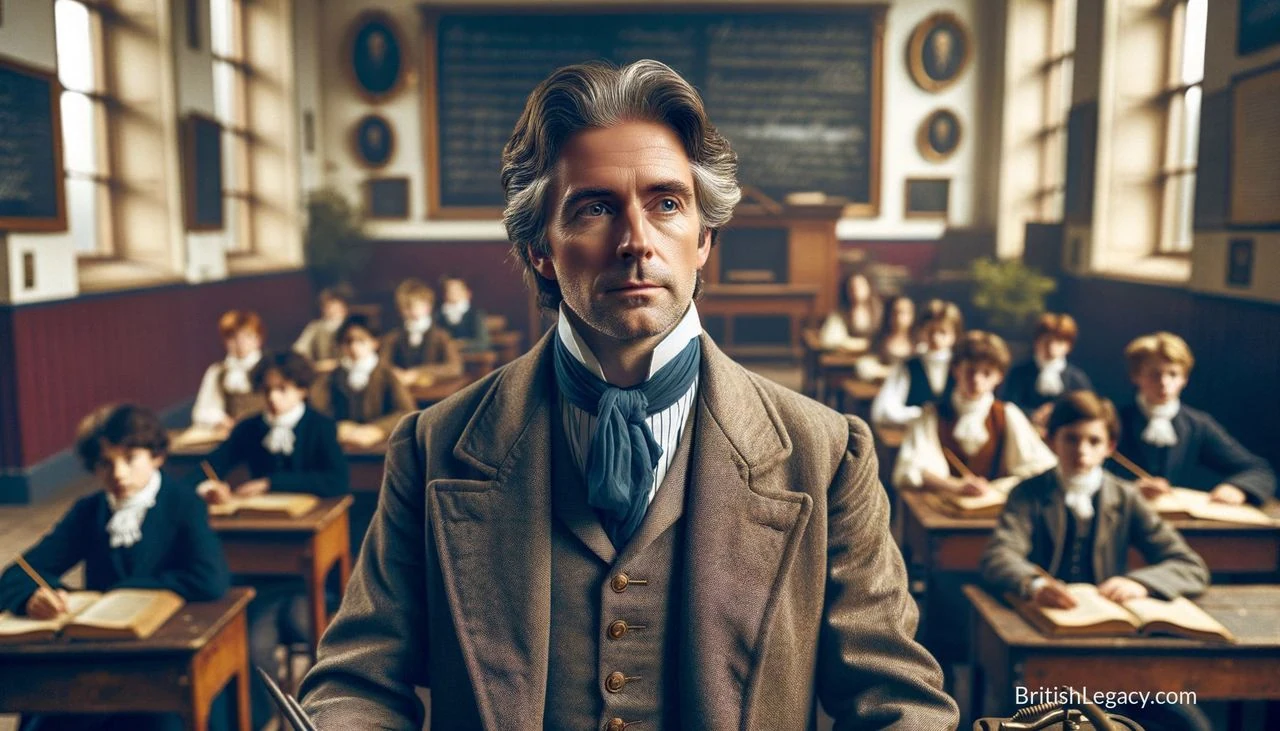
In early nineteenth-century Britain, a schoolmaster with a small teaching staff faced a practical problem: how could one teacher instruct hundreds of children? Joseph Lancaster’s answer was to train pupils to teach one another. His monitorial system made older or more advanced students responsible for passing lessons to their peers, while the teacher supervised the school. It offered an economical way to extend elementary education, though the method and Lancaster’s own career also drew criticism.
A school in Southwark
Lancaster was born in Southwark, south London, on 25 November 1778. His father, Richard, had been a soldier and made cane sieves; his mother, Sarah Faulkes, was a shopkeeper. Lancaster joined the Society of Friends, or Quakers, intending to become a teacher. As a teenager he was interested in missionary work in Jamaica. The account of his early life also records that he is said to have run away from home and been returned through the naval connections of the minister Thomas Urwick.
In 1798 Lancaster founded a free elementary school with support from his father. In 1801 he began a free school in Borough Road, Southwark, where he used a version of the monitorial method. Pupils who had learnt material would be rewarded for passing it on to another child. The monitors helped Lancaster teach a large school without the cost of employing a comparable number of assistant teachers.
He set out his approach in Improvements in Education as it Respects the Industrious Classes of the Community, published in 1803. The book brought favourable attention, and visitors came to the Borough Road school. Lancaster travelled around the British Isles to explain his methods. In Belfast, he presented the system in terms of economy and described how a single master might govern more than a thousand children. He also stipulated that pupils should not be asked whether they belonged to a church, meeting house or chapel.
Support, argument and discipline
Lancaster’s school attracted powerful supporters. In 1805 he had an audience with George III at Weymouth. His backing also included John Russell, the sixth Duke of Bedford, and the royal dukes of Kent and Strathearn and Sussex. In 1808, supporters created the Society for Promoting the Lancasterian System for the Education of the Poor, later known as the Royal Lancasterian Society. The group raised money for the school, and Lancaster’s ideas spread to other places.
His approach developed alongside a different monitorial system associated with Andrew Bell in Madras. Earlier precedents were also noted: the schoolmaster David Manson had used a related method in Belfast decades before. Lancaster’s work therefore belongs to a wider history of attempts to teach many children efficiently, rather than to a story of one person inventing peer instruction in isolation.
The system provoked religious and educational opposition. Lancaster’s non-sectarian stance worried some Anglican critics, who feared that leaving instruction open across religious traditions would weaken Christianity. Sarah Trimmer, active in charity and Sunday-school work, attacked the use of pupil monitors. There were also concerns about standards and discipline. Lancaster rejected corporal punishment, but punishments in his schools could include tying misbehaving children in sacks or suspending them in cages. Robert Southey, himself opposed to the rod, condemned these practices.
Financial troubles and a new society
Lancaster fell out with the society established to promote his system. The dispute involved poor financial management, and he was imprisoned in a debtors’ sponging house. Committee members also received allegations that he had privately beaten boys. Critics accused him of deism and homosexuality; these were accusations made amid the conflict, not established explanations for the society’s decision. Lancaster was ousted in 1814. The society was renamed the British and Foreign School Society, setting it apart from the Anglican National School System, and another teacher took over at Borough Road.
Bankrupt, Lancaster continued to lecture and help form local organisations around the United Kingdom. His system had produced a generation of teachers, including Thomas Harrod, James George Penney, John Pickton, John Veevers and John Thomas Crossley. The schools also formed part of a broader nineteenth-century debate over how education should be organised, who should provide it and what place religion should have in the classroom.
Across the Atlantic and beyond
In 1818 Lancaster and his family sailed to the United States with backing from the mill owner David Holt and other friends. He had supporters in Philadelphia and New York, but his attempts to establish schools did not all succeed. He helped start a model school in Philadelphia for training teachers and opened a school in Baltimore that was not financially viable. A Lancasterian school in New Haven, founded with local assistance, was run successfully by one of his American followers.
His ideas had also reached South America. Simón Bolívar had visited the Borough Road school in 1810, when he was in England on a diplomatic visit. Lancaster later travelled to Venezuela, arriving at La Guaira in May 1824 with his daughter Betsy and her husband. He stayed in Caracas until 1827, but the educational work faced difficulties. Lancaster did not speak Spanish, and disagreement over whether religion should be taught caused problems with the city council. He and Bolívar also fell out over money promised to support the schools. Lancaster left Caracas in April 1827.
He married Mary Robinson in Caracas that year, with Bolívar attending the wedding. In 1829 Lancaster went to Canada, where he opened a school in Montreal, but his effort to secure funding failed and he returned to the United States. These journeys show both the reach of the educational model and the obstacles to establishing it: a teaching method could travel, but its success still depended on money, language, local support and decisions about the curriculum.
Death and the limits of the system
Lancaster died in New York City on 23 October 1838, from injuries sustained in a street accident. At the time of his death, between 1,200 and 1,500 schools were said to use his principles. The British and Foreign School Society had enjoyed considerable success earlier in the century, but monitorial teaching lost popularity during the 1820s and 1830s, and the society became a more conventional school organisation. The system’s scale and economy had been influential, but they did not make it a permanent answer to the demands of education.
One schoolroom built to Lancaster’s specifications survives at the British Schools Museum in Hitchin, Hertfordshire. His published works include Improvements in Education (1803), The British System of Education (1812) and Epitome of the Chief Events and Transactions of my own Life (1833).
Why Joseph Lancaster deserves a place in British Legacy
Lancaster deserves a place in British Legacy because his work addressed a concrete obstacle to widening elementary education: the cost and scale of teaching. In the Borough Road school, monitors helped pupils learn by passing lessons to one another, under a teacher’s supervision. Lancaster promoted the method through a published account, a network of supporters and journeys around the British Isles. Its importance lies not in a claim that he alone invented peer teaching, but in how he organised and advocated a model intended to bring instruction to large numbers of children.
His British story also includes the arguments his methods exposed. Supporters valued the system’s economy and its non-sectarian character; opponents challenged its religious approach, standards and discipline. The society formed to promote Lancaster’s schools eventually continued under a different name and outlasted his personal control, while the monitorial method itself later declined. His career thus connects an ambitious effort to expand schooling with the practical and ethical questions that accompany it. The surviving Lancasterian schoolroom in Hitchin gives that history a tangible place in Britain, and his experience abroad shows how a Southwark schoolmaster’s model travelled without guaranteeing success wherever it went.
Sources
Joseph Lancaster — Wikipedia revision 1379006300
Adapted in part from Joseph Lancaster by Wikipedia contributors, under CC BY-SA 4.0. Text has been edited and combined with the existing article; this adapted text is shared under the same licence. Contributor history.