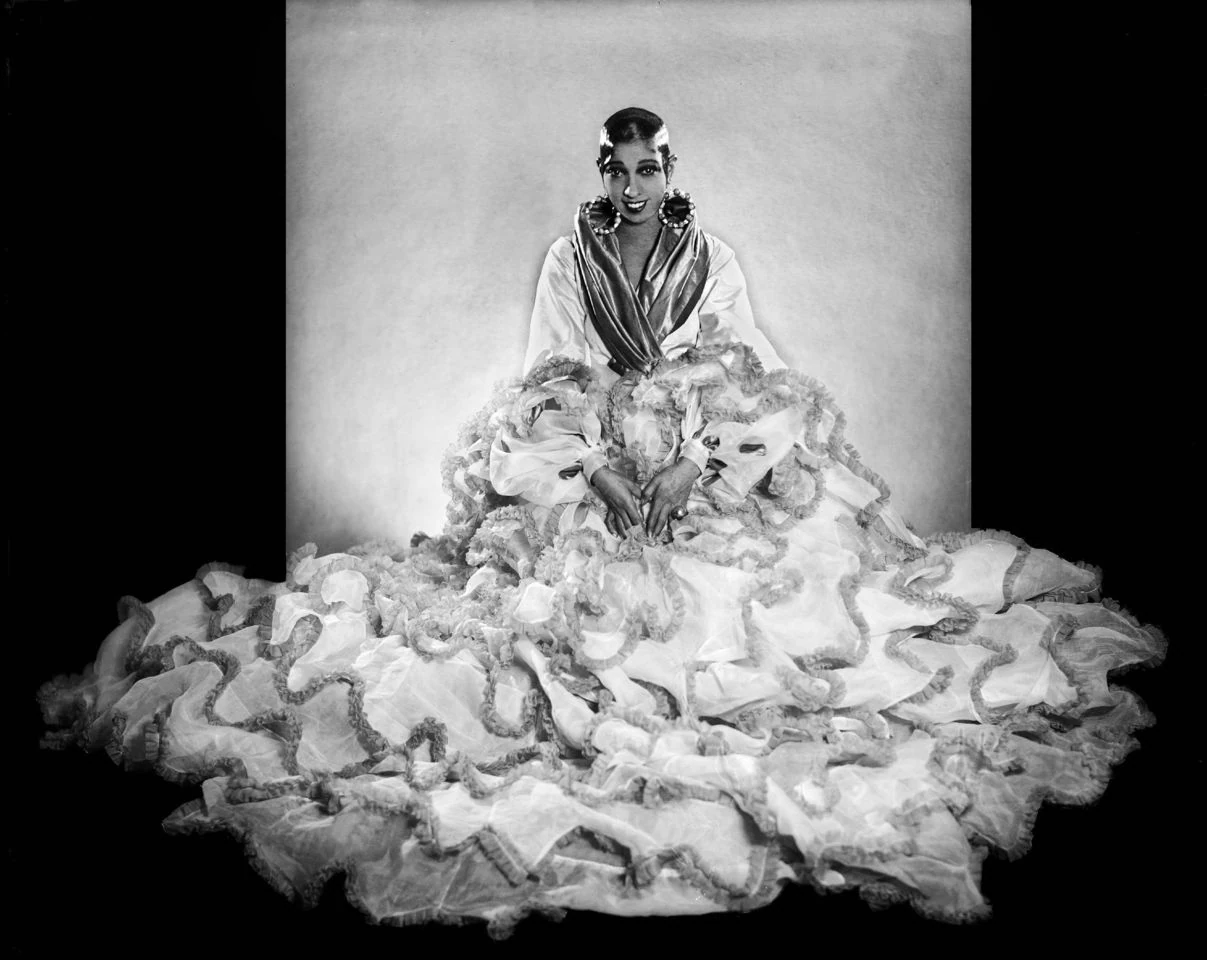
Josephine Baker’s career crossed continents and roles: dancer, singer, film star, French Resistance agent and civil rights campaigner. Born in St Louis, she became famous in Paris, where her daring performances made her an emblem of the Jazz Age. Britain enters her story not through a well-evidenced claim that she transformed British fashion, but through her appearance at the Royal Variety Performance at the London Palladium in 1974, her influence on the Charleston’s arrival in the United Kingdom, and later British theatre productions that returned her life to the stage.
From St Louis to the Paris stage
Born Freda Josephine McDonald in St Louis, Missouri, on 3 June 1906, Baker grew up in poverty. She left school at 12 and worked in domestic service and as a waitress before joining a street performance group. As a teenager she travelled to New York and found work in chorus lines, including the touring production of Shuffle Along. There, rather than disappear into the line, she used comic improvisation to attract attention. She later appeared in the revue The Chocolate Dandies.
In 1925, aged 19, Baker travelled to Paris with La Revue nègre. Her performance of Danse sauvage at the Théâtre des Champs-Élysées helped establish her as a star. The following year, in the Folies Bergère revue La Folie du jour, she wore the short skirt of artificial bananas that became one of the most recognisable images of her career. The costume and performance made her a sensation, but the attention she received was bound up with the period’s fascination with racialised ideas of the “exotic”. Her stage persona could be celebrated as modern and daring while also being framed by stereotypes.
Baker’s Paris success grew through theatre, music and film. She became the first Black woman to star in a major motion picture, the 1927 silent film Siren of the Tropics. She later appeared in films including Zouzou and Princesse Tam Tam. From 1930 she also sang professionally; “J’ai deux amours”, which expressed her attachment to both her country and Paris, became her best-known song. Her popularity in France did not translate into equivalent success in the United States. A 1936 Broadway revival of Ziegfeld Follies faltered, and she returned to Europe.
War work and a second public role
In 1937 Baker married French industrialist Jean Lion and became a French citizen. When war began in 1939, she was recruited as an “honourable correspondent” by the French military intelligence service. Her social access as a celebrated performer helped her gather information from people she encountered at parties and official gatherings. She passed reports to French intelligence and, when the service went underground, directly to London. The account of her wartime work also records cooperation with British intelligence.
After the German invasion of France, Baker left Paris for the Château des Milandes in the Dordogne. The house became a place of refuge for Resistance fighters and Jewish refugees; she helped provide documents and money. She later travelled in North Africa and entertained British, French and American troops. Her wartime service was recognised in France with the Resistance Medal, the Croix de Guerre and appointment as a Knight of the Légion d’honneur.
Her public life after the war was not confined to entertainment. In the United States she refused to perform for segregated audiences and challenged discrimination directly. In 1951 she protested after being refused service at New York’s Stork Club; the ensuing dispute with columnist Walter Winchell damaged her bookings. She continued to speak against racism, and in 1963 addressed the March on Washington alongside Martin Luther King Jr, wearing her Free French uniform and medal. These actions belonged to a transatlantic struggle, but her experience of discrimination in the United States and her standing as a French war hero gave her activism a distinctive authority.
A British appearance and a continuing stage life
Baker’s most clearly documented British performance came in 1974, when she appeared in the Royal Variety Performance at the London Palladium. The engagement followed a return to the stage at Carnegie Hall in 1973 and formed part of a later career in which she continued to perform despite exhaustion and financial difficulty. At the Palladium, a performer whose career had been made largely in France appeared before a British audience as an established international star.
Her connection with British performance culture reaches beyond that appearance. Writing in the BBC Magazine in 2014, historical dance teacher Darren Royston described Baker as the Beyoncé of her day and credited her with bringing the Charleston to the United Kingdom. That specific claim offers a more grounded account of her British cultural reach than broad assertions that she dictated British fashion. Her influence is also visible in theatre: Cush Jumbo’s play Josephine and I premiered at London’s Bush Theatre in 2013 and was later presented in New York. In 2021, a production of Josephine, co-written by Leona Allen and Jesse Briton, toured the UK, with Ebony Feare in the title role.
Baker’s later years brought further performances, including a retrospective revue at the Bobino in Paris in April 1975, marking 50 years in show business. Four days after its opening, she suffered a cerebral haemorrhage and died in Paris, aged 68. She was buried in Monaco. In 2021, a symbolic casket containing soil from places connected with her life was carried to the Panthéon in Paris; her remains stayed in Monaco. She became the first Black woman honoured in France’s secular memorial to its distinguished citizens.
Why Josephine Baker deserves a place in British Legacy
Baker’s place in British Legacy is not a claim that she was British, or that every element of her style can be traced into British fashion. It rests on specific cultural crossings. Her 1974 appearance at the London Palladium brought a performer shaped by Parisian stages and wartime service to a major British entertainment venue. The account of her role in popularising the Charleston in the United Kingdom points to a more direct effect on British dance culture. Later, British theatre-makers continued to interpret her life: Josephine and I premiered at the Bush Theatre, while a separate production toured the UK in 2021.
Her wider significance also lies in the combination of work those British audiences and artists encountered. Baker used performance to build an international career, then put her fame and access to practical use in wartime intelligence and support for people fleeing persecution. After the war, she challenged racial segregation, including by refusing to entertain segregated audiences and speaking at the March on Washington. Those achievements make her more than a glamorous image recalled from the Jazz Age. They show how performance can travel across borders, carry contested images of race and gender, and provide a public platform for action. Her British legacy is therefore best understood through documented performances, dance influence and later acts of theatrical remembrance, set within a life whose reach was international.
Sources
Josephine Baker — Wikipedia, revision 1379488469
Adapted in part from Josephine Baker by Wikipedia contributors, under CC BY-SA 4.0. Text has been edited and combined with the existing article; this adapted text is shared under the same licence. Contributor history.