
Julian Clary made a career out of being unmistakably himself. In heavy make-up and extravagant clothes, he took camp, innuendo and audience interaction from the alternative comedy scene into British television, stage shows and pantomime. His work ranged from the knowingly offbeat game show Sticky Moments with Julian Clary to West End musical theatre, novels and children’s books. The through-line was a comic persona that resisted the idea that a performer had to soften or conceal what made him distinctive.
From Teddington to the alternative comedy scene
Clary was born Julian Peter McDonald Clary on 25 May 1959 in Surbiton, Surrey, and grew up in Teddington, Middlesex, with two older sisters. His mother, Brenda, was a probation officer, and his father, Peter, a police officer. The family were Roman Catholic. Clary attended St Benedict’s School in Ealing before studying English and Drama at Goldsmiths’ College, University of London.
He began performing in the early 1980s, when alternative comedy offered space for acts that did not follow conventional stand-up patterns. Early characters included Gillian Pieface and The Joan Collins Fan Club. In another guise, Leo Hurll, he appeared as a fictional keyboard player for Thinkman, a pop project conceived by Rupert Hine. As The Joan Collins Fan Club, he paired theatrical make-up and deliberately flamboyant clothes with a stage act that included his dog, Fanny the Wonderdog.
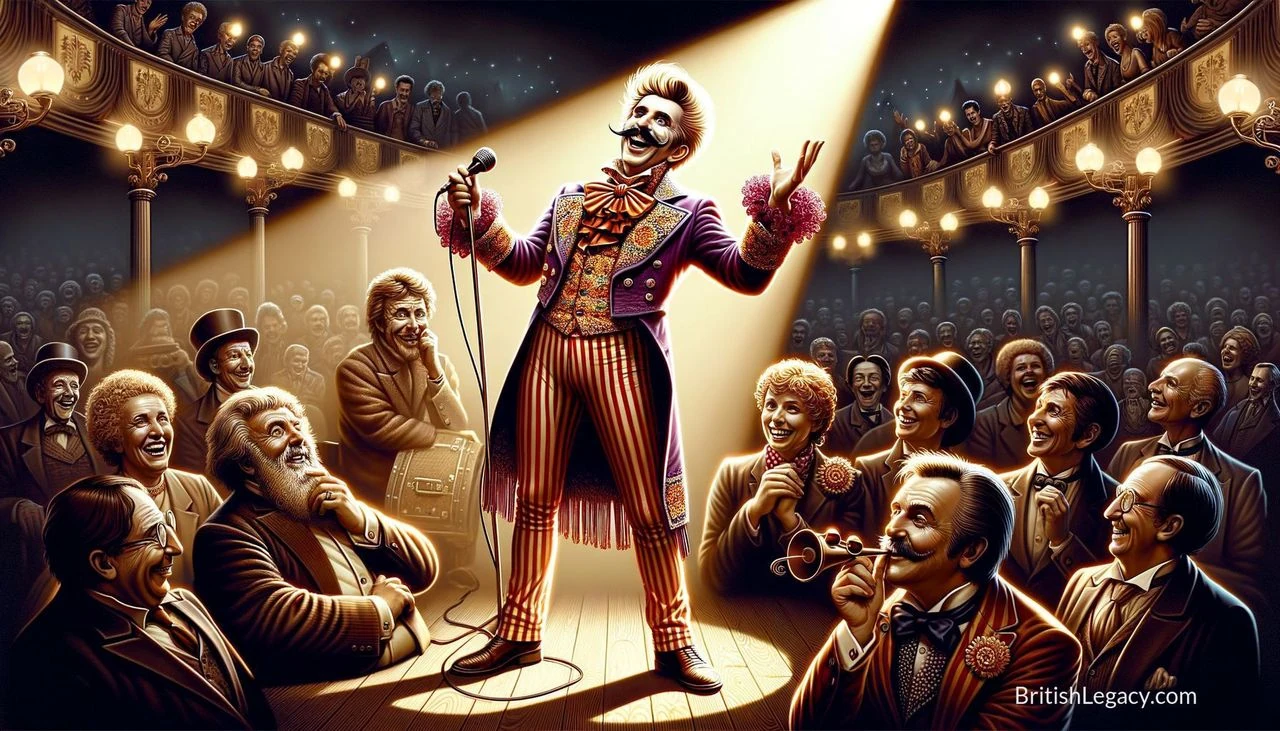
Clary’s comedy made his sexuality part of his public persona rather than something to hide. His act combined innuendo with direct exchanges with audiences: he might comment on a spectator’s clothes, flirt with men in the crowd or turn an interruption into a comic moment. The effect depended not only on the words but on the character delivering them, and on the contrast between polished presentation and mischievous provocation.
Television and the Clary persona
Television widened his audience. Clary appeared several times on Channel 4’s Friday Night Live in the mid-to-late 1980s. In 1989 he co-hosted ITV’s Trick or Treat with Mike Smith, then fronted Sticky Moments with Julian Clary on Channel 4. The programme used the shape of a quiz show as a comic framework: points could be awarded for reasons that had little to do with answering questions correctly. Its loose format suited a performer whose appeal rested on personality, timing and the playful disruption of television conventions.
In 1992, Clary and Lee Simpson starred in the Channel 4 audience-participation sitcom Terry and Julian. He also made appearances in drama and improvisational comedy, and later hosted the studio-based All Rise for Julian Clary, in which he played a judge in a mock courtroom. Other television work included the Sky series Prickly Heat, panel appearances on Have I Got News for You and a third-place finish on the BBC’s Strictly Come Dancing in 2004, partnered by Erin Boag.
His television career was not confined to comedy formats. Clary presented, judged and narrated programmes, and returned repeatedly to live entertainment. In 2012 he won the tenth series of ITV’s Celebrity Big Brother. The result brought a new generation of viewers to a performer whose career had already crossed stand-up, variety and television over several decades.
From the West End to the pantomime stage
Theatre became a substantial part of Clary’s working life. In 2002 he played Leigh Bowery in the London production of Taboo, returning for its UK tour in 2004. From 2007 to 2008 he played the Emcee in Rufus Norris’s West End production of Cabaret. A decade later, he appeared opposite James Nelson-Joyce in Le Grand Mort, a play written for him by Stephen Clark, at Trafalgar Studios 2.
Pantomime offered a different kind of theatrical home: a recurring place for comic character, audience participation and broad performance. Clary appeared in productions including Cinderella, Aladdin, Dick Whittington and Jack and the Beanstalk, often playing Dandini or a comic supernatural figure. He became a regular in the London Palladium pantomimes, appearing there in productions including Cinderella, Dick Whittington, Snow White and Goldilocks and the Three Bears. In 2019 he was inducted on to the Palladium’s Wall of Fame. In 2023 he joined the UK tour of Jesus Christ Superstar as Herod, and later played Seaman Smee in the Palladium’s Peter Pan.
These stage roles show the range of a performer often identified first with a single television image. Musical theatre required him to inhabit an existing production; pantomime placed his comic persona in a shared, live exchange with an audience. He also toured his own stage act, with shows including The Mincing Machine Tour, My Glittering Passage, Natural Born Mincer and The Joy of Mincing.
Books, radio and other work
Clary’s writing has moved between memoir, comedy and fiction. His early books included My Life with Fanny the Wonder Dog and How to Be a Man. A Young Man’s Passage recounts his life and career up to the 1993 British Comedy Awards. He later wrote the novels Murder Most Fab and Devil in Disguise, as well as the children’s series The Bolds, which began in 2015. In 2021, The Lick of Love: How Dogs Changed My Life told his life through his pets. His varied list of publications makes clear that his comic voice was not limited to a stage or screen character.
Radio provided another setting for his performance. In 1992, he presented the BBC Radio 1 show Intimate Contact, playing a genial problem-solver responding to callers with the help of reporter Hugh Jelly, performed by Philip Herbert. He has also appeared on BBC Radio 4’s Just a Minute. His musical performances included a comic recording of “Leader of the Pack” in 1988, released under the Joan Collins Fan Club name; it reached number 60 in the UK singles chart.
Clary’s work also includes film and a continuing presence in live entertainment. He appeared in Carry On Columbus in 1992 and later in The Baby Juice Express. In 2016 he was named an ambassador for the Adelaide Fringe, promoting the festival internationally. His career has therefore taken in formats with quite different demands: a short comic appearance, a recurring television character, a touring solo show, a West End role and books for young readers.
Visibility, comic freedom and the British stage
Clary’s open presentation of himself mattered as well as the jokes. His act made a gay comic persona visible in mainstream British entertainment without treating flamboyance as a problem to be explained away. That is a specific contribution, rather than proof that one performer alone changed public attitudes. His career placed camp performance and innuendo before television audiences, and then carried the same confident theatricality into live shows and family pantomime.
In 1993, his appearance at the British Comedy Awards became a widely discussed incident after he made a sexual joke about Norman Lamont, who had presented an award. The audience laughed, Lamont did not complain, and Clary was criticised in some newspapers. The episode belongs to the story of a comic style built to provoke, but it should not stand in for the breadth of his work. His subsequent television career continued, as did his stage and writing work.
Clary has also received recognition from universities: Goldsmiths made him an Honorary Fellow in 2005, and the University of East Anglia awarded him an honorary Doctorate of Civil Law in 2014. Those honours sit alongside a career whose reach is better measured through its range: alternative comedy, television, radio, books, musical theatre and pantomime. Across those settings, his stagecraft has remained identifiable while adapting to different audiences and forms.
Why Julian Clary deserves a place in British Legacy
Julian Clary deserves a place in British Legacy because he made a distinctive comic voice part of mainstream entertainment without sanding away its defining qualities. His early alternative-comedy characters, appearances on Friday Night Live and the unconventional game-show format of Sticky Moments brought camp performance and innuendo to television audiences. His act did more than rely on provocative lines: it used costume, character and direct audience exchange to make a recognisable form of performance. Clary’s visibility as an openly gay performer is an important part of that history, though it should not be inflated into a claim that one person single-handedly changed society.
His legacy also rests on the durability and breadth of his work. Clary moved between television, touring stand-up, radio, fiction, children’s books, the West End and the British pantomime tradition. Roles in Cabaret and Taboo called on different skills from a solo comedy tour; his repeated pantomime appearances brought his theatrical personality into a familiar seasonal form for audiences across the country. His writing extended that work to readers beyond the theatre and television audience. Together, these achievements connect a singular performance style with the wider British culture of live comedy, television entertainment and popular theatre.
Sources
Julian Clary — Wikipedia revision 1370852891 · Julian Clary — Wikipedia
Adapted in part from Julian Clary by Wikipedia contributors, under CC BY-SA 4.0. Text has been edited and combined with the existing article; this adapted text is shared under the same licence. Contributor history.
.JPG)