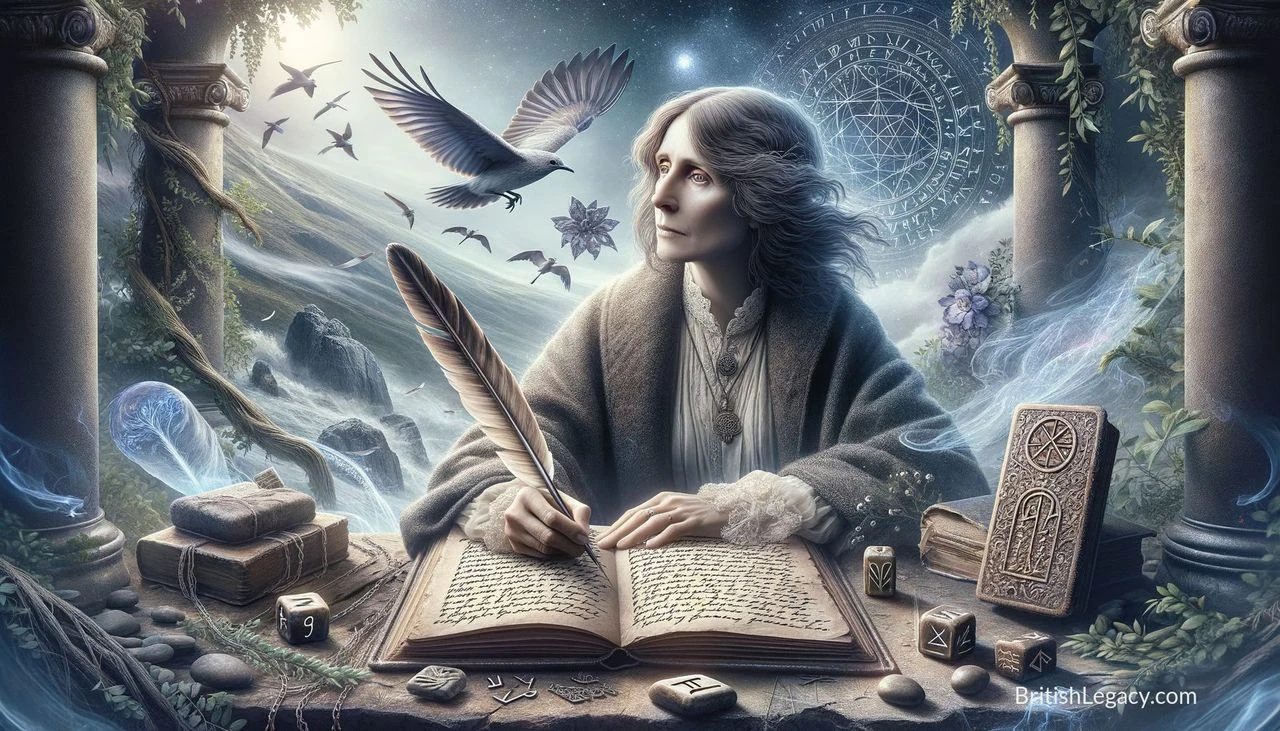
Kathleen Raine’s poetry joined a vivid sense of the natural world to a lifelong interest in spiritual and philosophical traditions. The landscape of Northumberland, where she spent part of her childhood, remained central to her imagination. She became not only a poet but also a scholar of William Blake, W. B. Yeats and Thomas Taylor, and a founding member of the Temenos Academy. Her career linked creative work with a conviction that poetry could carry ideas about nature, myth and the sacred.
Ilford and the Northumberland years
Raine was born Kathleen Jessie Raine in Ilford, Essex, on 14 June 1908. Her father, George Raine, was a schoolmaster and Methodist lay preacher; her mother, Jessie, was Scottish and spoke Scots as her first language. During the First World War, Raine spent a few years with her aunt Peggy Black at the manse in Great Bavington, Northumberland. She later described the place as an idyllic world and the foundation of her poetry. In her recollection, Northumberland was a place of belonging that she never forgot.
Poetry was present in her family life. Raine remembered her maternal relatives singing and reciting Scottish songs and ballads, while her father introduced her to literary poetry, Shakespeare and etymology. He had studied Wordsworth, and Raine saw Shakespeare plays as a child. Her mother encouraged her writing from infancy. These strands—oral tradition, literary study and close attention to place—formed part of the inheritance she later described in her poetry and autobiographical writing.
After County High School in Ilford, Raine went to Girton College, Cambridge, on an exhibition to study natural sciences, including botany and zoology. She received her master’s degree in 1929. At Cambridge she met Jacob Bronowski, William Empson, Humphrey Jennings and Malcolm Lowry. The combination of scientific study and poetic ambition gave her work a distinctive point of reference: the natural world was not simply scenery, but a subject for observation and reflection.
Poetry, scholarship and spiritual thought
Raine’s first collection, Stone and Flower, appeared in 1943, published by Tambimuttu and illustrated by Barbara Hepworth. It was followed by Living in Time in 1946 and The Pythoness in 1949. Her poems drew on nature, myth and spiritual ideas, with Platonism and Neoplatonism among the traditions that particularly interested her. Her work also engaged directly with other writers: Blake, Yeats and the Platonist Thomas Taylor became subjects of sustained study.
That scholarship was more than a parallel to her poetry. Her two-volume Blake and Tradition, published in 1969, developed from lectures she gave at the National Gallery of Art in Washington in 1968. The account of her career identifies her as the first woman lecturer in that series. The study argued for the antiquity, coherence and integrity of Blake’s philosophy, answering T. S. Eliot’s earlier assertion that it lacked such coherence. Raine also wrote on Yeats and Taylor, and edited a selection of Taylor’s work.
Alongside books of poetry and criticism, Raine wrote a three-volume autobiography: Farewell Happy Fields, The Land Unknown and The Lion’s Mouth. First published separately, the volumes were later gathered as Autobiographies. They return to the places and experiences that shaped her, setting individual memory within larger patterns. Her work in other forms included translations of Balzac’s Cousin Bette and Lost Illusions.
From Temenos to Collected Poems
Raine’s interest in spiritual symbolism also found an institutional home. In 1981, she co-founded Temenos, a periodical, with Keith Critchlow, Brian Keeble and Philip Sherrard. In 1990, the group established the Temenos Academy of Integral Studies. The academy stressed a universalist philosophy and explored connections among spirituality, literature and culture. Its creation extended Raine’s work beyond her own books, making space for teaching and discussion informed by the traditions she studied.
The Collected Poems of Kathleen Raine appeared in 2000, drawing on eleven previous volumes. It should not be confused with a single collection that represented the whole of her career from the outset: Raine had published earlier collected editions, including one covering poems from 1935 to 1980. The 2000 volume brought a wide body of poetry together for readers able to follow its development across decades. A later paperback edition was published by Faber and Faber in 2019.
Raine’s poems also reached audiences through music. Richard Rodney Bennett set her texts in Spells (1974–75), for soprano, chorus and large orchestra. Other composers, including Geoffrey Bush, Mike Oldfield, Nigel Butterley and Joseph Phibbs, made musical settings of her work. These settings show how her writing travelled beyond the printed page into song, choral music and orchestral composition.
Recognition and later life
Raine received the Cholmondeley Award in 1970 and the Queen’s Gold Medal for Poetry in 1992. In 2000 she was made a Commander of the Order of the British Empire and appointed a Commandeur of the Ordre des Arts et des Lettres. She also received honorary doctorates from universities in the United Kingdom, France and the United States. The awards recognised a career that crossed poetry, criticism and the study of literary and spiritual traditions.
She died in London on 6 July 2003, aged 95. The account of her death records that she died of pneumonia after being knocked over by a reversing car while posting a letter. Her writing and the institutions she helped establish outlasted her, as did the continuing presence of her poems in musical settings and collected editions.
Why Kathleen Raine deserves a place in British Legacy
Kathleen Raine merits a place in British Legacy because her work brought together several strands of British intellectual and literary life without reducing one to another. Her poetry drew on the remembered landscape of Northumberland and on traditions of song and ballad, while her studies of Blake and Yeats placed her in direct conversation with major writers of the English tradition. In Blake and Tradition, she made a sustained scholarly case for the structure and seriousness of Blake’s thought. That combination of creative practice and criticism gave readers a way to encounter poetry both as art and as a form of intellectual inquiry.
Her contribution also extended beyond her own publications. By helping to found Temenos and the Temenos Academy, Raine supported a continuing forum for exploring links among literature, spirituality and culture. Her poems, in turn, have been taken up by composers, while successive collected editions have made work from across her career available to new readers. These are specific forms of cultural influence: books that preserve and develop literary debate, an academy built around shared study, and poems that continue to generate new artistic interpretations. Raine’s British legacy lies in that durable connection between place, poetry, scholarship and institutions.
Sources
Kathleen Raine — Wikipedia revision 1373664563
Adapted in part from Kathleen Raine by Wikipedia contributors, under CC BY-SA 4.0. Text has been edited and combined with the existing article; this adapted text is shared under the same licence. Contributor history.