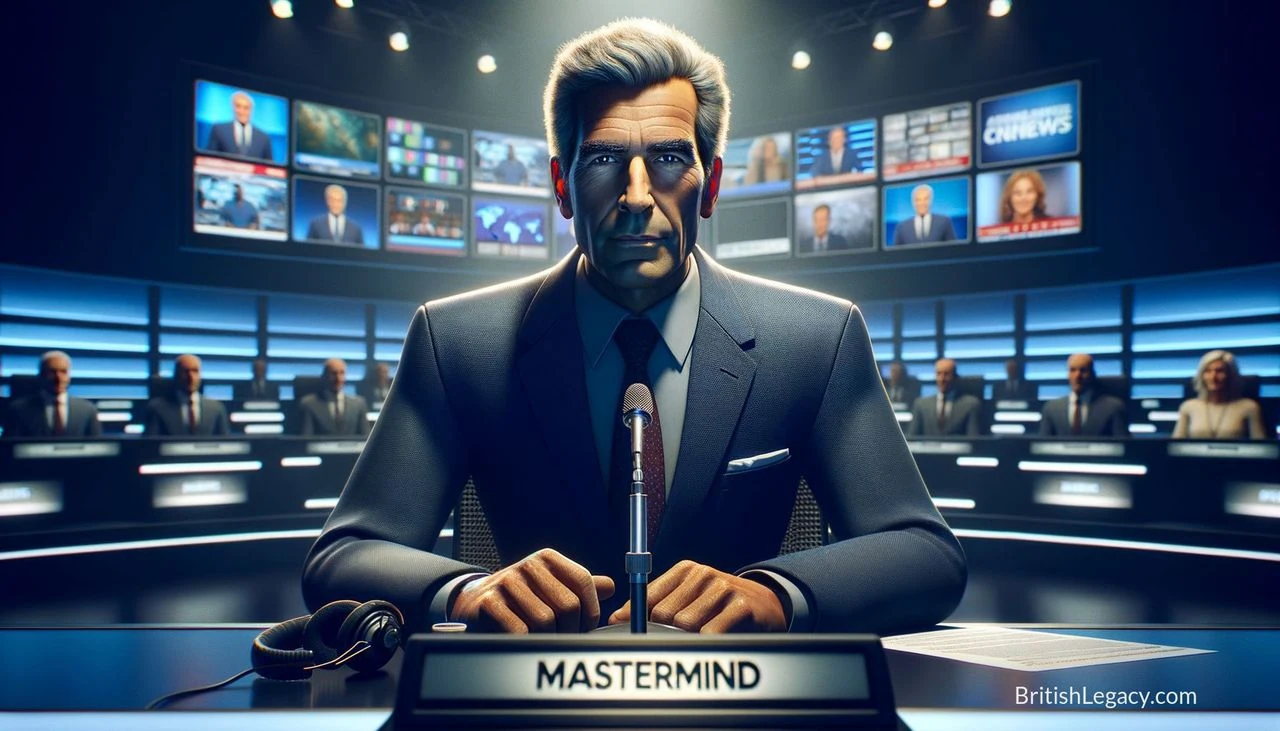
John Humphrys spent decades asking questions in front of a national audience. On BBC Radio 4’s Today, his challenging interviews made him one of British broadcasting’s most recognisable presenters; on television, he brought the austere black chair of Mastermind to a new generation of contestants. The work behind that public profile began in south Wales, in local newspapers, and took him from reporting in Liverpool to the BBC’s foreign bureaux and flagship news programmes.
A reporter from Cardiff
Humphrys was born Desmond John Humphrys on 17 August 1943 in Adamsdown, Cardiff. His mother, Winifred, was a hairdresser; his father, Edward, worked as a French polisher. One of five children, he attended Cardiff High School, then a grammar school. He left at 15 rather than go to university, and began as a reporter at the Penarth Times, a weekly local newspaper south of Cardiff. He later joined the Western Mail, gaining experience at a larger regional paper before moving into broadcasting.
He joined the commercial television channel Television Wales and the West, and was its first reporter at the scene of the Aberfan disaster in October 1966. The disaster killed 144 people and destroyed parts of the village. Later that year, Humphrys joined the BBC as district reporter for Liverpool and the north-west. His early BBC work included reporting on the dock strikes, sometimes for national news.
From foreign reporting to the Nine O’Clock News
Humphrys went on to work as a foreign correspondent. His assignments took him to the United States and South Africa, where the BBC sent him to open a news bureau. In 1974, he reported by satellite on US president Richard Nixon’s resignation. He covered the execution of Gary Gilmore in 1977 and, from South Africa, reported on the end of Rhodesia and the creation of Zimbabwe. The work brought international events into British homes, but the demands of life on the road eventually wore on him. He returned to London in 1980 to become the BBC’s diplomatic correspondent.
In 1981, he became the main presenter of the BBC’s flagship Nine O’Clock News, a role he held until 1987. His appointment came as the BBC changed the part played by news presenters: Humphrys and fellow presenter John Simpson were involved in preparing the broadcast, rather than simply reading a script written by others. He also made occasional appearances on television news in the 1990s. During the 1991 Gulf War, he volunteered as a presenter on BBC Radio 4’s News FM service.
The microphone and the black chair
Humphrys began presenting Today in January 1987, alongside Brian Redhead. The BBC Radio 4 breakfast programme became the setting for his best-known work: direct interviews with politicians and other public figures, in which he pressed guests to explain their positions. His style could be outspoken and challenging, and politicians sometimes criticised it after tough live broadcasts. He also presented the political television programme On the Record from 1993 until it ended in 2002, and presented Panorama.
One interview in particular became part of the programme’s history. On 11 November 2012, Humphrys questioned BBC director-general George Entwistle on Today about Entwistle’s lack of knowledge of a Newsnight investigation that had wrongly accused a senior Conservative figure of child abuse. Entwistle resigned later that day. Humphrys later said that he had not set out to humiliate him. The exchange illustrates the intensity of live broadcasting, as well as the scrutiny faced by people in positions of authority.
In February 2019, Humphrys announced that he would leave Today, saying he should have quit years earlier. His final edition aired on 19 September. His guests included Tony Blair, Dame Edna Everage and David Cameron. He had also taken on a very different kind of questioning: in 2003, he became the fourth regular host of the revived Mastermind, following Magnus Magnusson, Peter Snow and Clive Anderson. He hosted the programme and Celebrity Mastermind until 2021. His 735th and final episode aired on 26 April that year.
Beyond the news studio
Humphrys’s broadcasting work extended to religion, politics and popular culture. In 2006, he presented the Radio 4 programme Humphrys in Search of God, speaking with authorities on Christianity, Judaism and Islam as he examined his own agnosticism and childhood religious belief. He temporarily replaced David Dimbleby as host of Question Time in 2009. He also appeared as himself in the 2013 film Closed Circuit and in the television comedy The Life of Rock with Brian Pern.
He wrote books on language, food, religion and public life. Lost for Words criticised what he saw as the misuse of English; Beyond Words considered what language says about contemporary life. His other titles include The Great Food Gamble, In God We Doubt: Confessions of a Failed Atheist and the 2019 memoir A Day Like Today. He also co-wrote books with his son Christopher and with doctor Sarah Jarvis.
After leaving the BBC, Humphrys became a weekly columnist for the Daily Mail and presented a Sunday afternoon programme on Classic FM. His public comments have included criticism of what he saw as the BBC’s approach to Europe and immigration. In a 2014 interview, he described the BBC as broadly liberal rather than conservative and argued that its coverage had not been sufficiently sceptical of the pro-European and pro-immigration cases. In 2019, he said he considered himself a feminist. These views form part of the record of a broadcaster who made argument, not only delivery, central to his public work.
Family, awards and public service
Humphrys married Edna Wilding in 1964. They had two children, Christopher and Catherine, and separated in the late 1980s. Wilding died of cancer in 1997. In 2000, Humphrys and his then partner, broadcaster Valerie Sanderson, had a son, Owen. He has also spoken publicly about his agnosticism and, in his books and broadcasting, returned to questions of faith and belief.
His awards included Journalist of the Year at a ceremony organised by The House and Channel 4 in 2000, and a Gold Sony Radio Award in 2003. The Plain English Campaign awarded him a silver platter for Crystal Clear Broadcasting. He also received an honorary degree from Abertay University in Dundee. In 2005, he founded Kitchen Table Charities Trust, which collects donations and distributes small grants to projects, mostly in sub-Saharan Africa.
Why John Humphrys deserves a place in British Legacy
John Humphrys’s place in British broadcasting rests on the range of work he did across its principal forms. He reported for local and regional newspapers, covered major events as a foreign correspondent, presented the BBC’s Nine O’Clock News and spent more than three decades on Today. That career connected reporting from abroad with the daily examination of public affairs at home. On radio, his direct questioning made political interviews a prominent part of a programme heard at the start of the working day. The 2012 interview with BBC director-general George Entwistle showed how a live exchange could expose what a senior figure knew—and did not know—about a serious reporting failure.
His contribution was not confined to current affairs. As host of Mastermind, Humphrys presided over a format built around contestants’ specialist subjects and general knowledge, carrying on a programme that had already passed through several regular presenters. His work on language, religion and the BBC’s own assumptions extended the same appetite for examination beyond the interview studio. And through Kitchen Table Charities Trust, he established a practical channel for small grants to projects, mainly in sub-Saharan Africa. These are specific strands of a Welsh broadcaster’s career within British public life: journalism that questioned authority, television that invited audiences to value knowledge, and charitable work that directed donations towards community projects.
Sources
John Humphrys — Wikipedia, revision 1375305692
Adapted in part from John Humphrys by Wikipedia contributors, under CC BY-SA 4.0. Text has been edited and combined with the existing article; this adapted text is shared under the same licence. Contributor history.