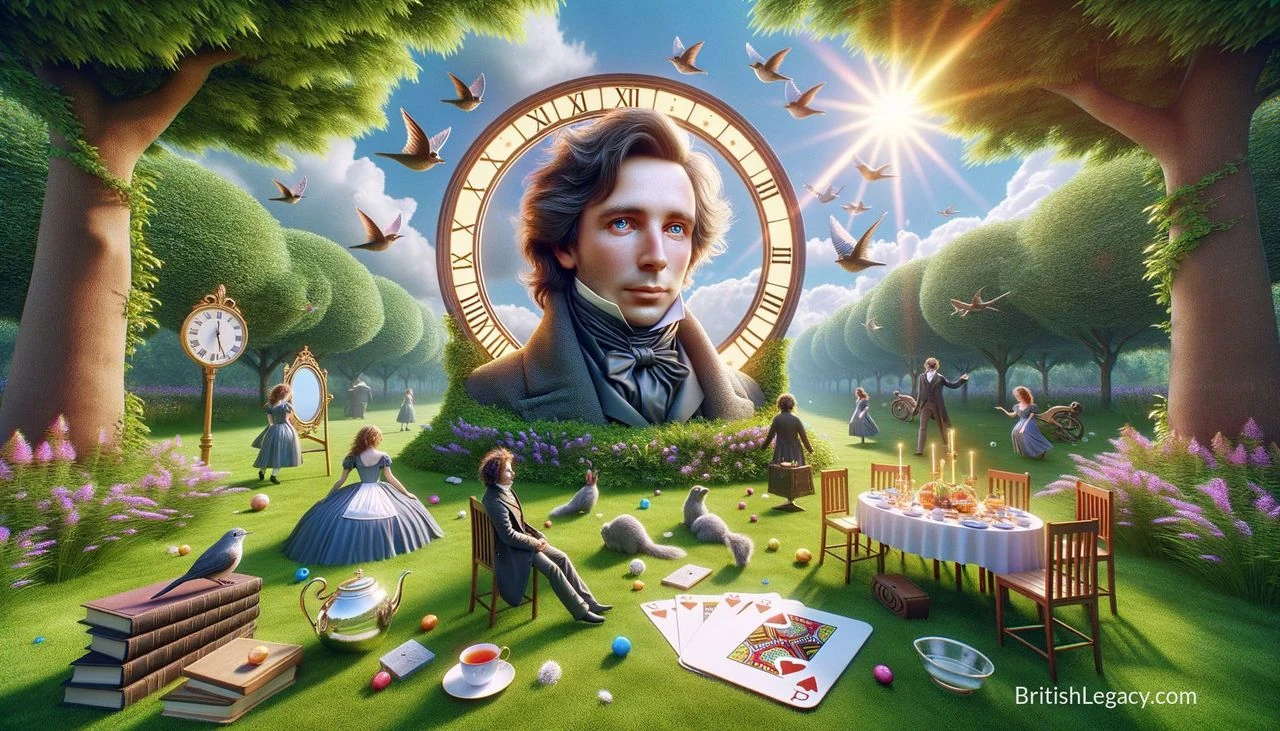
Lewis Carroll’s most famous invention was a world in which the rules kept changing. In Alice’s Adventures in Wonderland and Through the Looking-Glass, familiar logic becomes a source of comedy and surprise: a child falls down a rabbit hole, crosses into a world beyond a mirror and meets characters who treat language as a game. Their creator, Charles Lutwidge Dodgson, was not only a writer. He was a mathematician, photographer, teacher and Anglican deacon whose interest in puzzles and patterns ran through both his imaginative and academic work.
A scholar at Christ Church
Dodgson was born at All Saints’ Vicarage in Daresbury, Cheshire, on 27 January 1832. He was the third-oldest of eleven children and the oldest boy. When he was eleven, his father, Charles Dodgson, took up a new post at Croft-on-Tees in Yorkshire, and the family moved there. Dodgson was educated at home before entering Rugby School in 1846. He later described his school years as unhappy, although he excelled academically.
He went to Christ Church, Oxford, in 1850. After taking first-class honours in mathematics, he remained at the college as a scholar and teacher. In 1855 he became its mathematical lecturer, a post he held for 26 years. He also lived at Christ Church for most of his life. His professional work involved subjects including geometry, algebra, mathematical logic and recreational mathematics; he published mathematical books under his own name.
Mathematics was not a separate compartment from Carroll’s fiction. The unusual reasoning in the Alice books has often been considered alongside his interest in logic, and his published mathematical work included puzzles and arguments as well as formal studies. In 1895, for instance, he wrote “What the Tortoise Said to Achilles”, a philosophical argument about deductive reasoning. His talent for making rules visible, then testing what happens when they are stretched, served both the lecturer and the storyteller.
The story told on the river
Dodgson began writing poems and stories while young, and in 1856 he first published under the name Lewis Carroll. The pen name was formed by translating parts of his real name into Latin and back into English. He had met the Liddell family after Henry Liddell became Dean of Christ Church. On 4 July 1862, during a boating trip with the dean’s children, he told a story about a girl’s adventures underground. Alice Liddell asked him to write it down.
Dodgson eventually gave her a handwritten, illustrated manuscript, Alice’s Adventures Under Ground. Encouraged by the children of his friend George MacDonald, he took the work to a publisher. Expanded and substantially revised, it appeared as Alice’s Adventures in Wonderland in 1865, with illustrations by John Tenniel. The book introduced readers to a sequence of transformations, arguments and verbal puzzles, as well as characters including the Cheshire Cat, the Queen of Hearts and the Mad Hatter.
Alice Liddell is widely identified as the inspiration for the heroine, but Dodgson denied that the character was based on any real child. The distinction matters: the story’s origin lies in a particular friendship and afternoon, but the book became its own imaginative construction. Its humour depends not simply on nonsense but on the confident, often literal application of rules that no longer make sense in Wonderland.
The sequel, Through the Looking-Glass, and What Alice Found There, followed in 1871. Alice enters a world on the other side of a mirror, where the structure of a chess game shapes her journey. The book includes Tweedledum and Tweedledee, Humpty Dumpty and “Jabberwocky”, a poem whose invented words convey a vivid sense of sound and action. Dodgson’s other well-known nonsense poem, The Hunting of the Snark, appeared in 1876.
More than the Alice books
Carroll’s writing extended beyond fantasy. He produced poetry, mathematical works and puzzles, and his later fiction included the two-volume Sylvie and Bruno, published in 1889 and 1893. His interests also took practical form. In 1889, he devised the Wonderland Postage-Stamp Case, a small folder designed to organise stamps and encourage letter-writing. He invented the nyctograph, a gridded card and system of symbols that made it possible to take notes in the dark without lighting a lamp.
He also devised the word game “Doublets”, in which one word is changed into another by altering a single letter at each step, with each intermediate form remaining a word. The game appeared in Vanity Fair in 1879, and Carroll contributed a weekly column about it until 1881. His work on voting systems and mathematical logic reflected the same appetite for orderly procedures and their consequences.
Photography was another sustained pursuit. Dodgson took it up in 1856 and made portraits of artists, writers and other notable sitters, alongside photographs of children, adults and landscapes. He stopped in 1880, after producing a substantial body of work. His different activities shared a close attention to form: a photograph’s arrangement, a puzzle’s rules or a sentence’s double meaning could each reward close looking.
Life, death and remembrance
Dodgson remained connected to Christ Church as a teacher and resident long after the Alice books had made him famous. He died in Guildford, Surrey, on 14 January 1898, following influenza and pneumonia, and was buried at Mount Cemetery. His life and work are commemorated in several British places associated with him: a memorial stone was unveiled in Poets’ Corner at Westminster Abbey in 1982, and stained-glass windows at All Saints’ Church in Daresbury depict characters from the Alice books. The Lewis Carroll Centre, attached to the church, opened in 2012.
Why Lewis Carroll deserves a place in British Legacy
Carroll’s place in British literary history rests first on the achievement of the Alice books. Their lasting power comes from more than their cast of instantly recognisable characters. By giving language and logic comic, concrete consequences, he made readers alert to how words work and how rules can be questioned. The books have travelled far beyond their Victorian setting, but their distinctive combination of invention, argument and play remains associated with the English literary tradition. “Jabberwocky” and the Alice stories also show how a writer can create memorable meaning without relying on ordinary sense alone.
His legacy is equally valuable for the way it connects literature with other kinds of thought. Dodgson’s mathematical career at Christ Church, his puzzles and word games, and his small inventions all show a mind drawn to structures that people could test and use. His writing does not ask readers to choose between precision and imagination: it makes the collision between them its subject. British commemorations at Westminster Abbey and Daresbury give that achievement a visible home, while the books continue to invite new readers into their puzzles. Remembering Carroll means recognising both a major Victorian storyteller and a creator whose curiosity crossed disciplinary boundaries.
Sources
Adapted in part from Lewis Carroll by Wikipedia contributors, under CC BY-SA 4.0. Text has been edited and combined with the existing article; this adapted text is shared under the same licence. Contributor history.