Lorraine Kelly’s broadcasting career has moved between Scottish and national television, news reporting and breakfast entertainment. She joined BBC Scotland as a researcher in 1983, became a reporter for TV-am the following year, and went on to present Good Morning Britain, GMTV and her long-running ITV programme, Lorraine. Her career also includes work for STV, charity campaigning and university service, making her a familiar presence across several parts of British public life.
From Glasgow to the newsroom
Kelly was born in Glasgow on 30 November 1959. She lived in the Gorbals until she was two, then grew up in Bridgeton and East Kilbride. Her father, John, worked as a television repairman. She attended Strathclyde Primary and John Street Secondary School in Glasgow, followed by Claremont High School after the family moved to East Kilbride.
Rather than take up a university place to study English and Russian, Kelly began work at her local paper, the East Kilbride News. In 1983 she joined BBC Scotland as a researcher. The following year she moved to TV-am as an on-screen reporter covering Scottish news. That transition—from local journalism to national broadcasting—set the pattern for a career in which reporting and presenting remained closely linked.
Kelly’s coverage of the Pan Am Flight 103 disaster at Lockerbie brought her wider attention. In 1989, she presented TV-am’s Summer Sunday programme with chief reporter Geoff Meade, and later that year she began covering the weekday presenters. On 31 January 1990, she became a main presenter of Good Morning Britain alongside Mike Morris. These early roles established her in the developing field of British breakfast television, where current affairs shared the screen with lighter features.
Making a place at GMTV
When GMTV launched in January 1993, Kelly presented a range of programmes, beginning with Top of the Morning. In March, after Fiona Armstrong left the main programme, Kelly moved into the principal breakfast show alongside Eamonn Holmes. Her route into the role was not uninterrupted: she went on maternity leave in 1994 and was subsequently removed from the main presenting team. She returned later that year to present a mother-and-baby slot.
That return led to a new strand of work. Kelly became presenter of Nine O’Clock Live; its popularity saw it move to an earlier slot and take the name Lorraine Live. She also presented a daily radio programme on Talk Radio around 1997–99, extending her breakfast-time presence beyond television.
As GMTV changed its branding, Kelly’s programme changed with it. It became LK Today in 2000 and, after another rebrand in 2009, GMTV with Lorraine. In April 2010, the programme began running throughout the year rather than taking breaks during school holidays, with guest presenters covering those periods. Kelly’s work at GMTV was therefore not simply one long, unchanged presenting role: the programme and its place in the schedule evolved around her.
A programme bearing her name
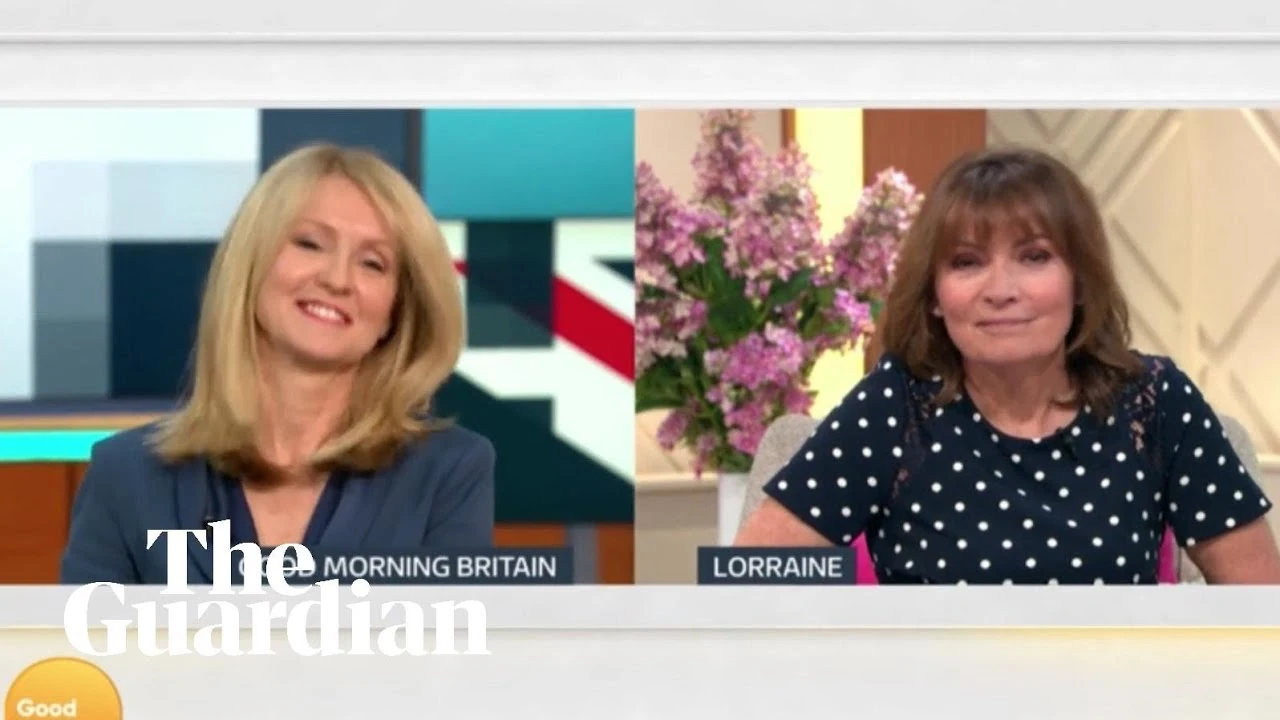
When GMTV ended in September 2010, ITV Breakfast took over, and Kelly’s new programme, Lorraine, launched alongside Daybreak. It carried forward the strand she had developed within GMTV, now as a distinct show under her own name. The programme’s continuing place in ITV’s morning schedule has made it the most recognisable title associated with her career.
Kelly’s work has extended beyond that programme. She presented Daybreak from 2012 to 2014, initially with Aled Jones from Monday to Thursday and Kate Garraway co-hosting on Fridays. In February 2014, she announced she would leave Daybreak to concentrate on Lorraine, which she began presenting five days a week that April. She has also appeared as an occasional reporter on Good Morning Britain and presented or contributed to programmes for Channel 5, BBC One and STV.
Her television work includes a range of formats beyond the breakfast sofa: she presented the documentary series Penguin A&E with Lorraine Kelly, co-presented Wedding Day Winners with Rob Beckett, and hosted STV’s annual Children’s Appeal. She has also narrated the children’s programme Raa Raa the Noisy Lion and served as the United Kingdom’s Eurovision vote spokesperson in 2003 and 2004. These roles show the breadth of her broadcasting career, from children’s television and entertainment to charity and live events.
Scottish broadcasting, charity and public service
Kelly’s work for Scottish television has been a lasting part of her career. Since 2011 she has hosted STV’s Children’s Appeal, and she has presented other STV programmes, including Lorraine & Friends and a Hogmanay broadcast. Her connection with Dundee also took a university form: she was elected the University of Dundee’s first female rector in 2004 and held the position until 2007. The university later awarded her an honorary Doctor of Laws for her services to charity.
Her charity commitments include serving as a celebrity patron of Worldwide Cancer Research and as a patron of POhWER and Help for Heroes. She has also been an ambassador for Sightsavers and for the STV Children’s Appeal. In 2011, she took part in Comic Relief’s BT Red Nose Desert Trek in the Kaisut Desert; the trek raised £1,375,037. These activities give substance to the relationship between her public profile and charitable work, beyond the broad claims of advocacy often attached to television personalities.
Kelly’s honours reflect both broadcasting and service. She was appointed an Officer of the Order of the British Empire in the 2012 New Year Honours for services to charity and the armed forces, then promoted to Commander of the Order of the British Empire in the 2020 Birthday Honours for services to broadcasting, journalism and charity. She received a special Scottish BAFTA in 2014 recognising her television career and a special BAFTA award in 2024. Her academic honours include the University of Dundee’s Doctor of Laws and an honorary Doctor of Arts from Edinburgh Napier University.
Why Lorraine Kelly deserves a place in British Legacy
Lorraine Kelly deserves a place in British Legacy because her career connects local Scottish journalism with the development of national breakfast television. She began at the East Kilbride News, joined BBC Scotland, and moved to TV-am as a reporter covering Scottish stories. From Good Morning Britain to GMTV, she became part of a format that brings news and information into the start of the day for audiences across the UK. The detail of her career matters: she returned to GMTV in a different role after maternity leave, built a successful programme within the schedule, and carried that strand into the independently titled Lorraine when ITV Breakfast replaced GMTV.
Her legacy also rests on a sustained relationship with Scottish institutions and charitable work. Hosting STV’s Children’s Appeal and serving as rector of the University of Dundee linked a national television career to public life in Scotland. Her patronage and ambassador roles, alongside the honours recognising charity, the armed forces, broadcasting and journalism, show how that public role has extended beyond presenting. The story is not simply one of longevity or popularity. It is a record of work across reporting, television formats and charitable causes, rooted in Scotland and carried into the everyday routines of British television viewers.
Sources
Lorraine Kelly (revision 1378884356) · Lorraine Kelly
Adapted in part from Lorraine Kelly by Wikipedia contributors, under CC BY-SA 4.0. Text has been edited and combined with the existing article; this adapted text is shared under the same licence. Contributor history.