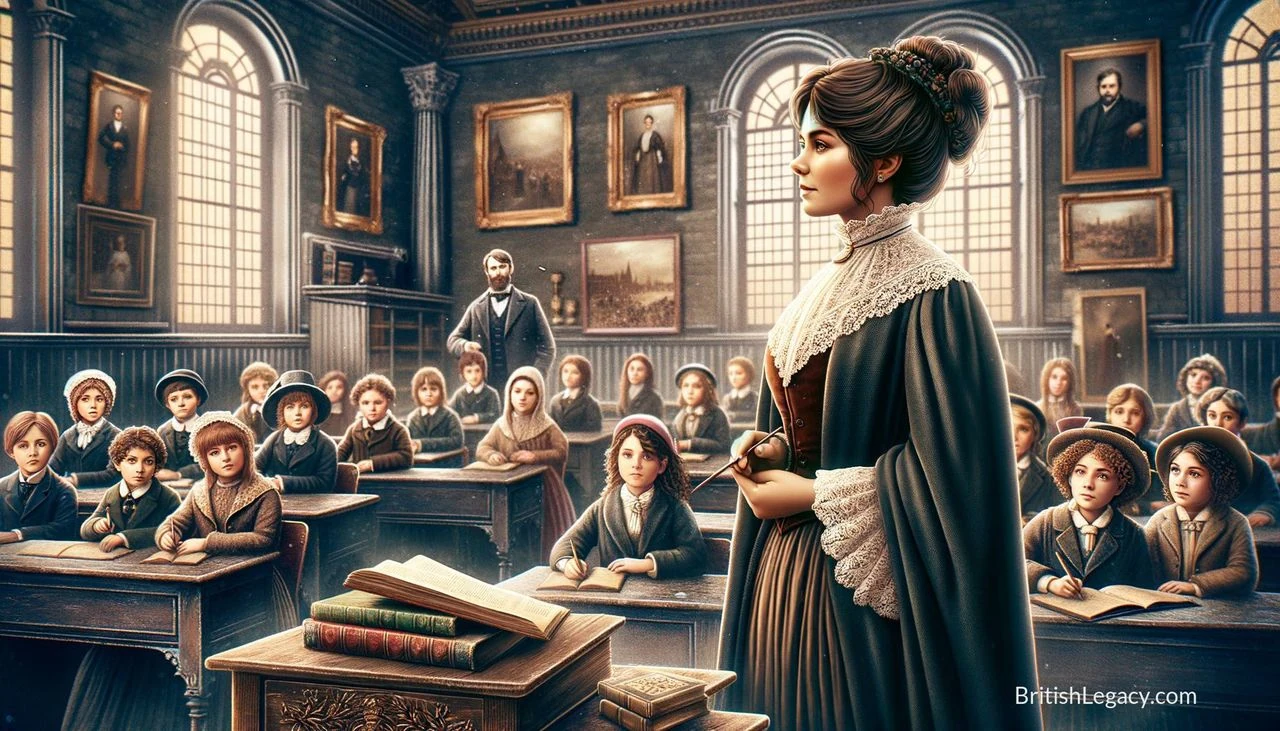
Maria Georgina Grey’s campaign for girls’ education took shape in public meetings, newspaper letters and practical institutions. With her sister Emily Shirreff, she helped organise a national union in 1871 and establish the Girls’ Public Day School Company the following year. The work addressed both the lack of secondary schooling for girls and the shortage of suitable routes into teaching. Grey’s contribution was not only to argue for change, but to help build organisations capable of carrying it forward.
A self-directed education
Born Maria Georgina Shirreff in Blackheath, London, on 7 March 1816, she was the third daughter of Admiral William Henry and Elizabeth Anne Shirreff. The family lived in France during part of her childhood. Maria and her sisters were initially taught at home by a governess, then Maria and Emily attended a boarding school in Paris from 1828. They left the following year because of Emily’s poor health. Their formal schooling ended early, but the sisters continued their education through reading, travel and study of languages.
In 1834 their mother brought the sisters back to England, where Maria and Emily began writing together. Their first book, Letters from Spain and Barbary, appeared in 1835; they published the novel Passion and Principle anonymously in 1841. In 1841 Maria married William Thomas Grey, a wine merchant. The sisters remained close and continued their writing and intellectual collaboration.
Their 1850 treatise, Thoughts on Self-Culture Addressed to Women, made a direct case for a broader education. It challenged the view that girls needed only enough learning to attract a husband, and proposed subjects including arithmetic, geometry, history, elementary science and politics. The authors also argued that women’s education should continue beyond the point at which it was commonly considered complete. These arguments anticipated the practical work Grey would later pursue in public life.
From argument to organised action
After William Grey’s death in 1864, Maria took a more active role in public affairs and joined Emily’s work to improve girls’ education. She was particularly concerned by the lack of funding. In 1870 she wrote repeatedly to The Times to raise money for the North London Collegiate School for Girls, and encouraged its head, Frances Buss, to introduce student teachers.
That year Grey also stood, unsuccessfully, for election as a representative for Chelsea on the London School Board. She was among the first women to seek election to the board. Her addresses were published as The School Board of London. Grey regarded the experience as a turning point, and it helped direct her and Emily towards a wider campaign for women’s education. She also connected education to civic participation: in 1870 she published Is the Exercise of the Suffrage Unfeminine? and argued that girls should be prepared for increased civil responsibilities.
In 1871 Grey proposed a national movement to promote women’s education, first presenting her scheme to the Society of Arts. She set out the proposal again at the Social Science Association’s annual congress in Leeds. The sisters then formed a provisional committee for the National Union of the Improving the Education of Women of All Classes, later known as the Women’s Education Union. Its aim was to establish good, affordable day schools for girls from all classes above elementary level. Emily served as its organising secretary until 1879, while both sisters took an active role.
Schools and the next generation of teachers
The union’s work led to the formation in 1872 of the Girls’ Public Day School Company, established to provide new secondary schools for girls from different social classes. Grey served on its council until 1890, when ill health prevented her from continuing, and was made a vice-president. The company’s purpose was practical: to create schools where girls could receive a more substantial education than the limited instruction criticised in the sisters’ earlier writing.
Grey also recognised that expanding schools required trained teachers. She encouraged the company to establish teacher-training departments and, in 1878, helped found a training college with the Teachers’ Training and Registration Society. In 1885 the college was renamed the Maria Grey Training College for Women. It later merged with Borough Road College in 1976 to form the West London Institute of Higher Education, now part of Brunel University.
Her public work continued alongside writing and speaking. Among her publications were On the Education of Women, a paper read to the Society of Arts in 1871, and Last Words to Girls on Life in School and after School, published in 1889. The range of her activity—campaigning, institution-building and writing—helped make the case for girls’ education both an argument about opportunity and a programme of concrete provision.
Retirement and remembrance
Grey continued to speak and write during the 1880s, but by 1890 ill health had curtailed her public work. She lived in retirement for the final 15 years of her life. Emily died in 1897. Maria died on 19 September 1906 at her home in Kensington, London, where she had lived with her sister.
Grey’s work is remembered in the institutions she helped establish and in the training college that bore her name. Her books also preserve the reasoning behind her campaign: education should equip girls for more than a narrowly prescribed role, and learning should not end when society deemed it sufficient for marriage. Those arguments sat alongside practical efforts to raise funds, organise schools and prepare teachers.
Why Maria Georgina Grey deserves a place in British Legacy
Maria Georgina Grey deserves a place in British Legacy because she helped turn the case for girls’ education into organised, durable work. Her contribution joined public advocacy to institution-building: she wrote to raise funds for the North London Collegiate School for Girls, stood for election to the London School Board, helped organise the Women’s Education Union and served on the council of the Girls’ Public Day School Company. These were distinct forms of effort, directed towards access to schooling and a stronger public recognition of women’s educational needs.
Her work also addressed what would make expanded education sustainable. Grey encouraged teacher-training departments and helped found a training college for women teachers, which later carried her name. That focus on preparing teachers connected the growth of girls’ schools with the people needed to teach in them. Her writing with Emily Shirreff supplied the intellectual basis for this work, arguing for serious study—including mathematics, science, history and politics—and for education continuing into adult life. Together, these achievements show a British reformer working across ideas, institutions and professional training. Her legacy lies not in unsupported claims of worldwide transformation, but in the specific organisations and educational opportunities she helped set in motion.
Sources
Adapted in part from Maria Georgina Grey by Wikipedia contributors, under CC BY-SA 4.0. Text has been edited and combined with the existing article; this adapted text is shared under the same licence. Contributor history.