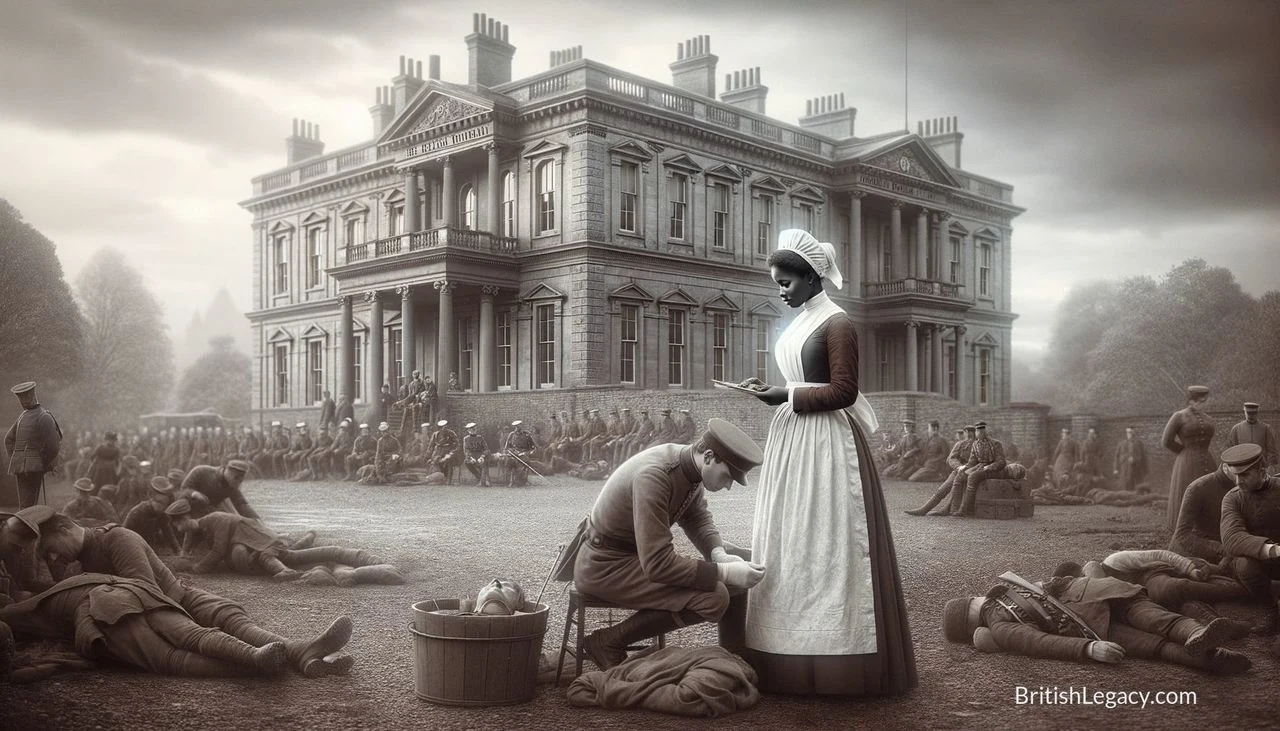
Mary Seacole reached the Crimean War not as a member of Florence Nightingale’s nursing detachment but as a businesswoman who had made her own way across continents. In 1855 she opened the British Hotel near Balaclava, intending to provide comfortable quarters for sick and convalescent officers. It became a place to buy meals and provisions, while Seacole herself also went out to assist wounded soldiers. Her story brings together Caribbean medical traditions, resourceful enterprise and a determined journey into a conflict from which official nursing organisations had not taken her.
Kingston and the making of a healer
Mary Jane Grant was born in Kingston, Jamaica, on 23 November 1805. Her mother, Mrs Grant, ran Blundell Hall, a boarding house that also cared for military and naval personnel recovering from illness. Known as “The Doctress”, she used herbal remedies and traditional healing practices. Seacole learned from her mother and from observing military doctors. The boarding house gave her experience in caring for patients and a practical understanding of warmth, cleanliness, rest, food and attention to the sick.
Seacole later described herself as a Creole and took pride in her Jamaican and Scottish ancestry. Her father, James Grant, was a Scottish lieutenant in the British Army. As a young woman she travelled to London and returned to Jamaica with West Indian goods to sell. She also visited parts of the Caribbean, including Cuba, the Bahamas and Haiti, and worked alongside her mother at Blundell Hall. She sometimes provided nursing assistance at the British Army hospital at Up-Park Camp.
In 1836 she married Edwin Horatio Hamilton Seacole. They opened a provisions store in Black River, but the business did not prosper, and the couple returned to Blundell Hall. A fire destroyed much of the boarding house in 1843. Edwin died the following year, and Seacole’s mother died soon afterwards. Seacole took over the management of the rebuilt establishment. In 1850, during a severe cholera epidemic in Jamaica, she cared for patients there.
Business and medicine across the isthmus
Seacole’s next journey took her to Panama, where her half-brother Edward had established a hotel serving travellers crossing the isthmus during the California Gold Rush. She reached Cruces in 1851, as cholera spread through the town. She treated patients, charging those who could pay and caring for people who could not. Her methods included mustard poultices and rehydration. She contracted cholera herself and recovered.
Seacole also opened a British Hotel in Panama, but it was a restaurant rather than a conventional lodging house. The business served people making the arduous journey between the coasts. After moving to Gorgona, she briefly ran a hotel for women. She returned to Jamaica in 1852 and, in 1853, was asked by the island’s medical authorities to help care for people suffering in a severe yellow-fever outbreak. Her experience was practical and varied, though it should not be mistaken for formal medical training.
By early 1854, Seacole was back in Panama, settling business affairs and working at a mining establishment. News of the war with Russia reached her there. Some soldiers due to serve in Crimea were men she had previously nursed in Jamaica. She decided to go to England and offer her services.
Building the British Hotel
In London, Seacole sought a place in the nursing effort. Her own account describes approaches to the War Office, the Crimean Fund and people associated with Nightingale. She did not begin these inquiries until Nightingale’s first nursing party and a later contingent had already left. The available places were filled, and Seacole was not selected. She then chose to travel at her own expense, in partnership with Thomas Day, a Caribbean acquaintance and relation of her late husband.
Seacole sailed for Constantinople in January 1855 and went on to Balaclava. She selected a site at Spring Hill, near Kadikoi and on the British supply route towards Sevastopol. The British Hotel, built using salvaged materials and local labour, opened in March. It was planned as a mess table and comfortable quarters for sick and convalescent officers. After advice from the French chef Alexis Soyer, who visited soon after its opening, Seacole concentrated on food and drink rather than providing beds. The establishment also sold provisions and catered beyond its premises.
The hotel’s commercial work was only one part of Seacole’s presence in the Crimea. She nursed sick and wounded men, sold provisions near the British camp and went out towards the fighting. She also offered tea to ill and injured soldiers waiting to be moved at Balaclava. The extent and significance of her medical work have been debated; it is more accurate to describe these distinct activities than to call the hotel a hospital or to claim that she led an official nursing service. Soldiers called her “Mother Seacole”. The war correspondent William Howard Russell praised her assistance to the wounded and her readiness to go near the battlefield.
Seacole’s business prospered while the army remained, but the end of the war brought financial difficulty. After the Treaty of Paris was signed in March 1856, Allied troops left the Crimea. Seacole had unsold goods and creditors to pay; she auctioned stock and returned to Britain poorer than she had left. Her experience illustrates the risks of the enterprise that had enabled her to reach and support the troops.
Return to Britain and a written record
Back in Britain, Seacole’s financial troubles continued. A canteen venture with Day at Aldershot failed, and she was declared bankrupt in November 1856. Public attention and fundraising helped her and Day obtain discharge from bankruptcy the following January. A large military festival held in her support in 1857 raised money, although Seacole received only part of its profits. The episode was not a simple story of a grateful public securing lasting prosperity: despite prominent supporters, she had to contend with continuing financial strain.
In 1857 she published Wonderful Adventures of Mrs Seacole in Many Lands, an account of her travels and experiences. It records her years in Panama and the Crimea, including the practical business of feeding and supplying officers as well as her encounters with soldiers. The book is recognised as the first autobiography written by a Black woman in Britain. Its vivid first-person account preserves Seacole’s own voice, but also places her achievements within the wider history of travel, commerce and nursing.
Seacole returned to Jamaica in 1860 and later came back to London. She died at her home in Paddington on 14 May 1881. Her story faded from much public memory in Britain for nearly a century. Her grave was rediscovered in 1973, and her reputation has since been commemorated through memorials, public history and institutions bearing her name. In 2004 she topped an online poll of 100 Great Black Britons. A statue of Seacole by Martin Jennings was unveiled at St Thomas’ Hospital in London on 30 June 2016; its location and the interpretation of her place in nursing history have prompted debate.
Why Mary Seacole deserves a place in British Legacy
Mary Seacole’s place in British history rests on specific work, not on a need to turn her into a symbol without complication. She brought experience gained in Jamaica and Central America to the Crimea, where she created an independent base near the British forces. The British Hotel was a business, not an official hospital, but it supplied food and provisions to officers; Seacole also cared for sick and wounded men and went out to assist soldiers near the fighting. Her actions mattered to people facing illness, injury and difficult conditions far from home. The distinction between her commercial work and her nursing makes her achievement clearer, not smaller.
Her life also connects Britain’s history to Jamaica and the wider Caribbean. Seacole travelled, traded and practised forms of care learned from her mother, and later wrote about those experiences in a pioneering autobiography. Her efforts to join the official nursing service, followed by her decision to travel independently, show how a woman outside established institutions could still find ways to serve. Remembering her in Britain means recognising both the contribution she made to soldiers and the resourcefulness with which she built her own route to the Crimea. It also means treating her legacy with accuracy: her work deserves attention without overstating her formal role or reducing her story to a contest with Florence Nightingale.
Sources
Mary Seacole (revision 1379862214) · Mary Seacole
Adapted in part from Mary Seacole by Wikipedia contributors, under CC BY-SA 4.0. Text has been edited and combined with the existing article; this adapted text is shared under the same licence. Contributor history.