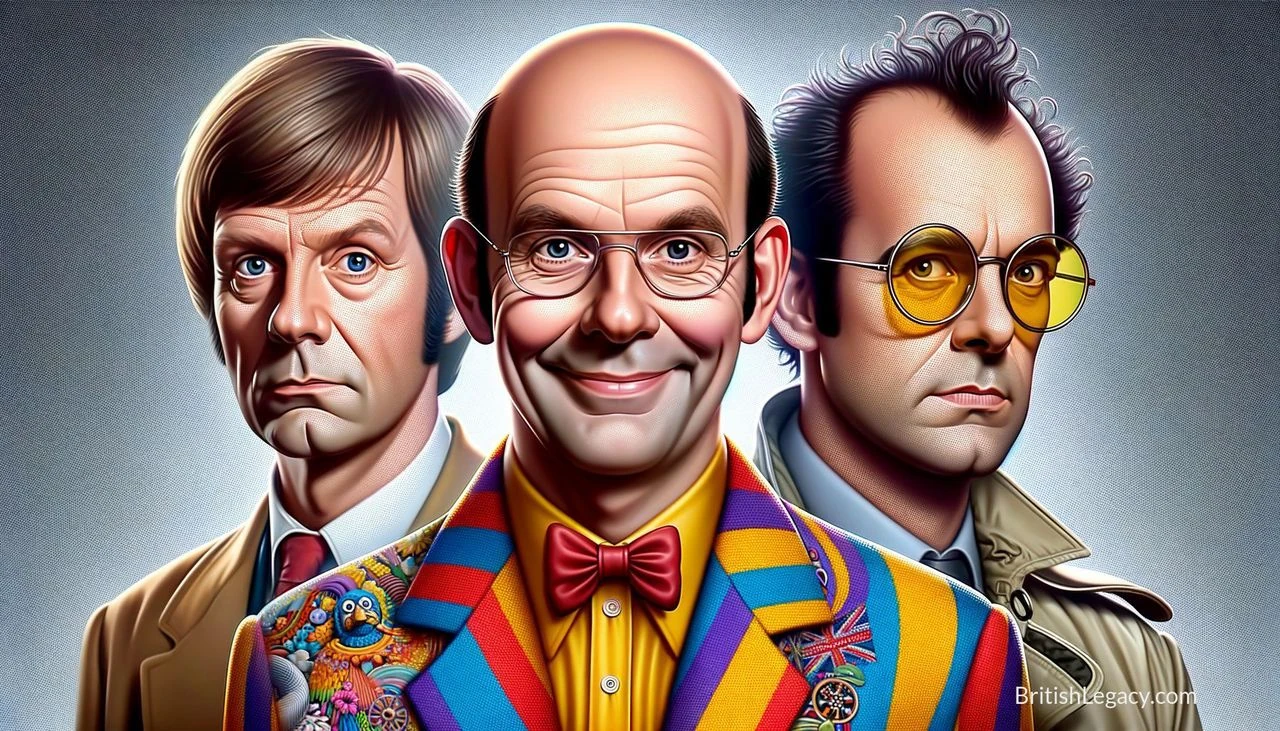
Matt Lucas’s career has moved between the deliberately absurd world of sketch comedy and the disciplined demands of stage and screen acting. He became widely known through Little Britain, the BBC comedy he wrote and performed with David Walliams, but that was one chapter in a working life that began on television in the 1990s and has included Doctor Who, West End musicals and The Great British Bake Off.
Early television and a creative partnership
Matthew Richard Lucas was born in Paddington, London, on 5 March 1974. He studied drama at the University of Bristol from 1992 to 1995 but did not complete his degree. He also spent time with the National Youth Theatre, where he met David Walliams, who would become his long-term comedy collaborator.
Lucas’s first television work included appearances with Vic Reeves and Bob Mortimer. He became a regular on Shooting Stars, playing George Dawes, a giant baby who sat at a drum kit and delivered the scores. He also played George’s mother, Marjorie Dawes, a character who would later appear in Little Britain. These roles established an early pattern: Lucas could build a character through costume, voice and physical performance, then return to that character over time.
Lucas and Walliams had worked together before Little Britain. In 1999, they created Rock Profile, a comedy series that spoofed famous musical personalities. Their partnership developed through several projects before Little Britain began as a BBC Radio 4 programme and became a television series in 2003. Lucas and Walliams wrote and performed its sketches, with Lucas playing characters including Vicky Pollard, Daffyd Thomas and Marjorie Dawes.
Little Britain and the question of comedy’s limits
Little Britain became Lucas’s most commercially successful work. Its recurring characters and catchphrases made the show prominent in British popular culture, while its format gave Lucas room to play sharply different roles. The sketches drew on recognisable social types and habits, using exaggeration as their comic method. That approach also left the programme open to criticism: some of its portrayals relied on racial caricature.
In 2020, Lucas and Walliams apologised for portrayals including a Caribbean woman played in blackface and a Thai bride character. The apology followed the removal of the series from Netflix and BBC iPlayer. The episode belongs in the history of the programme as well as the history of Lucas’s career: the show was a major success, but its comic choices have also been reconsidered and challenged.
Lucas’s work with Walliams continued in Come Fly with Me, a television comedy about the airline industry in which both performers played multiple characters. The series aired in 2010 and 2011. Their collaborations formed a substantial part of Lucas’s public profile, but he continued to take on work outside their shared projects.
From Nardole to the West End
Lucas played Nardole in Doctor Who, first appearing in the 2015 Christmas special and returning for the 2016 special and the programme’s tenth series. His character shared the screen with Peter Capaldi’s Twelfth Doctor. The role brought Lucas’s comic timing to a science-fiction series, while his other screen work ranged from the film Alice in Wonderland (2010) to its sequel, Alice Through the Looking Glass (2016), in which he played Tweedledee and Tweedledum.
His stage career has included both comedy and musical theatre. Lucas played Leigh Bowery in the musical Taboo in 2002 and appeared in Prick Up Your Ears in 2009. He took the role of Monsieur Thénardier in the 25th anniversary concert of Les Misérables at the O2 in 2010, then returned to the part in the West End and in later staged concert productions. He also played Bill Snibson in a 2018 revival of Me and My Girl at Chichester Festival Theatre.
Lucas’s screen roles have continued alongside his theatre work. He played Joe in Paddington, appeared in the 2011 comedy Bridesmaids and later took roles in Wonka and Gladiator II. In 2017, the University of Bristol awarded him an honorary Doctor of Letters degree. The award recognised a connection to the university where he had studied, even though he had left before completing his degree.
Television beyond sketch comedy
In March 2020, Lucas became co-presenter of The Great British Bake Off, alongside Noel Fielding. He left the programme in 2023. The role placed him in a very different television format from Little Britain: rather than writing and performing a gallery of characters, he shared the presenting duties of a baking competition. It extended a career in which Lucas has worked as a performer, writer, singer and television host.
During the first months of the COVID-19 pandemic, Lucas released a reworked version of his “Baked Potato Song” as “Thank You Baked Potato”. Proceeds went to the Feed NHS campaign, which aimed to provide meals for NHS workers. He also wrote a children’s picture book based on the song, with proceeds again going to the campaign. The project linked a comic creation to a specific fundraising effort rather than simply adding another performance credit.
Lucas has spoken about having alopecia since childhood. It is a personal detail that has been included in accounts of his public life, but it should not be confused with evidence of a broader advocacy campaign. His career is most clearly traced through the work itself: recurring television characters, comedy writing with Walliams, screen acting, live performance and presenting.
Why Matt Lucas deserves a place in British Legacy
Matt Lucas deserves a place in British Legacy because his work has been closely connected to the development and reach of British television comedy. From George Dawes on Shooting Stars to the characters he created and performed in Little Britain, he has helped make comic performance built around transformation, repetition and distinctive characterisation familiar to a broad audience. His collaboration with David Walliams produced programmes for radio and television, and its popularity made Lucas a recognisable presence in British entertainment. The story is not one of uncomplicated acclaim: the later apology for racial caricatures is an important part of how Little Britain is now understood. Including both achievement and criticism gives a more useful account of the show’s place in culture.
Lucas’s legacy also rests on the range of work he has pursued beyond sketch comedy. He has performed in Doctor Who, appeared in international films, and taken on demanding musical-theatre roles, including Monsieur Thénardier in several Les Misérables productions. His work as a Bake Off presenter brought him to a different television audience, while the “Thank You Baked Potato” release directed proceeds towards meals for NHS workers during the pandemic. These are specific contributions across British comedy, drama, theatre and television, rather than a claim that one performer represents a whole national tradition. Together, they make Lucas a subject whose career reflects both the variety and the changing standards of British popular entertainment.
Sources
Matt Lucas — revision 1378830403
Adapted in part from Matt Lucas by Wikipedia contributors, under CC BY-SA 4.0. Text has been edited and combined with the existing article; this adapted text is shared under the same licence. Contributor history.