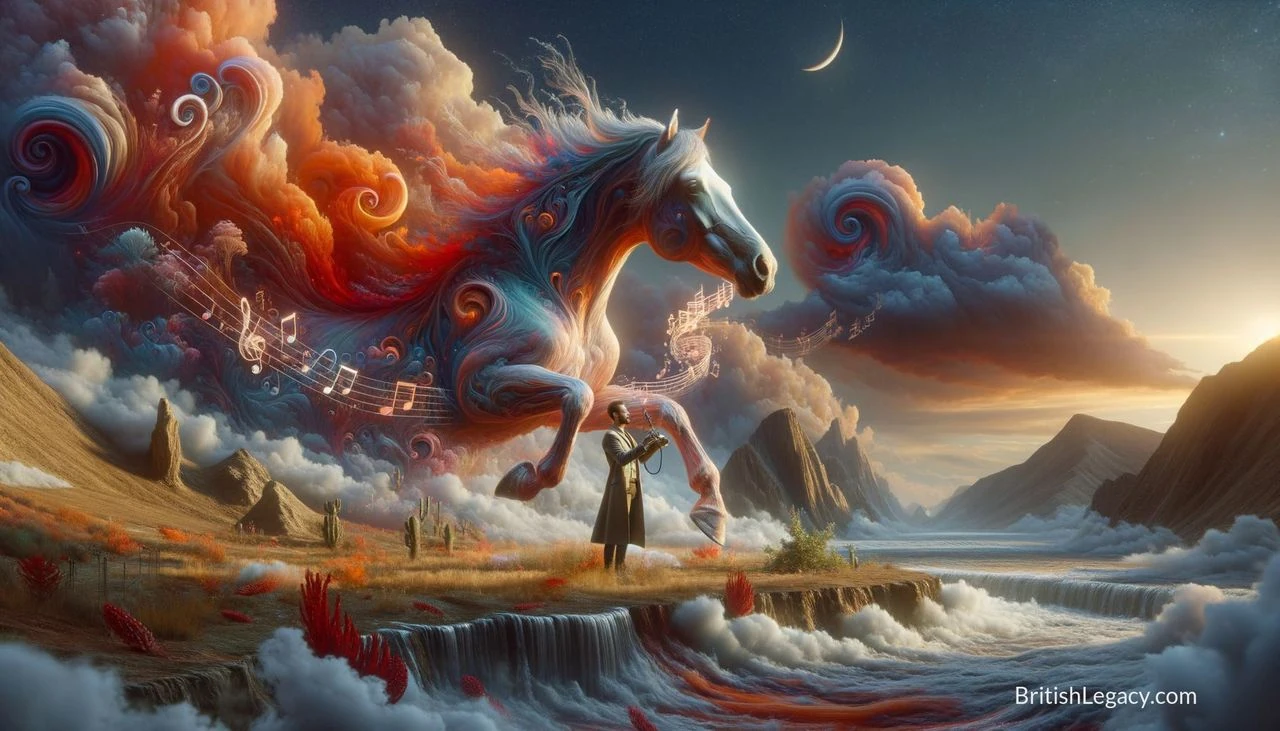
Matthew Sweeney’s poems made room for the improbable without losing sight of ordinary life. Horses, rooms and familiar situations could take an unexpected turn; the result was not simply whimsy, but a way of looking again at the world. Born in County Donegal, Sweeney spent many years in London before later living in Romania, Germany and Cork. His life and work were Irish and European in reach, while his long London period and involvement in British poetry workshops and residencies gave him a substantial place in the literary life of Britain.
Donegal, Dublin and London
Sweeney was born in Lifford, County Donegal, on 6 October 1952, and grew up in Clonmany. He attended Gormanston College from 1965 to 1970, then read sciences at University College Dublin. He later studied German and English at the Polytechnic of North London and spent a year at the University of Freiburg. He graduated with a BA Honours degree in 1978. That education, moving between scientific study and languages, Ireland and mainland Europe, preceded a writing life that would resist a narrow national frame.
He met Rosemary Barber in 1972; they married in 1979 and had two children, Nico and Malvin. Sweeney lived in London for many years, until 2001. After separating from Barber, he lived in Timișoara and Berlin. In 2007 he met Mary Noonan, and the following year moved to Cork to live with her. This changing geography matters to his story: Sweeney’s connection to Britain was neither a claim that he was British nor a brief visit, but a sustained period of residence and participation in its poetry community.
A poetry of the uncanny and the recognisable
Sweeney published his first collection, A Dream of Maps, in 1981. Further books included A Round House, The Lame Waltzer, Blue Shoes, Cacti, The Bridal Suite and A Smell of Fish. Across a career of numerous collections, his writing was associated with labels including “Alternative Realism” and “Imagistic Narrative”. These terms suggest a practice in which startling or dreamlike events can sit alongside recognisable people, places and concerns, rather than an escape from reality into fantasy.
Horse Music, published by Bloodaxe Books in 2013, became one of his notable collections and received the Piggot Poetry Prize in 2014. It is a useful entry point to Sweeney’s imagination, but not the whole of his work. He published Inquisition Lane in 2015, and in 2018, the final year of his life, two more collections appeared: My Life as a Painter and King of a Rainy Country. The latter drew inspiration from Baudelaire’s posthumously published Petits poèmes en prose.
His work extended beyond poetry collections. He wrote the children’s novels The Snow Vulture and Fox, and, with John Hartley Williams, the satirical thriller Death Comes for the Poets. He also edited anthologies, including Emergency Kit: Poems for Strange Times, with Jo Shapcott, and The New Faber Book of Children’s Verse. His writing was translated into Dutch, Italian, Hebrew, Japanese, Latvian, Mexican Spanish, Romanian, Slovak and German, giving it readers well beyond the countries in which he lived.
Workshops, residencies and recognition
Sweeney’s contribution to poetry included the attention he gave to other writers. His editor at Allison and Busby, Bill Swainson, recalled workshops in which poems were circulated anonymously and read and discussed carefully by participants. Swainson described Sweeney’s workshops and later residencies as combining seriousness with generosity and enjoyment. Sweeney held residencies at the University of East Anglia and London’s Southbank Centre, among other places. These documented activities offer a firmer account of his work with emerging writers than broad claims that he mentored a generation.
His awards and appointments recognised different stages of his career. He received the New Statesman Prudence Farmer Award in 1984 and the Cholmondeley Award in 1987, followed by an Arts Council Writers’ Award in 1999 and an Arts Council of Ireland Writers’ bursary in 2001. Black Moon was shortlisted for the Poetry Now Award in 2008, and Sweeney’s work was shortlisted for the T. S. Eliot Prize in 2007. He received the Steven Kings Award in 2011 and the Maria Elsa Authors and Poets Award in 2012. He was also elected to Aosdána, the Irish association of artists.
Sweeney’s standing was not confined to prizes. He read at the Rotterdam Poetry Festival in 1998, 2003 and 2009. The breadth of his publication, translation and literary activity makes clear why accounts of him have placed him in a European context as well as an Irish one. His writing was described by poet Gerard Smyth as that of someone who regarded himself, first, as a European poet; that observation fits the range of languages and influences associated with his work, without erasing his origins or the years he spent in Britain.
Final work and remembrance
Sweeney was diagnosed with motor neuron disease in 2017, the year before his death. He continued writing until three days before he died at Cork University Hospital on 5 August 2018, aged 65. Family and friends were with him. A special ceremony celebrating his life was held at Cork’s Triskel Arts Centre on 8 August, and he was buried the following day in Clonmany New Cemetery in County Donegal, returning in death to the place where he had grown up.
In an interview shortly before his death, Sweeney was asked about his legacy. His answer resisted easy assurances of lasting fame: he said that what mostly awaited a poet was posthumous oblivion, while imagining that his German translations might matter to a young reader in Hamburg, Munich or Vienna. The remark is a telling counterweight to grand claims about literary immortality. It recognises the uncertainty of a writer’s afterlife while locating a possible continuation in the act of reading, translation and influence.
Why Matthew Sweeney deserves a place in British Legacy
Sweeney deserves a place in British Legacy not because he was British—he was an Irish poet born and raised in County Donegal—but because his life and work were closely connected with Britain’s literary culture. He lived in London for many years, studied at the Polytechnic of North London and held a residency at the Southbank Centre. His workshops and residencies gave practical expression to his commitment to poetry beyond his own books. That British connection is specific and substantial, while his later life in Romania, Germany and Cork reminds us that it was one part of a wider European story.
His literary achievement also resists a single label or celebrated title. From A Dream of Maps to Horse Music and his final collections, Sweeney built a varied body of work that moved between poetry, children’s fiction, satire and editing. The translations of his poems carried them into numerous languages, while his workshops created settings in which other writers could test and improve their work. Remembering him in a British context can therefore do more than add a poet’s name to a national roll-call: it can show how Britain’s literary life has been shaped by writers whose identities and imaginations cross borders. Sweeney’s example brings together a grounded connection to London’s poetry institutions and a distinctly international outlook, without confusing either with a claim of British nationality.
Sources
Matthew Sweeney — revision 1372641642 · Matthew Sweeney
Adapted in part from Matthew Sweeney by Wikipedia contributors, under CC BY-SA 4.0. Text has been edited and combined with the existing article; this adapted text is shared under the same licence. Contributor history.