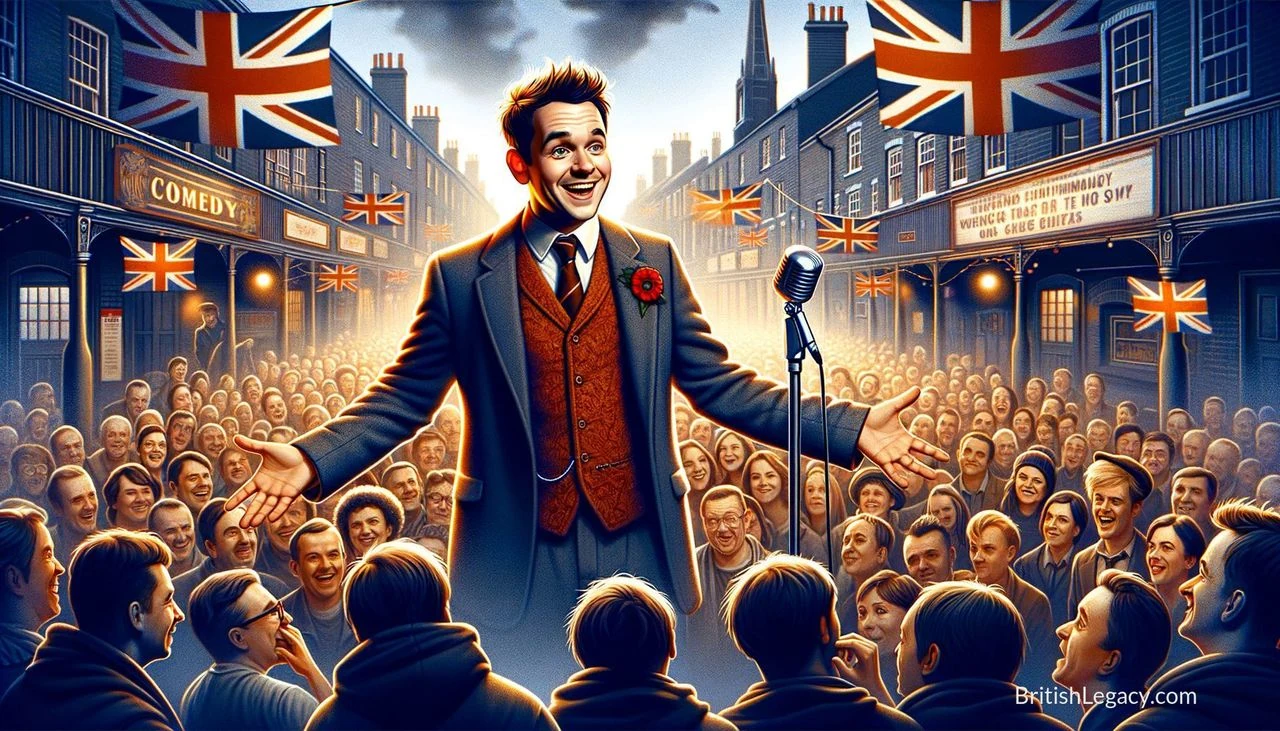
Micky Flanagan’s comedy often begins with a familiar distinction: going out is not necessarily the same as going “out out”. The phrase became a recognisable part of his stand-up, but it points to a broader quality in his work: the ability to turn ordinary decisions and social rituals into stories with their own characters, stakes and comic logic. His route to the stage was far from direct. He left school at 15, worked at Billingsgate Fish Market and as a furniture maker, returned to education as an adult, and became a professional comedian in 1997.
Growing up in London’s East End
Born Michael John Flanagan on 7 October 1962 in Whitechapel, he grew up in Bethnal Green. His father, Jim, worked as a welder and later as a fish porter. Flanagan was a bright pupil, but became disengaged from schoolwork and began truanting. He left at 15 without qualifications. At 13, he had joined the Young Socialists; as a teenager, he was also keen to leave the East End.
His first job came through his father: carrying fish at Billingsgate Fish Market. In 1981, he spent a summer working as a kitchen porter on Fire Island, New York. Back in London, he worked as a furniture maker for several years. When that business failed, he returned to Fire Island for another summer. These early jobs form a striking contrast with the career that followed, but also help explain why accounts of work, money and class became part of his comic territory.
At 25, Flanagan resumed his education, beginning with a GCSE in English before taking a foundation course in Arts and Social Sciences. He began a degree at City University when he was 29. He later trained as a teacher through a postgraduate certificate, but chose not to make teaching his career. He described the experience as “the unhappiest year of my life”, saying that problems he remembered from his own schooling remained.
Finding a route to stand-up
Flanagan took a comedy course at Jacksons Lane in north London in 1996 and became a professional comedian the following year. The early stages of his career were built through performances at comedy clubs and festivals rather than a single instant breakthrough. In 2001 he appeared in the Big Value Comedy Show at the Edinburgh Fringe as one of four headline acts. He co-headlined a show with Nina Conti in 2003 and performed at London clubs including Balham’s Banana Cabaret and the Bearcat Comedy Club.
His first full-length solo show, What Chance Change?, followed in 2006. The next year he was nominated for Best Newcomer at the Edinburgh Comedy Awards. That recognition preceded a wider run of touring and television work. The Out Out Tour took him around Great Britain in 2010 and 2011, and his later tours included Back in the Game Live and An’ Another Fing Live.
Television and radio brought his stand-up to audiences beyond the clubs. He appeared on Michael McIntyre’s Comedy Roadshow in 2009 and performed on Live at the Apollo, Stand Up for the Week and the Royal Variety Performance in 2010. He also appeared on Mock the Week and was a panellist on the BBC1 game show Epic Win. His television appearances continued with programmes including The Mad Bad Ad Show, I Love My Country and Was It Something I Said?.
From “out out” to the wider stage
The “out out” routine captures Flanagan’s approach: he takes a small point of social language and makes it carry a whole scene. In the sketch, different kinds of going out have different meanings, with “out out” signalling a proper night on the town. In 2009, his agent complained to the Advertising Standards Authority that a 118 118 television advert had used the catchphrase and a similar idea. The ASA acknowledged the similarity but said it could not take action. The episode illustrates how a line from a comedy performance can travel into public conversation, though the complaint itself did not result in a ruling against the advertiser.
Flanagan’s work also reached listeners through Radio 2’s Out to Lunch, on which he was a regular performer in 2008, and a four-part Radio 4 series, Micky Flanagan: What Chance Change?, which he presented in 2010. His comedy depends on the detail and momentum of spoken storytelling: an everyday experience becomes an accumulating account, shaped by turns of phrase and the speaker’s way of seeing it. The East End voice and colloquial language are part of that performance, not just decoration.
His schedule has included substantial live tours as well as broadcast appearances. Back in the Game Live was filmed at Hackney Empire, while An’ Another Fing Live was filmed at the O2 Arena. In 2023–24 he toured with If Ever We Needed It.... In 2015, he took a year’s sabbatical, citing work-related stress and a need to relax. The pause is a reminder that a public career built around constant performance has its limits, too.
A comic voice shaped by class and experience
Flanagan’s public persona is grounded in the contrast between his early working life and his later career on stages and television. Fish-market work, furniture making and adult study are not simply biographical markers: they offer the kinds of lived settings from which stories about aspiration, embarrassment and social codes can be made. His humour draws on observation and vernacular speech, often finding comedy in the way people describe ordinary choices and relationships.
His family life is more private than his stage material. He is married to Cathy and they have one son. He retains a London base in East Dulwich and lives primarily in the Hampshire countryside. In 2011, he signed a deal with Ebury Publishing to write an autobiography. These details sit alongside a career in which much of the material is recognisable without being presented as a claim to speak for everyone who shares his background.
Why Micky Flanagan deserves a place in British Legacy
Micky Flanagan deserves a place in British Legacy because his career makes a clear connection between one London comedian’s experience and the changing routes into British entertainment. He left school without qualifications, worked in a market and in furniture making, then returned to education before finding stand-up. His progress through comedy courses, club stages, the Edinburgh Fringe, national touring and radio and television is a specific account of persistence and reinvention—not a story of overnight success. It shows how a performer can build an audience through live work before becoming a familiar presence on broadcast programmes.
His contribution is also distinctive in its attention to social language. “Out out” gives a compact example of how he turns a small distinction in everyday speech into a comic idea that audiences can recognise and repeat. His work brings East End experience and colloquial expression into mainstream comedy without requiring a formal explanation of either. The result is not that one comedian represents an entire class or city, but that particular details of speech, work and social life become material for shared laughter. His tours, recordings and broadcast appearances have carried that storytelling from London clubs to audiences across Britain, giving his place in British cultural life a concrete basis.
Sources
Adapted in part from Micky Flanagan by Wikipedia contributors, under CC BY-SA 4.0. Text has been edited and combined with the existing article; this adapted text is shared under the same licence. Contributor history.