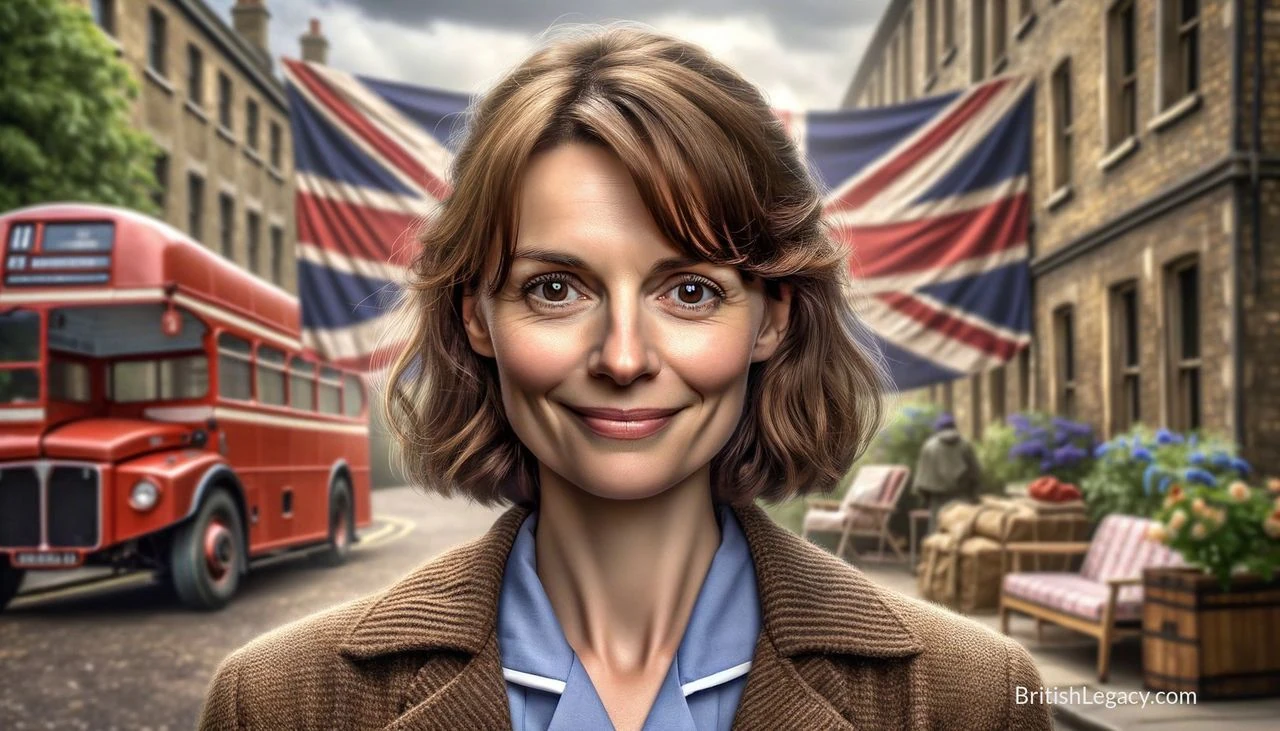
Miranda Hart made comic awkwardness a form of command. In her BBC sitcom Miranda, a stumble, a pause or a direct glance at the audience could become the engine of a scene. The character’s missteps were not a lack of control: they were part of a carefully written performance, shaped by physical comedy and a warm, self-aware relationship with viewers. Hart’s work on the series established her as a television comedy writer and performer; her role as Chummy in Call the Midwife showed a different register.
From Petersfield to performance
Miranda Katherine Hart Dyke was born in Torquay, Devon, on 14 December 1972, and grew up in Petersfield, Hampshire. She studied political science at the University of the West of England in Bristol, graduating with a 2:1, then took a postgraduate acting course at the Academy of Live and Recorded Arts. Her route into comedy included stage work as well as television: she wrote material for the Edinburgh Fringe and performed in character-based shows, including The Sitcom Trials.
Before her own series arrived, Hart appeared in a range of British television comedies. Her early credits included Smack the Pony, French & Saunders, My Family and Other Animals and The Vicar of Dibley. She played Teal in the science-fiction comedy Hyperdrive, earning a British Comedy Award nomination, and appeared in Not Going Out. There, an initial appearance as an acupuncturist led to a recurring role as Barbara, a sarcastic and clumsy cleaner. These parts gave Hart room to develop a comic style grounded in character, timing and physicality.
She had also begun creating comedy for radio. Miranda Hart’s Joke Shop aired on BBC Radio 2 in 2008, and its material helped lead towards her television breakthrough. Hart pitched a comedy show to the BBC in 2004; the eventual series was not simply a vehicle for her performance, but a project she wrote and shaped herself.
Building the world of Miranda
The television sitcom Miranda began broadcasting in November 2009. Its central character, Miranda Preston, shares elements of Hart’s own experiences, but the series presents them as comic situations rather than a straightforward record of her life. Sarah Hadland, Tom Ellis, Patricia Hodge, James Holmes and Sally Phillips joined Hart in a world of social blunders, romantic uncertainty and carefully staged embarrassment.
The show drew on a recognisable sitcom form while making Hart’s performance its defining feature. Slapstick, puns and direct addresses to the audience allowed her to make the gap between a character’s intentions and actions part of the joke. The comedy’s affection for its characters kept the embarrassment from becoming simply cruel. Hart’s physical performance mattered as much as the scripts: gestures, pauses and sudden reversals supplied their own punchlines.
The programme ran for three series, moving from BBC Two to BBC One, and concluded with two final episodes broadcast in December 2014. Its reception brought Hart a substantial run of awards and nominations. She won British Comedy Awards for her performance, and the series received awards including Best New TV Comedy. She also won Royal Television Society recognition for comedy performance and received several BAFTA nominations. A tenth-anniversary celebration, filmed at the London Palladium, aired in January 2020 as a party rather than a new episode.
Hart’s television work around the sitcom included presenting, panel appearances and live events. She co-presented segments of the Diamond Jubilee Concert in 2012 and later interviewed Bruce Forsyth for the one-off programme When Miranda Met Bruce. In 2014, she took My, What I Call, Live Show on tour across the UK and Ireland, extending a screen persona to arena audiences.
A different part in Call the Midwife
In 2012, Hart joined the BBC drama Call the Midwife as Camilla “Chummy” Fortescue-Cholmondeley-Browne, later Noakes. Set in London’s East End in the 1950s, the series gave her a part quite different from the comic centre of Miranda. Chummy’s place in the drama demonstrated that Hart could work within an ensemble and sustain a character in a period story, without relying on the sitcom’s direct address or broad physical gags.
Hart appeared in the series from 2012 to 2015. Her performance earned a National Television Award for outstanding drama performance in 2013 and a BAFTA nomination for supporting actress. The role widened the picture of her as a performer: comedy remained central to her public identity, but drama brought her before viewers in a different kind of British television institution.
Books, charity and work beyond the sitcom
Hart carried her voice into books, where humour and direct address could work without a studio audience. Is It Just Me?, published in 2012, combined stories, anecdotes and advice in her characteristic style; it won the National Book Award for non-fiction book of the year. She followed it with Peggy and Me, The Best of Miranda, Miranda Hart’s Daily Dose of Such Fun! and the children’s book The Girl with the Lost Smile. Her 2024 memoir, I Haven’t Been Entirely Honest with You, added a more personal book to that body of work.
Her charity work included several prominent Comic Relief and Sport Relief broadcasts. In 2010, she joined six other television celebrities in a Sport Relief cycle from John O’Groats to Land’s End that raised more than £1 million. She co-presented Sport Relief in 2012 and took part in Comic Relief sketches and programmes, including winning a 2011 Comic Relief edition of Celebrity MasterChef. These appearances placed her comic persona in a collective fundraising context, rather than making charity a general claim about her public life.
Hart’s screen work also included the comedy film Spy in 2015 and the Jane Austen adaptation Emma. in 2020. In the latter she played Miss Bates, a role that again drew on comic observation but belonged to a different period and style. Across television, film, radio, stage and books, her career has repeatedly involved writing or developing material as well as performing it.
Why Miranda Hart deserves a place in British Legacy
Miranda Hart’s place in British Legacy rests first on a specific creative achievement: she wrote and starred in a successful BBC sitcom that made her own comic instincts the structure of the show. Miranda combined a familiar television format with a distinctive performance language—physical mishaps, pointed self-awareness and direct communication with the audience. Hart’s role as writer and performer matters. The series was not only a character she played; it was a comedy she helped create and carry from an earlier radio project to national television, then to live audiences.
Her work also demonstrates range without requiring the claim that every appearance had the same effect. Chummy in Call the Midwife brought her into a major British drama as part of an ensemble, while her books, radio work and stage performances extended her comic voice across different forms. Her awards, including Royal Television Society and British Comedy recognition, mark the response to that work; her Sport Relief cycling challenge and broadcast participation show how her popular profile was also used in fundraising. Together, these contributions connect Hart’s career to British television comedy, drama, publishing and charity entertainment. Her legacy is not an abstract emblem of national humour, but a body of authored and performed work that reached audiences through institutions and formats central to British popular culture.
Sources
Miranda Hart — Wikipedia revision 1379411549 · Miranda Hart — Wikipedia
Adapted in part from Miranda Hart by Wikipedia contributors, under CC BY-SA 4.0. Text has been edited and combined with the existing article; this adapted text is shared under the same licence. Contributor history.