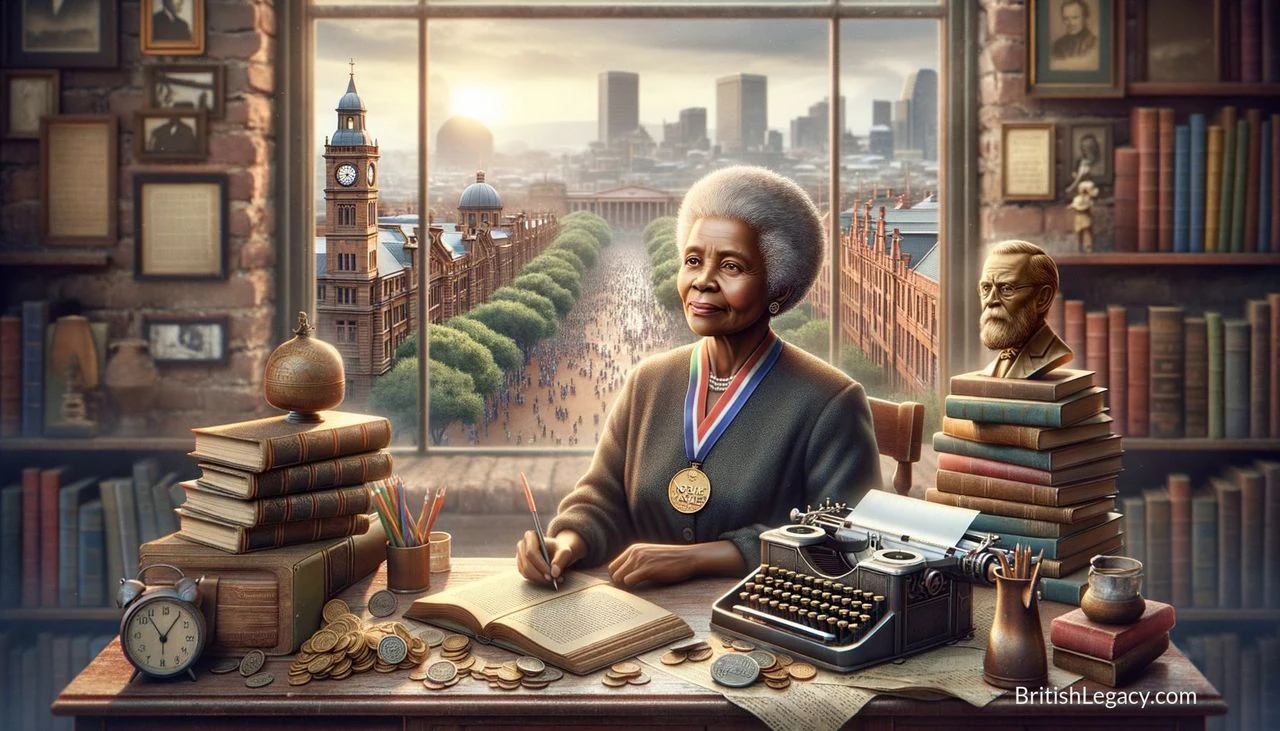
Nadine Gordimer made the politics of apartheid inseparable from the intimate choices of ordinary people. Across novels and short stories set in a racially divided South Africa, she examined how power entered homes, relationships and private consciences. Her work brought her international recognition, including the 1991 Nobel Prize in Literature and the Booker Prize for The Conservationist. But literary success did not soften her opposition to censorship or apartheid: she joined the African National Congress when it was banned and continued to write about a society whose authorities could prohibit her books.
Early writing in South Africa
Gordimer was born in Springs, a mining town near Johannesburg, on 20 November 1923. Her father, Isidore, was a Lithuanian Jewish immigrant and watchmaker; her mother, Hannah, was a British Jewish immigrant from London. Gordimer grew up in a secular household. Her mother’s concern about poverty and discrimination led her to establish a crèche for black children, while Gordimer herself encountered the coercive reach of the state when police raided the family home during her teenage years.
Much of her childhood was spent at home, and she began writing young. At 13, she published a story for children in the Children’s Sunday Express; by 16, she had published adult fiction. She attended a Catholic convent school and later studied for a year at the University of the Witwatersrand, where she encountered people across the colour bar. She did not complete a degree. Moving to Johannesburg in 1948, she continued to publish stories in South African magazines. Face to Face, her first collection, appeared in 1949; her first novel, The Lying Days, followed in 1953.
A turning point in her readership came in 1951, when The New Yorker accepted her story “A Watcher of the Dead”. The publication began a long relationship with the magazine and carried her work to a wider audience. The short story remained an important form for Gordimer, alongside the novels through which she explored the pressures of a changing South Africa.
Fiction under apartheid
Gordimer’s fiction repeatedly tested how racial and political systems shape personal lives. The Conservationist (1974), the novel that won her the Booker Prize, centres on Mehring, a wealthy white industrialist, and places his efforts to preserve his farm against a world and history his control cannot contain. It was co-winner of the prize with Stanley Middleton’s Holiday. In Burger’s Daughter (1979), Rosa Burger confronts her relationship to her father, an anti-apartheid activist, and to political commitment herself. The novel was banned shortly after publication, although an appeal board reversed the decision three months later.
July’s People (1981) imagines a violent revolution and follows a white couple sheltering with July, their former servant. Rather than treating political upheaval as distant spectacle, the novel asks what happens to familiar relationships and assumptions when the balance of power is overturned. Together, these books show Gordimer’s characteristic attention to moral ambiguity: characters’ choices matter, but they take place within unequal structures that constrain what can be chosen.
Censorship reached beyond these prominent novels. The government banned A World of Strangers for 12 years and The Late Bourgeois World for a decade from 1976. Gordimer challenged the logic of censorship in essays as well as fiction. In 1988, she addressed the subject in The Essential Gesture, arguing that the treatment of her own work could not be separated from the censorship of black writers. Her response resisted a simple account in which the lifting of a ban on one white author’s book could stand for freedom of expression as a whole.
Writing and political action
Gordimer’s political commitment was practical as well as literary. The arrest of her friend Bettie du Toit in 1960 and the Sharpeville massacre helped draw her into the anti-apartheid movement. She joined the African National Congress while the organisation was illegal, and hid ANC leaders in her home to help them evade arrest. She also supported people facing prosecution: close to Nelson Mandela’s defence attorneys, she helped edit his “I Am Prepared to Die” speech, delivered from the dock in 1964. In 1986, she testified on behalf of 22 anti-apartheid activists at the Delmas Treason Trial.
Her opposition to state control of information extended to broadcasting. She refused to allow her work to be aired by the South African Broadcasting Corporation while it remained under apartheid-government control. She served on the steering committee of the Anti-Censorship Action Group, helped found the Congress of South African Writers and became vice-president of International PEN. These roles connected the defence of writers and readers to the wider struggle against political repression.
After apartheid, Gordimer turned attention to HIV/AIDS, a major public-health crisis in South Africa. In 2004, she organised about 20 writers to contribute stories to Telling Tales, a fundraising book for the Treatment Action Campaign, which lobbied for government support for prevention and care. She criticised the government’s position on AIDS while supporting its work in other areas. Her political involvement was not uncritical allegiance: in 2012, she publicly condemned the ANC government’s Protection of State Information Bill.
A wider literary career
Gordimer’s award-winning novels continued into the post-apartheid era. The House Gun (1998) follows a couple confronting their son’s killing of a housemate and the place of crime, firearms and racial history in contemporary South Africa. The Pickup (2001) centres on a South African woman and an Arab immigrant whose relationship takes them across differences of class, immigration status and culture. Her final novel, No Time Like the Present, appeared in 2012.
The Nobel Prize in Literature, awarded in 1991, recognised a body of work the Swedish Academy described as “magnificent epic writing” that had been of great benefit to humanity. The Booker Prize for The Conservationist had already brought major recognition to her fiction. She received many further honours, among them the James Tait Black Memorial Prize for A Guest of Honour and the Commonwealth Writers’ Prize for The Pickup. Her work also travelled into film: Gordimer co-wrote the screenplay for a 1962 Danish adaptation of A World of Strangers, released in the United Kingdom under that title.
Gordimer remained in Johannesburg for most of her life, including more than five decades in the same Parktown home. She died there in her sleep on 13 July 2014, aged 90. Her career joined imaginative writing to sustained engagement with the conditions that shaped its setting: censorship, racial hierarchy, political resistance and, later, the choices facing a changing South Africa.
Why Nadine Gordimer deserves a place in British Legacy
Gordimer was South African, and her place here should not depend on recasting her as British. The specific connection is more modest and more meaningful: her mother was a British Jewish immigrant from London, and Gordimer’s fiction circulated beyond South Africa, including through a UK release of the film adaptation of A World of Strangers. These details locate her in a history of movement and cultural exchange without making British heritage a substitute for her own. Her central subject remained South Africa and the lived consequences of apartheid.
Her achievement is relevant to a British legacy because it demonstrates what literature can make visible across national borders. Gordimer built fiction from the moral and psychological pressures of racial division, while her work and public actions confronted censorship and political repression. She supported anti-apartheid activists, helped edit Mandela’s dock speech, and used her literary standing to challenge restrictions on writing and information. Later, she organised writers to raise funds for the Treatment Action Campaign. The benefit of that record is concrete: readers encounter not just declarations about justice, but stories in which unequal power changes people’s choices, relationships and responsibilities. Remembering Gordimer in British Legacy can acknowledge those connections while keeping the source of her authority clear: the South African life and history she wrote about and sought to change.
Sources
Nadine Gordimer — Wikipedia revision 1379082012
Adapted in part from Nadine Gordimer by Wikipedia contributors, under CC BY-SA 4.0. Text has been edited and combined with the existing article; this adapted text is shared under the same licence. Contributor history.