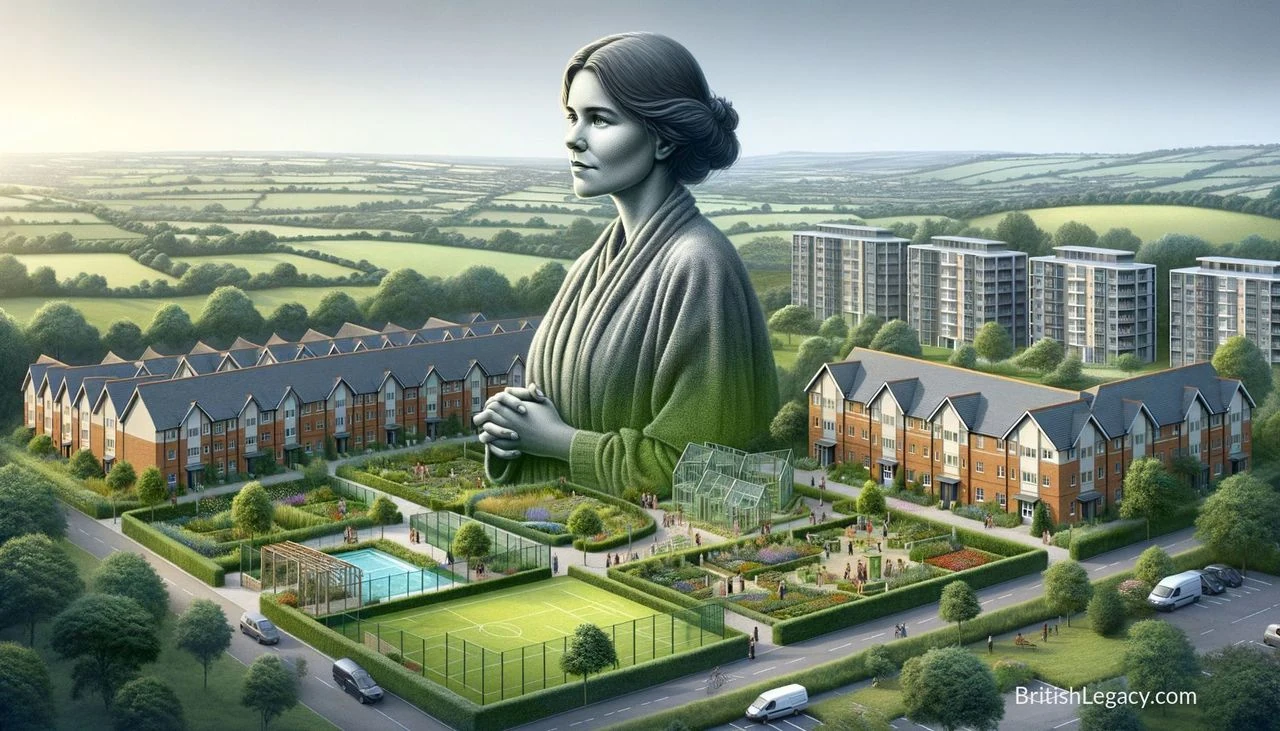
Octavia Hill’s reform work began with people and the conditions in which they lived. She managed housing for working families in London, insisting that good homes required careful maintenance and personal attention to tenants. She also campaigned to keep open spaces within reach of city residents. Those concerns came together in the National Trust, which Hill helped establish to protect places of historic interest and natural beauty.
A reformer shaped by poverty and work
Hill was born in Wisbech, Cambridgeshire, on 3 December 1838. Her family was committed to social reform, but its circumstances changed sharply after her father’s financial difficulties and bankruptcy in 1840. Her mother, Caroline, educated the children at home. Hill grew up in Finchley, then a village on the outskirts of London, and began working for the welfare of working people while still young.
At 13, she trained in glass-painting with a co-operative guild that provided work for women in financial difficulty. The guild later made toys for children at Ragged schools, and Hill was put in charge of its workroom at 14. She saw at close hand the difficult lives of the children in her care. In her spare time, she worked as a copyist for the artist and critic John Ruskin, whose interest in the guild would later have a practical consequence for her housing work.
Hill also helped children through toy-making and served as secretary to the women’s classes at the Working Men’s College in Bloomsbury. Her early work was shaped by family and social-reform influences, including her grandfather, the welfare reformer Thomas Southwood Smith, and the social reformer F. D. Maurice, a family friend. These experiences connected education, work and living conditions in her view of poverty.
Managing homes, not just buildings
In 1865, Ruskin used money he had inherited to acquire the leases of three cottages in Paradise Place, Marylebone, and placed them under Hill’s management. The houses were in poor condition. Hill arranged repairs and cleaning, and the surrounding waste ground was turned into a playground. In 1866, Ruskin acquired five more houses for her to manage in nearby Freshwater Place.
Hill’s model joined upkeep of the property to regular contact with the people living there. She and her assistants collected rent weekly, checked the buildings and got to know tenants personally. Rent income paid for management and repairs; returns above the agreed five per cent were reinvested in the properties for tenants’ benefit. The system required organised, persistent work: collecting rents, arranging repairs, keeping accounts and responding to arrears were all part of the same responsibility.
Her approach attracted new financial backers. By 1874, she had 15 housing schemes with around 3,000 tenants. In 1884, the Ecclesiastical Commissioners asked her to manage and improve 48 properties in South London. Hill trained assistants, including Emma Cons and Eva McLaren, and her work helped establish a model of professional housing management. Some local authorities later adopted elements of her methods, improving working-class housing without wholesale demolition or eviction.
Hill’s outlook was not without limits. She emphasised self-reliance and opposed municipal housing provision, which she considered impersonal and bureaucratic. She believed managers had responsibilities beyond rent collection, including attention to the condition of homes and family circumstances. Her system could be demanding, and she expected both tenants and staff to meet high standards. It was a distinctive approach to housing reform, rather than a simple programme of affordable rents.
Open spaces and the National Trust
Hill’s concern for urban welfare extended beyond the home. She argued that city residents needed places to sit, play, stroll and spend time outdoors. In 1883, she wrote that access to distant countryside could cost a worker both the fare and a day’s wages; neighbourhood spaces were needed for ordinary evenings and Saturday afternoons. She campaigned against development on suburban woodlands and helped protect Hampstead Heath and Parliament Hill Fields.
Her environmental work included a campaign in 1883 against a proposed railway serving quarries in the Lake District’s fells. Canon Hardwicke Rawnsley led the campaign, with Hill, Ruskin and solicitor Robert Hunter among those supporting it. Hunter had advised Hill on protecting London open spaces. The campaign helped bring together the people and ideas behind a trust that could acquire and preserve places for public benefit.
Hill, Hunter and Rawnsley met on 16 November 1893 and agreed to launch the National Trust, adopting the name suggested by Hunter. The Trust was inaugurated the following year. Its purpose was to protect places of historic interest or natural beauty for the enjoyment of the public. Dinas Oleu in Merioneth was its first property; Alfriston Clergy House became its first built property, and Wicken Fen its first nature reserve. A 1907 Act of Parliament gave the Trust a permanent purpose and powers to protect property for the nation.
Hill’s work for open spaces was not separate from her housing practice. In Marylebone, the conversion of waste ground into a playground showed the importance she attached to shared outdoor space close to home. Her campaigns for larger landscapes carried the same concern into the countryside: that beauty and room to breathe should not be reserved for those able to travel or pay.
Ideas carried forward
Hill’s work had an influence beyond the properties she managed herself. Housing schemes adopted her methods, and women she trained went on to work in housing management. Her organisation of rent collection, property maintenance and personal contact with tenants helped shape a professional tradition in the field. The Horace Street Trust, which she founded, developed into Octavia Housing.
She was also a founder member of the Charity Organisation Society, which arranged charitable grants and pioneered home visiting. Hill’s colleagues Samuel and Henrietta Barnett went on to found Toynbee Hall, part of a settlement movement that brought people from different social backgrounds into shared community work. In 1905, Hill joined the Royal Commission on the Poor Laws. Her views on public provision remained contested: she opposed many forms of state assistance, including old-age pensions, because she believed they could weaken self-reliance.
Hill died of cancer at her home in Marylebone on 13 August 1912, aged 73. Her remembrance is tied to both sides of her work: homes managed with sustained attention to their residents, and open places defended for public enjoyment. The National Trust, housing organisations and the professional practice of housing management each carry different parts of that record.
Why Octavia Hill deserves a place in British Legacy
Octavia Hill deserves a place in British Legacy because she treated housing as more than the provision of shelter. In Marylebone and later in South London, she connected building repairs, rent collection and close contact with tenants in a model that attracted support and grew to encompass thousands of residents. Her methods were demanding and rested on a strong belief in personal responsibility, but they also established the importance of skilled, organised housing management. The work of assistants she trained and the later development of Octavia Housing show how her practical approach continued beyond her own career.
Hill also helped make access to open space a public concern. She argued that city people needed places to rest and play near their homes, campaigned to protect Hampstead Heath and Parliament Hill Fields, and joined the effort that established the National Trust. That organisation gave lasting form to the idea that places of natural beauty and historic interest should be protected for public enjoyment. Her British legacy lies in these connected achievements: improving the management of urban homes, defending green spaces, and helping build institutions through which both could serve the public.
Sources
Adapted in part from Octavia Hill by Wikipedia contributors, under CC BY-SA 4.0. Text has been edited and combined with the existing article; this adapted text is shared under the same licence. Contributor history.