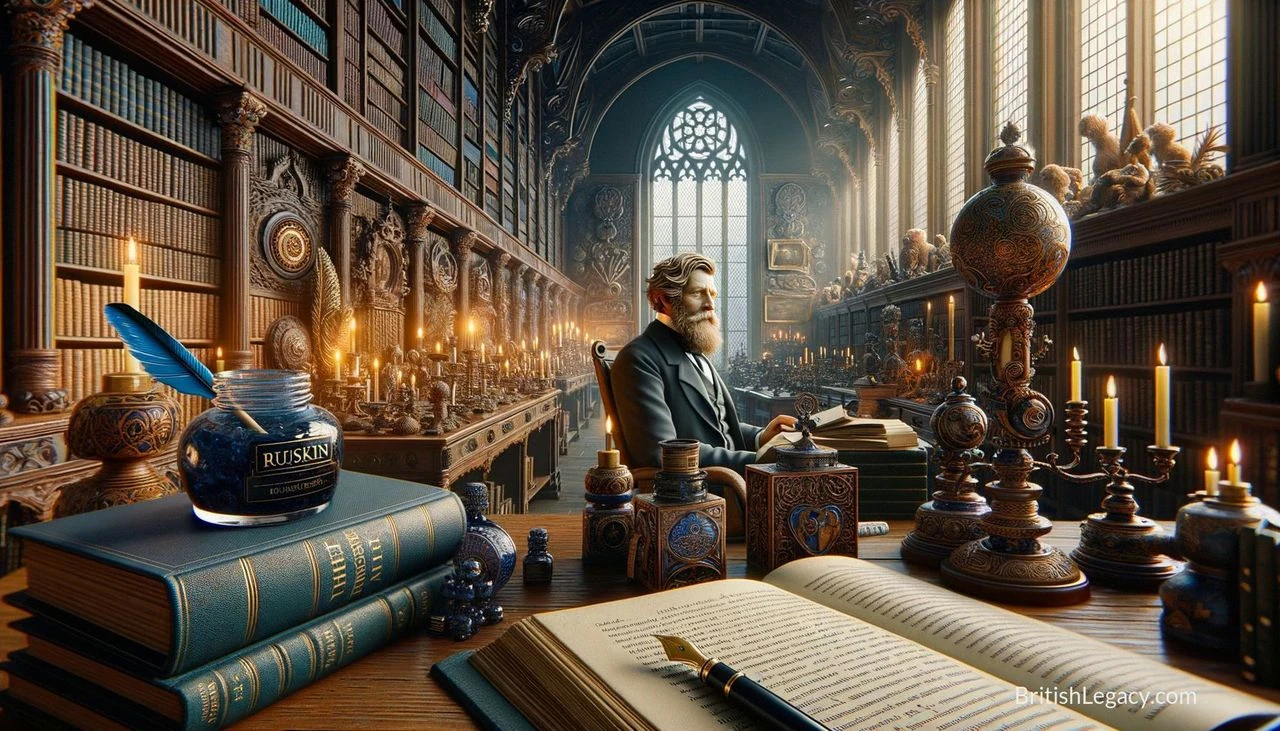
John Ruskin’s criticism began with a defence of J. M. W. Turner, but it grew into a much wider argument: art could not be separated from the conditions in which people lived and worked. In writing on painting, architecture, education and political economy, Ruskin asked readers to look closely at the world around them—and to consider what their choices revealed about society. His ideas helped shape debates about craftsmanship and the preservation of historic buildings, while his teaching and Guild of St George gave some of his principles a practical form.
Learning to look closely
Ruskin was born in London on 8 February 1819, the only child of John James Ruskin, a wine importer, and Margaret Cock. His parents educated him at home, and his childhood included extensive family travel in Britain and on the Continent. Those journeys gave him opportunities to observe landscapes, buildings and paintings at first hand. He also learned to draw, developing skills that would inform his later work as an art critic and teacher.
He studied at Christ Church, Oxford, after attending King’s College London. Oxford brought friendships and intellectual contacts, but his most consequential early achievement was literary. In 1843, Modern Painters appeared under the anonymous description “A Graduate of Oxford”. Its first volume defended Turner against critics who preferred the conventions of earlier painters. Ruskin argued that artists should attend to nature rather than rely on inherited formulas, and that truthful observation mattered to art.
Modern Painters expanded over five volumes, published between 1843 and 1860. Ruskin’s subject broadened from Turner’s landscapes to the connections between art, nature and moral life. He wrote with unusual attention to the details of what he saw, combining description with argument. The books established his public reputation and helped make criticism a means of debating not just taste, but the values that art expressed.
Architecture, artisans and the Pre-Raphaelites
In The Seven Lamps of Architecture (1849), Ruskin set out seven moral principles he believed should inform building, including truth, memory and life. In the three volumes of The Stones of Venice (1851–53), he used the city’s architecture to reflect on the society that had made it. His account of Gothic building placed particular emphasis on the worker’s freedom to think and make. The quality of a building, he argued, was bound up with the conditions and dignity of its makers.
That argument gave Ruskin’s architectural writing a social edge. He objected to treating craft as merely repetitive labour, detached from judgement and creativity. His account of Gothic workmanship influenced William Morris, who later became a central figure in the Arts and Crafts movement. Ruskin also supported the Pre-Raphaelites, whose close attention to nature had affinities with his insistence on direct observation. He defended their work publicly and encouraged artists including John Everett Millais and Dante Gabriel Rossetti.
Ruskin’s own engagement with art included teaching as well as writing. In 1857, he published The Elements of Drawing, a guide shaped by his experience of teaching drawing, including to students at the Working Men’s College. He later became the first Slade Professor of Fine Art at Oxford, where he founded the Ruskin School of Drawing and Fine Art in 1871. His teaching ranged beyond technique: he treated art as a way of learning to see, and argued that education should connect practical work with thought.
From criticism to social reform
In the late 1850s, Ruskin turned increasingly towards political economy and the organisation of work. His essays Unto This Last, first published in 1860 and collected as a book in 1862, challenged the idea that economic life could be understood through competition and money alone. Ruskin argued that accounts of wealth must take human well-being into consideration. He objected to the division of labour when it separated workers from the meaning and making of what they produced.
The essays provoked strong opposition and their magazine publication was cut short. Ruskin continued to develop his social criticism in other forms, including Fors Clavigera, a series of letters addressed to the workmen and labourers of Great Britain, begun in 1871. His ideas combined criticism of industrial capitalism with a belief in co-operation and a hierarchical social order; he did not advocate equality. His arguments about work and community were therefore complex, and should not be reduced to a simple endorsement of later political movements.
Ruskin also tried to put some of his convictions into practice. He founded the Guild of St George in 1871, initially as a fund and later as an organisation with members known as Companions. He envisaged a community that would support rural life, traditional crafts, education and access to art. The Guild acquired land and assembled a collection of artworks and other objects for public education. Its ambitions were larger than its achievements: plans for Guild schools were not realised, and its practical schemes operated on a modest scale. The organisation nevertheless endured as an educational charity.
Teaching, preservation and later years
Ruskin’s interest in education took several forms. Alongside the drawing school at Oxford, he taught at the Working Men’s College and supported educational opportunities for women. He also gave public lectures on art, architecture, work and education. In 1874, he organised Oxford undergraduates to help repair a road at North Hinksey, using manual work as a lesson in the value of labour. The scheme attracted attention and influenced some of the students who took part.
His writing on architecture helped make preservation a serious ethical concern. Ruskin warned that restoration could destroy the evidence of a building’s age and history, and argued instead for care that retained what time had made. His position shaped later thinking about conservation, even though he was sceptical of attempts to reproduce Gothic architecture in new buildings. The distinction mattered to him: copying a style could not recreate the conditions, skill and social life that had produced it.
Ruskin spent his later years mainly at Brantwood, his home on Coniston Water in the Lake District. His final major writing included Praeterita, an incomplete, personal account of his life, and The Storm-Cloud of the Nineteenth Century, in which he discussed the effects of industrialisation on the atmosphere. His health and mental state declined in his later years. He died at Brantwood on 20 January 1900, aged 80, and was buried at Coniston.
Why John Ruskin deserves a place in British Legacy
Ruskin’s place in British cultural history rests on the breadth of his work and on the connections he insisted upon making. He defended Turner and encouraged the Pre-Raphaelites, but his criticism was never only about ranking painters. His close observation of nature informed an argument about what art should do; his writing on Gothic architecture extended that argument to the freedom and dignity of the people who made buildings. Through The Elements of Drawing, his teaching at Oxford and his work with adult learners, he also treated looking and making as important parts of education.
His social writing brought these concerns into debates about labour and economic life. Unto This Last challenged accounts of wealth that ignored human welfare, while the Guild of St George attempted—on a limited scale—to support craft, rural life and public access to art. Ruskin’s ideas were not a complete programme for reform, and his social outlook included a belief in hierarchy. Yet his lasting contribution lies in asking how artistic standards, working conditions and the shape of society affect one another. That connection between cultural life and practical responsibility gives his legacy continuing relevance in Britain, where his teaching, writing and institutional ventures all took root.
Sources
John Ruskin — Wikipedia revision 1378213826
Adapted in part from John Ruskin by Wikipedia contributors, under CC BY-SA 4.0. Text has been edited and combined with the existing article; this adapted text is shared under the same licence. Contributor history.