
Mary Wollstonecraft made education the test of a society’s claims about reason and equality. In A Vindication of the Rights of Woman (1792), she argued that women appeared intellectually inferior not because they lacked ability, but because they were denied the education that would develop it. The argument grew from a life spent making a living through teaching and writing, and from a body of work that ranged from political pamphlets to novels, children’s books and travel writing.
A precarious start and an independent career
Wollstonecraft was born in Spitalfields, London, on 27 April 1759, the second of seven children. Her family’s finances deteriorated as her father squandered money on speculative projects, and the household moved repeatedly. Her early experience of instability sat alongside a strong sense of responsibility towards her sisters. In 1784, she arranged for her sister Eliza, who was unwell after childbirth, to leave her husband and infant. The decision challenged the expectations placed on women, though it exposed Eliza to social condemnation and financial hardship.
Wollstonecraft first worked as a companion and then helped establish a school with her sisters and her close friend Fanny Blood. The school failed after Blood left for Portugal and died there. Wollstonecraft later became a governess in Ireland, but the limited prospects available to poor, educated women pushed her towards authorship. In 1787 she moved to London and found work with the publisher Joseph Johnson. She wrote reviews for his Analytical Review, translated books from French and German, and produced works of her own. Her early publications included Thoughts on the Education of Daughters (1787), the novel Mary: A Fiction (1788) and the children’s book Original Stories from Real Life (1788).
Johnson’s circle brought Wollstonecraft into contact with political and literary figures, including Thomas Paine and William Godwin. She entered public debate in 1790 with A Vindication of the Rights of Men, a response to Edmund Burke’s defence of established social and political hierarchies. The pamphlet made her a recognised political writer and began a sustained critique of inherited privilege, convention and the assumptions used to justify women’s subordinate position.
Making education a question of rights
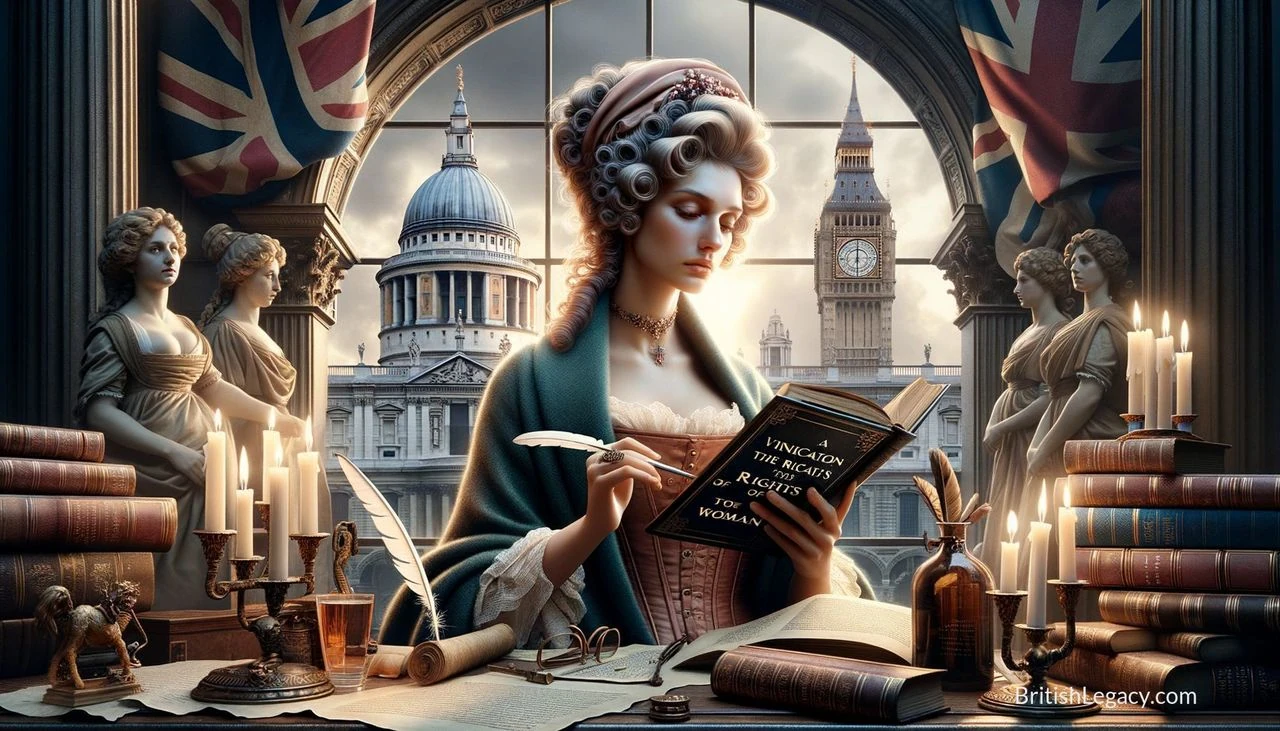
In A Vindication of the Rights of Woman, published in 1792, Wollstonecraft argued that girls and women should receive an education commensurate with their place in society. Women were expected to raise children and to participate in family life, yet were denied the schooling that could prepare them to do so as informed, rational people. That contradiction, she maintained, harmed women and society alike. Women should be treated as rational beings and as companions to men, not trained merely to attract them or serve as ornaments.
Her case was not simply that individual women deserved more opportunity. Wollstonecraft challenged a system that rewarded women for beauty and dependence, then treated the resulting limits on their knowledge as proof of natural inferiority. She argued that education could help women become more independent and contribute to the wider good. In her proposals for national education, she called for boys and girls to be educated together, while also setting out different arrangements for children of different social circumstances. Her argument combined a demand for women’s intellectual development with a practical account of how education might shape family and public life.
Wollstonecraft’s writing on education began before the celebrated Vindication and continued across genres. Her educational works addressed children’s habits and reasoning as well as women’s opportunities. In her novels, she examined the costs of marriages arranged around money and the limited choices open to women. Maria: or, The Wrongs of Woman, left unfinished at her death and published posthumously, follows a woman confined in an asylum by her husband. Together, these works show an author who used both argument and fiction to scrutinise the conditions that restricted women’s lives.
Revolution, relationships and writing
Wollstonecraft followed the French Revolution closely. After writing The Rights of Men, she travelled to Paris in December 1792. The political upheaval and the growing danger to foreigners shaped her life there. She formed a relationship with the American Gilbert Imlay and gave birth to their daughter, Frances, known as Fanny, in 1794. The relationship ended, and Wollstonecraft later travelled in Scandinavia on business connected with Imlay. Her reflections on that journey became Letters Written in Sweden, Norway, and Denmark (1796), a personal travel narrative that also considers society, nature and commerce.
Back in England, Wollstonecraft resumed her literary work and grew close to Godwin. They married on 29 March 1797 after she became pregnant, although both had previously been critical of marriage as an institution. Their daughter Mary was born on 30 August. Wollstonecraft died of septicaemia on 10 September 1797, aged 38, eleven days after the birth. Mary Shelley later became a writer and the author of Frankenstein.
Godwin’s Memoirs of the Author of A Vindication of the Rights of Woman, published in 1798, disclosed intimate details of Wollstonecraft’s relationships and life. The account damaged her reputation for decades, as readers and critics focused on her unconventional personal life rather than her arguments and writing. Her works returned to greater prominence with the growth of the women’s suffrage movement and, later, feminist scholarship. That recovery helps explain why her intellectual work and her personal history have so often been read together, even when the latter has overshadowed the former.
Why Mary Wollstonecraft deserves a place in British Legacy
Wollstonecraft’s place in British intellectual history rests on the clarity with which she connected women’s education to their status as rational people. In A Vindication of the Rights of Woman, she did not accept that social custom could stand as evidence of natural difference. Instead, she examined the schooling women received, the expectations imposed on them and the conclusions society then drew from the results. That reasoning made education more than a private or domestic concern: it became a question about justice and the quality of public life. Her earlier educational writing and her later fiction carried the same scrutiny into the everyday institutions that shaped women’s choices.
Her legacy also includes the range and independence of the career she built. At a time when respectable work for educated women was restricted, she supported herself through teaching, translation, reviewing and authorship. She wrote about education, political power, revolution, marriage and travel, rather than confining herself to one subject or form. The damage done to her reputation after Godwin’s memoir is part of that history too: readers spent generations judging her life by standards she had challenged, before renewed attention returned to her arguments. Remembering Wollstonecraft in British Legacy means recognising both her demand that women be educated as rational participants in society and the persistence of her writing across changing debates about rights and equality.
Sources
Mary Wollstonecraft — Wikipedia revision 1379401036
Adapted in part from Mary Wollstonecraft by Wikipedia contributors, under CC BY-SA 4.0. Text has been edited and combined with the existing article; this adapted text is shared under the same licence. Contributor history.
.jpg)