
David Hockney’s career began in Bradford and travelled widely, but it repeatedly returned to the act of looking: at a face, a room, a swimming pool or the changing landscape of Yorkshire. A painter, photographer and stage designer, he moved between media without abandoning figurative art. His experiments with collage, computers and iPad drawing made the tools of image-making part of his subject; his portraits and landscapes kept people and places in view.
Bradford, art school and an early break with convention
Hockney was born in Bradford on 9 July 1937, the fourth of five children of Kenneth and Laura Hockney. He attended Wellington Primary School and Bradford Grammar School before studying at Bradford College of Art from 1953 to 1958. At the Royal College of Art in London, where he studied from 1959 to 1962, he encountered fellow students including R. B. Kitaj, Frank Bowling and Neil Stokoe. His work appeared alongside Peter Blake’s in the 1961 exhibition New Contemporaries, which helped announce the arrival of British Pop art.
His relationship with the movement was never a simple matter of adopting a label. Early paintings also showed expressionist qualities, and he continued to argue for the possibilities of figurative work at a time when abstract art was prominent. A dispute over his final assessment at the Royal College became an unusually direct demonstration of that conviction. Hockney refused to write an essay required for his examination, maintaining that he should be assessed on his art. When the college said he could not graduate without the essay, he painted Life Painting for a Diploma in protest. The RCA changed its regulations and awarded him a diploma.
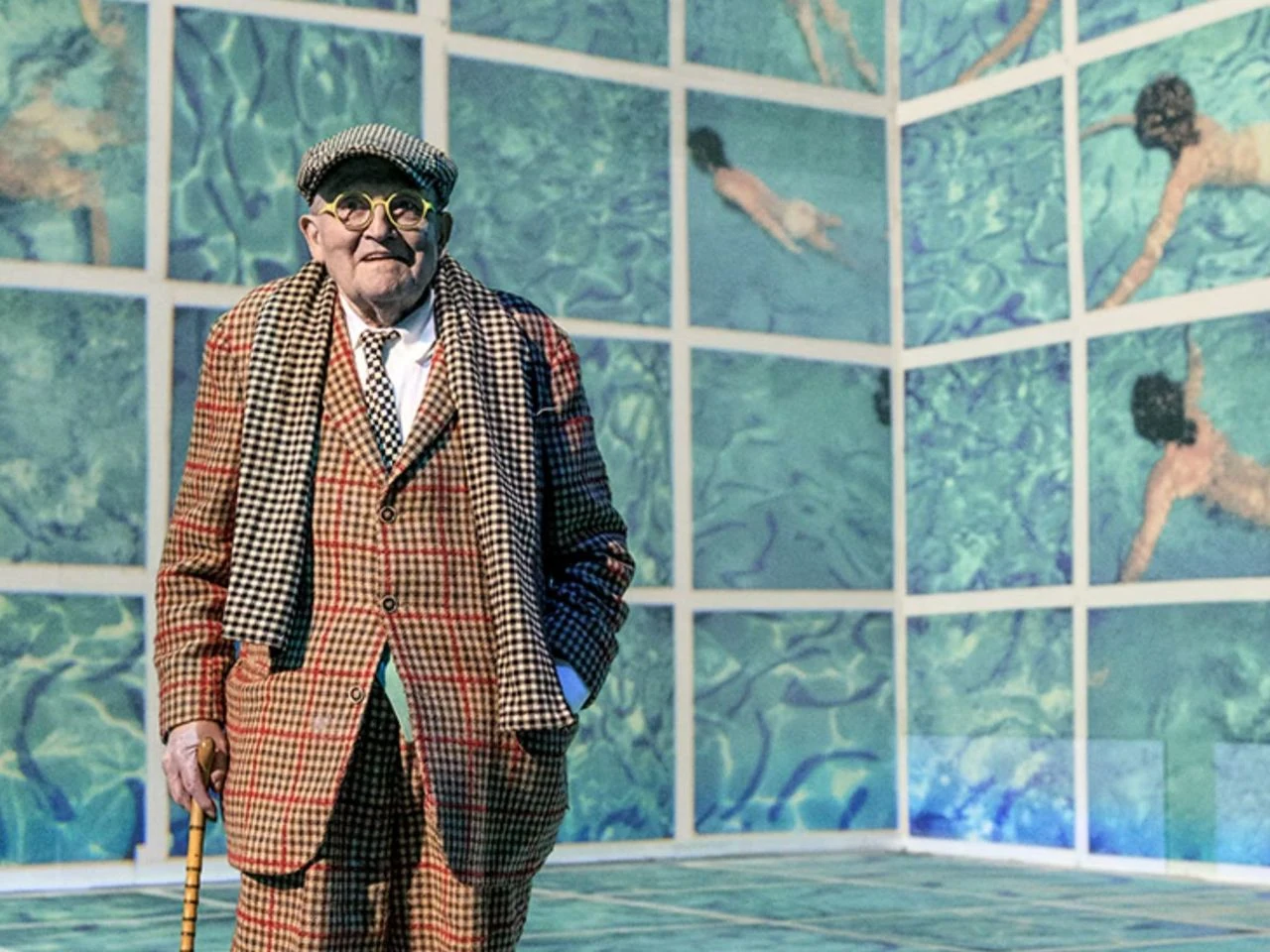
After a short period teaching at Maidstone College of Art, Hockney taught in the United States, including at the University of Iowa, the University of Colorado, Boulder, and the University of California. In 1964 he moved to Los Angeles. California’s light and way of life provided a new setting for his work, including paintings of swimming pools made with acrylic paint and vivid colour. A Bigger Splash (1967) became one of his best-known images. Rather than treating the pool only as a motif, Hockney made it a way to organise colour, surface, architecture and the instant of movement.
Portraits, prints and pictures made in parts
Portraiture remained a constant alongside those Californian scenes. From 1968 he made a series of portraits and double portraits of friends, relatives, lovers and people in the art world, often just under life-size. Mr and Mrs Clark and Percy (1970–71), featuring fashion designer Ossie Clark and Celia Birtwell, places its subjects in a carefully observed interior. Hockney returned to familiar sitters across decades and made more than 300 self-portraits. In the late 1990s, he also used a camera lucida to make more than 200 drawings of friends, family and himself.
Printmaking was not a sideline to his painting. He had begun making prints as a teenager, and later worked in lithography and etching, producing series that drew on literature, art history and his surroundings. A Rake’s Progress (1961–63), Illustrations for Fourteen Poems from C. P. Cavafy (1966) and Illustrations for Six Fairy Tales from the Brothers Grimm (1969) show the range of those interests. His collaboration with printer Aldo Crommelynck led to further experiments in etching, including the 20-print suite The Blue Guitar, inspired by Wallace Stevens’s poem and the work of Pablo Picasso.
In the early 1980s, Hockney began making what he called “joiners”: composite images assembled from multiple photographs. He first used Polaroid prints, then commercially processed colour photographs. The separate images, taken at slightly different times and from different viewpoints, make the finished picture resist the single, fixed perspective of a conventional photograph. Pearblossom Highway #2 is a landscape example; My Mother, Bolton Abbey turns the approach towards portraiture. These works made photographic limitations a prompt for invention rather than a reason to accept the camera’s view.
Yorkshire, technology and the stage
Hockney’s returns to Yorkshire produced a substantial body of landscape work. He visited his mother there regularly in the 1990s and, from the late decade, began to spend longer periods painting the countryside. He worked outdoors in oils and watercolour, often building large pictures from multiple canvases. Bigger Trees Near Warter, a 15-by-40-foot view of a Yorkshire coppice painted on 50 canvases, was shown at the Royal Academy in 2007. In 2008 he gave it to Tate, describing the subject as England and the gift as something he wanted to do.
He did not confine his experiments to traditional materials. In 1985 he used the Quantel Paintbox, a computer that allowed him to draw directly on screen. From 2009 he made hundreds of portraits, still lifes and landscapes with an iPhone and iPad drawing application. He also used digital tools to design a stained-glass window for Westminster Abbey. Unveiled in 2018, the Queen’s Window depicts hawthorn blossom in Yorkshire and is situated in the Abbey’s north transept. It brings a local landscape into a national place of worship through a design developed with a contemporary drawing tool.
His work in the theatre extended the same interest in how images occupy space. Hockney designed sets for the Royal Court Theatre, Glyndebourne and the Metropolitan Opera, among other companies. His early productions included Ubu Roi at the Royal Court in 1966 and The Rake’s Progress at Glyndebourne in 1975. Later opera designs included Wagner’s Tristan und Isolde and Richard Strauss’s Die Frau ohne Schatten at the Royal Opera House. In these projects, drawing and painting had to work at the scale of performance, with scenery, costumes, lighting and music meeting in a shared space.
Hockney’s exhibitions carried this varied practice to broad audiences. The Royal Academy’s 2012 exhibition A Bigger Picture brought together more than 150 works, with Yorkshire landscapes and iPad drawings among them; it attracted more than 600,000 visitors in under three months. Tate Britain’s 2017 retrospective, which surveyed six decades of work across painting, drawing, print, photography and video, became the gallery’s most-visited exhibition at that time.
Public life, fashion and recognition
Hockney’s British connection was not confined to where he was born or the subjects he painted. He came out as gay at 23 while studying in London, several years before the partial decriminalisation of sex between men in England and Wales in 1967. His work explored gay love, including in We Two Boys Together Clinging (1961) and Domestic Scene, Los Angeles (1963). He also signed a 2010 open letter protesting arts cuts. His interest in public debate could be outspoken: he campaigned against the 2005 smoking ban in pubs and restaurants.
His personal style became part of his public image, but the documented relationship between his art and fashion includes more than clothes he wore himself. In 2005, Burberry creative director Christopher Bailey centred a spring/summer menswear collection on Hockney; in 2012, Vivienne Westwood named a checked jacket after him. Hockney also designed the cover and pages for the French edition of Vogue in 1985, painting Celia Birtwell from multiple views. These examples link his work to fashion through named commissions and references, rather than relying only on general claims of influence.
His honours included the John Moores Painting Prize in 1967, appointment as a Member of the Order of the Companions of Honour in 1997 and the Order of Merit in 2012. He was a Royal Academician and declined a knighthood offered in 1990. In 2018, Portrait of an Artist (Pool with Two Figures) sold at Christie’s in New York for $90 million, then a record auction price for work by a living artist. Jeff Koons reclaimed that record in 2019. Hockney died at his home in London on 11 June 2026, aged 88.
Why David Hockney deserves a place in British Legacy
Hockney’s place in British cultural history rests not on a single signature image but on a career that kept renewing the terms of visual art. Educated in Bradford and London, he emerged alongside the generation associated with British Pop art, yet resisted being confined by that movement. He painted portraits and landscapes when abstraction held much of the art world’s attention, and made the experience of seeing central to his work. His Yorkshire paintings brought the changing countryside into large-scale contemporary art; his gift of Bigger Trees Near Warter to Tate placed a monumental image of an English landscape in a public collection.
His contribution also reaches beyond painting. The joiners questioned the camera’s single viewpoint; his printmaking and theatre designs connected image-making with literature, performance and public display; his digital drawings treated new tools as practical artistic media. The Queen’s Window at Westminster Abbey gives that inventive approach a specifically British public setting, while his fashion collaborations show how his visual identity travelled into another creative industry. Across these different forms, Hockney made experimentation legible to wide audiences without giving up close attention to people and place. That combination—local roots, international reach and a willingness to test how pictures are made—makes his career a substantial part of Britain’s modern artistic legacy.
Sources
David Hockney — Wikipedia, revision 1376796197 · David Hockney — Wikipedia
Adapted in part from David Hockney by Wikipedia contributors, under CC BY-SA 4.0. Text has been edited and combined with the existing article; this adapted text is shared under the same licence. Contributor history.
.jpg)