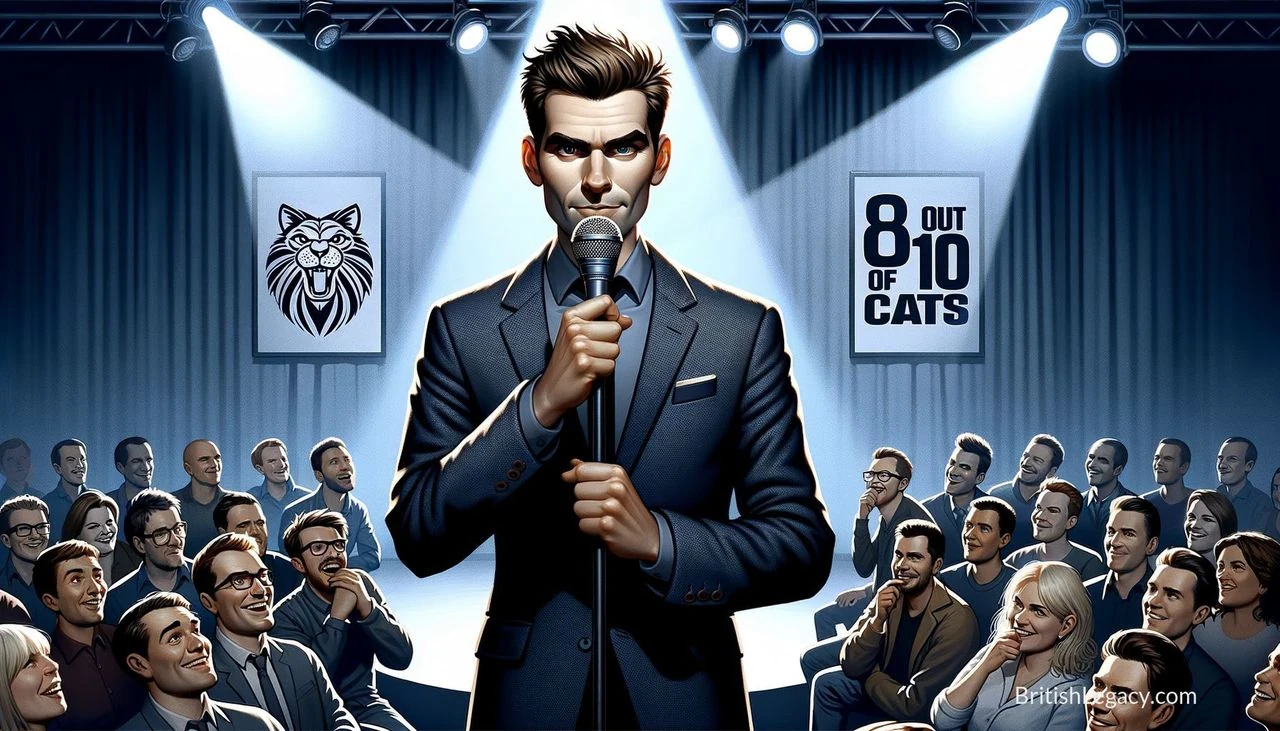
Jimmy Carr’s public image rests on a striking contrast: the clipped precision of a deadpan one-liner and the noisy arguments that can follow it. He has carried that style from London comedy clubs to some of British television’s most recognisable panel shows, while maintaining that stand-up, rather than presenting, is his central craft. His career charts both the reach of modern television comedy and the scrutiny that comes with jokes designed to cross boundaries.
From Shell to the London circuit
James Anthony Patrick Carr was born on 15 September 1972 in Isleworth, London. He grew up in Farnham Common in Buckinghamshire, attended Farnham Common School and Burnham Grammar School, and completed his sixth form at the Royal Grammar School in High Wycombe. After gaining four A grades at A-level, he studied social science and political science at Gonville and Caius College, Cambridge, graduating with first-class honours in 1994.
After university, Carr worked in the marketing department at Shell. He later said he felt miserable in the job and took voluntary redundancy in January 2000. His first paid stand-up performance followed later that month. He had already tried a five-minute unpaid set at the Tut ’n’ Shive pub in Islington in December 1999; from 2000 he began appearing regularly at London clubs including Up The Creek, the Banana Cabaret and the Bearcat Comedy Club.
The early work was not an instant leap from office life to television fame. Carr built a stage career through club performances, festival appearances and touring. His first Fringe appearance under his name came in 2001, as part of the revue Rubbernecker at the Café Royal. In 2002 he presented a solo show, Bare Faced Ambition, at the Gilded Balloon and was nominated for the Perrier Award. The following year, a larger following and television work helped move his Edinburgh performances to a bigger venue. The Observer included him among its 50 funniest acts in British comedy in 2003.
Building a career on television
Carr’s television work began in the early 2000s with Channel 4 game shows, including Distraction and Your Face or Mine? He became a familiar presenter of The Big Fat Quiz of the Year, which began in 2004, and from 2005 hosted 8 Out of 10 Cats. The panel show used questions and discussion about topical events as the frame for comic exchanges between its guests. Carr presented it as it moved between Channel 4, More4 and E4, through 2021.
In 2012, he began presenting 8 Out of 10 Cats Does Countdown, which joins the comedians and panel format of 8 Out of 10 Cats to the word and number rounds of Countdown. The long-running spin-off placed his quick, controlled interruptions alongside a game with its own familiar rules and rhythms. His other television work has included 10 O’Clock Live, a Channel 4 comedy current-affairs programme, and the quiz show I Literally Just Told You. He has also presented programmes for Comedy Central and appeared on panel shows including QI and A League of Their Own.
His work has travelled beyond British television. Carr appeared on American late-night programmes and hosted the US version of Distraction. Netflix released his stand-up special Funny Business in 2016, and he presented the American panel show The Fix in 2018. Those projects extended a career whose foundations remained live performance: Carr has described television as a side show to stand-up, and his tours have taken him to audiences in Britain and overseas.
The mechanics of a stage persona
Carr is associated with rapid-fire one-liners, a deadpan delivery and dark, often provocative subject matter. The effect depends on compression: the audience is given little time between the setup and the turn, while his carefully level delivery contrasts with the response in the room. That technique has served him in both club sets and television formats, where a short joke can punctuate a longer exchange.
His live work has included tours such as Gag Reflex, Rapier Wit, Laughter Therapy, Funny Business and Terribly Funny. In 2006, Gag Reflex won the British Comedy Award for Best Live Stand-Up. Carr has repeatedly returned to the Edinburgh Festival Fringe, where early performances helped establish him as a club comic before his television profile grew. After a decade away, he returned to the Fringe in 2024 with Laughs Funny.
The stage persona has also made the boundaries of comedy a recurring subject of public argument. Carr has defended the principle that comedy should not have forbidden subjects, while jokes about injured servicemen and disabled people drew criticism. In 2021, a joke about the murder of Roma people during the Holocaust in his Netflix special His Dark Material prompted condemnation from organisations including the Auschwitz Memorial, Hope not Hate and the Traveller Movement. Carr said the joke was intended to draw attention to Roma victims; he stood by it despite the backlash. These disputes are part of the documented reception of his work, not proof that every audience or critic responds in the same way.
Public scrutiny and professional range
In 2012, Carr’s participation in the K2 tax avoidance scheme became public. The controversy followed reporting about the scheme and criticism from Prime Minister David Cameron. Carr withdrew from it and apologised, describing his involvement as “a terrible error of judgement”. In a later television appearance, he acknowledged that what he had done was wrong and argued that the law should be made clearer. The episode remains a conspicuous collision between his public comedy and questions about the responsibilities attached to earning and paying tax.
Writing has been another part of Carr’s career. With Lucy Greeves, he published The Naked Jape: Uncovering the Hidden World of Jokes in 2006, a book about the history and theory of joke-telling. He later wrote Before & Laughter, published in 2021. His professional life has also included charity appearances: he took part in the 2012 Secret Policeman’s Ball in New York in support of Amnesty International and appeared at Stand Up for Heroes events in 2018 and 2023.
Recognition has come in several forms. Carr received a Royal Television Society Award for Best On-Screen Newcomer in 2003 and the British Comedy Award for Best Live Stand-Up in 2006. These honours sit alongside a body of work sustained by touring, television hosting and writing, rather than by a single format or role.
Why Jimmy Carr deserves a place in British Legacy
Jimmy Carr’s place in British Legacy rests on a clearly identifiable contribution to British comedy and television: he has brought a distinctive stand-up technique into mainstream panel-show formats without leaving the live circuit behind. His work on 8 Out of 10 Cats and 8 Out of 10 Cats Does Countdown made the quick exchange between comedian, guest and host a durable part of Channel 4’s comedy output. The latter show, in particular, sets his rapid jokes against the methodical structure of a familiar quiz, making comedy and wordplay work together for a broad television audience.
His route into that position matters too. Carr left a marketing job, began with small club sets and developed his stage career through years of touring and Fringe appearances. That path gives the story more substance than a list of television credits: his presenting work grew from a working comedian’s experience of timing, audience response and live performance. His international specials and appearances show how far that British television and touring career has travelled.
His legacy is not a claim that every joke succeeds or that criticism should be dismissed. Controversies over material and the tax scheme belong in the account because they show the consequences of his choices and the scrutiny his public profile attracts. Taken together, the achievements and disputes make Carr a significant contemporary figure in British comedy: a performer whose style is instantly recognisable, whose television work has endured, and whose career continues to provoke debate about the limits and responsibilities of humour.
Sources
Jimmy Carr — Wikipedia, revision 1379387957 · Jimmy Carr — Wikipedia
Adapted in part from Jimmy Carr by Wikipedia contributors, under CC BY-SA 4.0. Text has been edited and combined with the existing article; this adapted text is shared under the same licence. Contributor history.