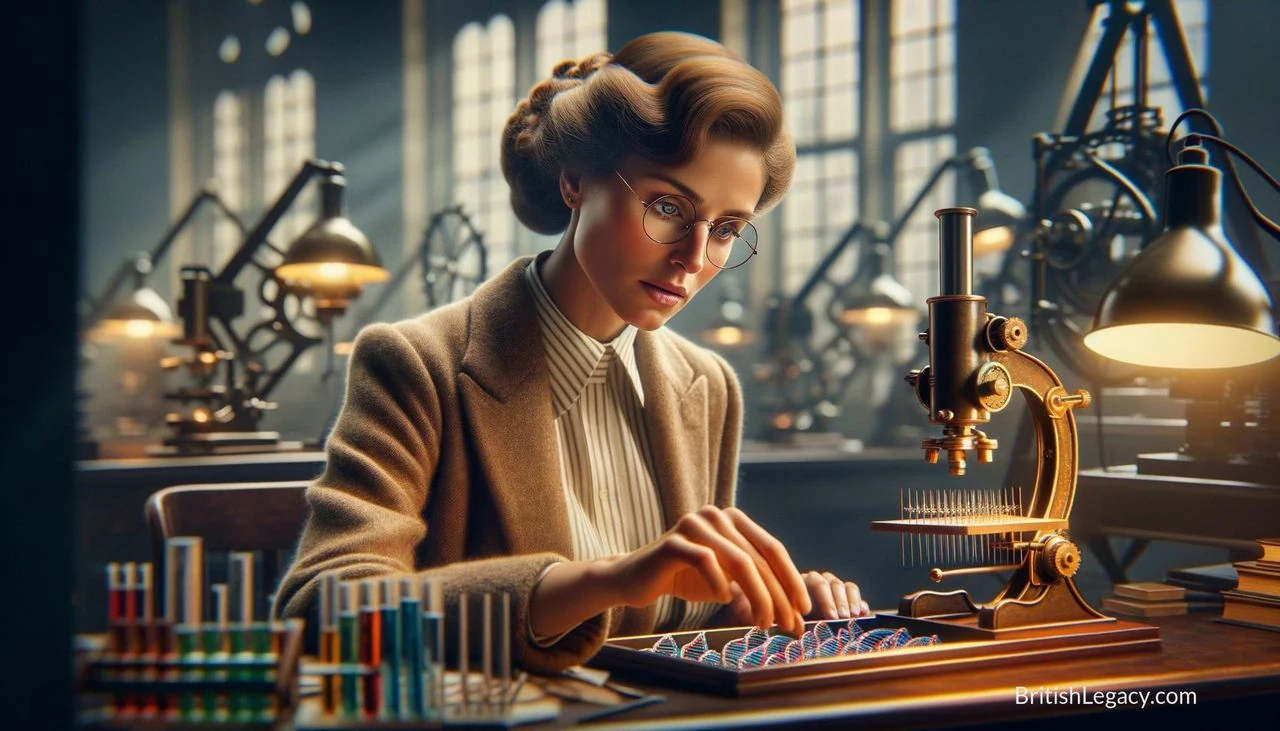
Rosalind Franklin’s research helped make the structure of DNA legible. At King’s College London, she brought physical chemistry and painstaking X-ray diffraction work to the molecule, distinguishing its forms and producing evidence that proved crucial to the double-helix model. The familiar story of Photo 51 is only part of her scientific life: before DNA, she investigated coal and carbon; after leaving King’s, she led research on viruses at Birkbeck. Her career was cut short at 37, but its range extended well beyond the discovery for which she is now best known.
From Cambridge to coal research
Franklin was born in Notting Hill, London, on 25 July 1920. She studied natural sciences at Newnham College, Cambridge, graduating in 1941. She then joined the British Coal Utilisation Research Association, where she investigated the structure and porosity of coal. Her findings connected the material’s fine internal structure with its permeability and performance as fuel. This work formed the basis of her Cambridge doctorate, awarded in 1945, and established her as a physical chemist before her better-known research on DNA.
In 1947 Franklin moved to Paris to work at the Laboratoire Central des Services Chimiques de l’État with Jacques Mering. There she developed her practical command of X-ray crystallography, applying diffraction methods to carbon and other materials that did not form regular crystals. She studied how carbon’s atomic arrangement changed as it was converted to graphite and published influential work distinguishing graphitising from non-graphitising carbon. The techniques she developed in Paris would later prove important in her work on biological molecules.
What the X-rays showed
Franklin began work at King’s College London in 1951 as a research associate in its Medical Research Council Biophysics Unit. Her research was redirected to DNA, and Raymond Gosling, a graduate student, worked with her. Franklin refined the X-ray equipment and developed a method for controlling humidity around DNA fibres. This allowed her and Gosling to produce clearer diffraction images and to establish that DNA could take two forms, which they called A and B.
The distinction mattered. Franklin’s measurements showed that the forms behaved differently as their water content changed. Her analysis also indicated that phosphate groups lay towards the outside of the molecule and helped define structural dimensions. Photo 51, the celebrated image of B-form DNA, was taken by Gosling in 1952 while he was working with Franklin. Its cross-shaped pattern provided striking evidence of a helical structure. It was not, by itself, a complete account of DNA’s arrangement, but it formed part of a body of experimental work that constrained the possible models.
Watson and Crick, working at Cambridge, used important findings from the King’s research. Watson saw Photo 51 after Wilkins showed it to him; Franklin had not given him the photograph. A report prepared for a Medical Research Council visit to King’s, containing data from Franklin and Gosling’s work, was also shown to Crick by Max Perutz. How information passed between the two institutions, and how the contributions were acknowledged, has since been disputed and examined. What is clear is that Franklin’s experimental results were central to testing and informing the model. In 1953, Watson and Crick published their proposed double helix in Nature, alongside papers by Wilkins and by Franklin and Gosling that presented evidence from the King’s team.
Franklin’s own work did not amount to the finished structure proposed by Watson and Crick. She was cautious about building models before the data warranted them, and her research notes show her developing a view of the molecule’s helical character. In early 1953 she and Gosling prepared work on DNA that was consistent with the model. This history is more precise than either the claim that she alone discovered the double helix or the older portrayal of her as a minor figure: she produced crucial experimental evidence and made her own substantial contributions to understanding DNA’s structure.
A new laboratory, new questions
Franklin moved to Birkbeck College in 1953, where she led a research group under the crystallographer John Desmond Bernal. She continued to study biological structures, turning in particular to viruses. Her team investigated tobacco mosaic virus using X-ray diffraction. Franklin established that its particles were uniform in length and worked with colleagues to show that protein subunits were arranged helically around the virus’s RNA. She also oversaw research on other plant viruses, including turnip yellow mosaic virus.
These studies brought together structural analysis, experimental discipline and collaboration with younger researchers. Aaron Klug, who worked with Franklin at Birkbeck, continued aspects of the group’s research after her death and later received the 1982 Nobel Prize in Chemistry for work on crystallographic electron microscopy and biological structures. Franklin’s Birkbeck research also included work on polio virus, though illness prevented her from completing that project.
In 1957, Franklin began preparing a large model of tobacco mosaic virus for the international fair in Brussels. The exhibition opened on 17 April 1958, the day after her death. She died in Chelsea, London, on 16 April, aged 37, from ovarian cancer. Her work on viruses continued through her team, and the research was recognised in the inscription on her tomb as a lasting benefit.
Recognition and the record of discovery
Franklin did not share the 1962 Nobel Prize in Physiology or Medicine awarded to Francis Crick, James Watson and Maurice Wilkins for work on nucleic acids. She had died four years earlier; Nobel Prizes are not awarded posthumously. The prize recognised the recipients’ body of work, rather than serving as a complete accounting of every contribution to the discovery of DNA’s structure. Her role was not fully acknowledged in the original presentation of the discovery, and later accounts, including Watson’s memoir, helped prompt closer scrutiny of the evidence and of the way credit had been assigned.
Recognition of Franklin’s scientific work has since taken many forms in Britain. King’s College London named the Franklin–Wilkins Building in honour of the researchers’ work there, and the Royal Society established the Rosalind Franklin Award and Lecture for contributions to natural science, engineering or technology. Her former school, St Paul’s Girls’ School, established a technology centre in her name; Newnham College, Cambridge, opened a graduate residence named the Rosalind Franklin Building. A blue plaque commemorates her London home, and a later plaque at King’s records the DNA diffraction research carried out there.
In 2019, the European Space Agency named its ExoMars rover Rosalind Franklin. The following year, the Royal Mint issued a 50p coin marking the centenary of her birth, featuring a stylised version of Photo 51. These honours do not replace the scientific record; they make visible a researcher whose contribution to one of modern science’s defining discoveries was once too often reduced or obscured.
Why Rosalind Franklin deserves a place in British Legacy
Franklin’s place in British Legacy rests first on the quality and reach of her science. Her work at the British Coal Utilisation Research Association and in Paris advanced the study of coal and carbon; at King’s, her X-ray diffraction research with Raymond Gosling produced evidence that helped establish DNA’s structure; at Birkbeck, she led ambitious research on viruses. Those are connected achievements, not a single famous image standing in for an entire career. They show how methods developed in one field can open questions in another, and how careful measurement can shape a major scientific explanation.
Her story also matters because it makes the history of discovery more accurate. Franklin was neither the sole maker of the double-helix model nor a peripheral observer. Her experimental results were used by other researchers, while the transfer and acknowledgement of those results became a lasting subject of debate. Remembering her alongside Gosling, Wilkins, Watson and Crick gives a fuller account of how science was done and how credit was recorded. British institutions now commemorate her through awards, buildings and plaques, while the Royal Mint’s centenary coin brought her image and work to a wider public. Her legacy lies both in what her research established and in the continuing effort to recognise the people whose evidence makes scientific discovery possible.
Sources
Rosalind Franklin — revision 1379860107
Adapted in part from Rosalind Franklin by Wikipedia contributors, under CC BY-SA 4.0. Text has been edited and combined with the existing article; this adapted text is shared under the same licence. Contributor history.