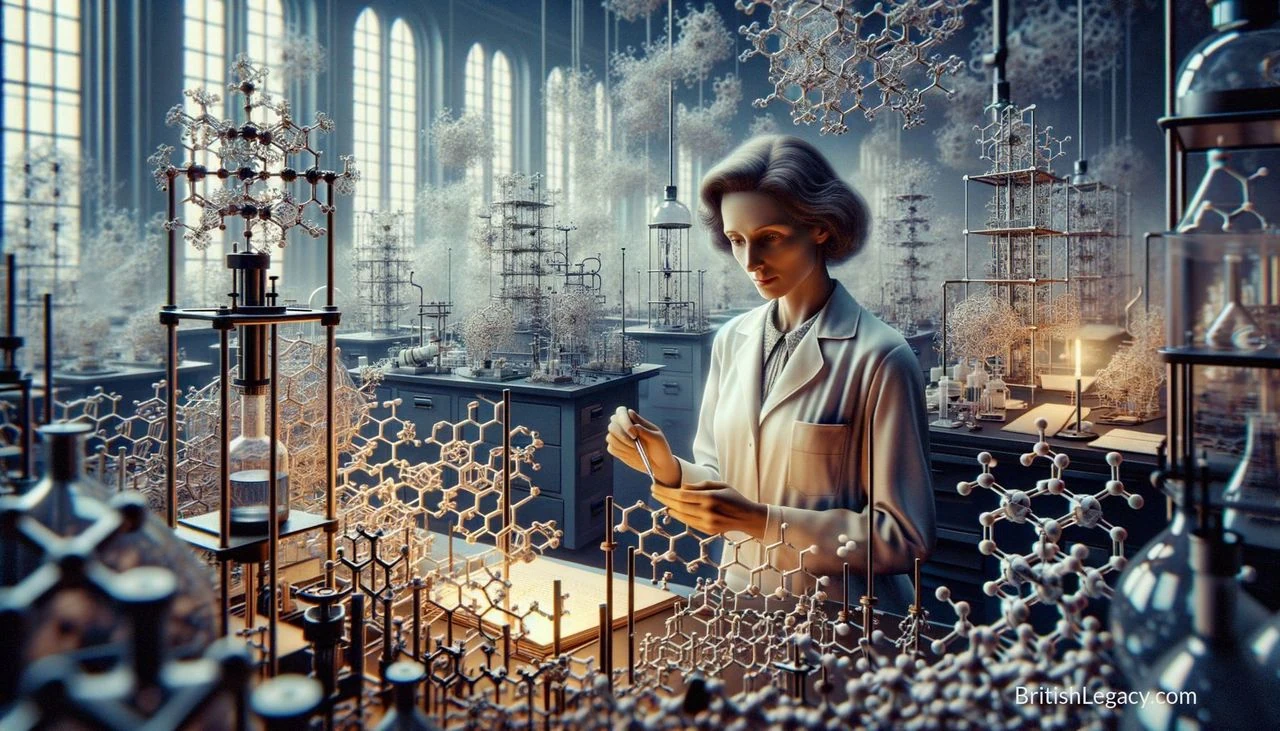
Dorothy Hodgkin made molecules visible. Using X-ray crystallography, she worked out the arrangements of atoms in substances too complex for the methods of her early career. Her research revealed the structures of penicillin and vitamin B12, and, after decades of work, insulin. The discoveries advanced a developing field and placed an Oxford-based English chemist at the centre of international science.
A childhood interest becomes a scientific method
Born Dorothy Mary Crowfoot in Cairo on 12 May 1910, she was the eldest of four daughters of John Winter Crowfoot and Grace Mary Hood. Her parents worked in North Africa and the Middle East, and the family spent part of each year in England. In 1914, when Dorothy was four, her mother left her and her younger sisters with their grandparents near Worthing while she returned to Egypt. The children spent much of their childhood apart from their parents, who encouraged Dorothy’s interest in science from a distance.
Her mother, a botanist, helped foster that interest. Dorothy was studying crystals by the age of ten; as a teenager, she and her sister examined pebbles with a portable mineral-analysis kit. A book about X-ray crystallography, given to her by her mother for her sixteenth birthday, helped direct her towards the technique that would define her career. She attended Sir John Leman Grammar School in Beccles, where she was one of two girls permitted to study chemistry. Because Latin was required for Oxford admission, the headmaster gave her extra tuition.
In 1928 she entered Somerville College, Oxford, to study chemistry, graduating with first-class honours in 1932. That autumn she began doctoral research at Newnham College, Cambridge, under John Desmond Bernal. She worked with him on applying X-ray crystallography to biological substances, including pepsin. Hodgkin’s later accounts gave Bernal credit for taking the initial photographs and for key insights, even as the work became a foundation for her own research. Cambridge awarded her PhD in 1937 for research on X-ray crystallography and the chemistry of sterols.
From Oxford laboratory to molecular structures
Hodgkin returned to Oxford in 1934 with a research fellowship at Somerville. She began teaching chemistry with her own laboratory equipment; in 1936 the college appointed her its first fellow and tutor in chemistry. She remained in that post until 1977, while her research helped establish X-ray crystallography as a means of investigating biological molecules. In 1947 she was elected a Fellow of the Royal Society.
Her work demanded patience as well as technical ingenuity. In 1934 she developed rheumatoid arthritis, which caused pain and swelling in her hands and later affected her feet. When the condition made it difficult to operate the switch on her X-ray equipment, she devised a lever. In later years she spent considerable time in a wheelchair, but continued her scientific work.
In 1945, working with C. H. Carlisle, Hodgkin published a three-dimensional structure of a steroid, cholesteryl iodide. That year she and colleagues, including biochemist Barbara Low, solved the structure of penicillin. Their analysis showed that the molecule contained a beta-lactam ring, contrary to scientific opinion at the time. The research was published in 1949. Rather than treating this as a recipe for producing the antibiotic, it is more accurate to see the achievement as a structural explanation of the molecule: a difficult piece of chemistry that clarified what penicillin was.
Vitamin B12 and the long work on insulin
Hodgkin first encountered vitamin B12 in 1948. Its large, intricate molecule posed a formidable problem: apart from the presence of cobalt, much of its structure was unknown. She grew crystals and used their properties, followed by X-ray analysis, to work towards the arrangement of its atoms. Her findings were published in 1955 and 1956. In 1964 she received the Nobel Prize in Chemistry for her work on the structures of important biochemical substances, including vitamin B12. She was the third woman to receive the chemistry prize.
Insulin presented a still longer challenge. Hodgkin began investigating it in 1934, after receiving a small sample of crystalline insulin from Robert Robinson. Existing crystallographic methods could not yet resolve a molecule of its complexity. It took decades of improvements in technique and computing before she and an international team could determine the structure; that work was achieved in 1969. The result extended what structural research could tackle and contributed to understanding a hormone central to diabetes treatment. It should not be confused with a claim that her work alone made insulin treatment possible: the achievement was to determine the molecule’s structure after a sustained collective scientific effort.
In 1960 Hodgkin became the Royal Society’s Wolfson Research Professor, a position that supported her research at Oxford until 1970. She was also a mentor and teacher: one of her Oxford students was Margaret Roberts, later Margaret Thatcher. Hodgkin was a lifelong Labour supporter, while Thatcher later kept a portrait of her former teacher in Downing Street.
International science and work for peace
Hodgkin maintained scientific contacts abroad, including with researchers in Moscow, India and China. She first visited China in 1959 and returned several times over the next quarter-century. She also travelled and lectured internationally on insulin research. From 1972 to 1975 she was president of the International Union of Crystallography.
Her public commitments extended beyond science. Concerned about social inequality and the risk of armed conflict, she supported efforts to reduce the threat of nuclear war. She became president of the Pugwash Conferences on Science and World Affairs in 1976 and held the post until 1988. She accepted the Lenin Peace Prize in 1987 for work on peace and disarmament. Her marriage to historian Thomas Lionel Hodgkin, whom she married in 1937, connected her family life with another international perspective: his work and interests were closely tied to African politics and the emerging postcolonial states. They had three children.
Hodgkin died in Ilmington, Warwickshire, on 29 July 1994, aged 84. Her honours included the Order of Merit in 1965 and the Copley Medal in 1976; she was the first woman to receive the latter. She served as Chancellor of the University of Bristol from 1970 to 1988. Her name also lives on in a Royal Society fellowship, a building at Oxford and a lecture established in her honour.
Why Dorothy Hodgkin deserves a place in British Legacy
Hodgkin’s place in British scientific history rests on more than a list of distinctions. Based for most of her working life at Oxford, she helped turn X-ray crystallography into a powerful way to investigate biological molecules. Her work on penicillin clarified its structure, while her analysis of vitamin B12 showed how the technique could address a molecule of extraordinary complexity. The Nobel Prize recognised that achievement, but its importance also lies in the new possibilities it opened for structural chemistry and biology.
Her insulin research demonstrates the scale and duration of that contribution. The project began in 1934, when the available methods were inadequate, and reached its structural breakthrough in 1969 after decades of technical development and collaboration. Hodgkin’s career shows how scientific progress depends not only on a striking result but also on patient work, improved instruments and the exchange of knowledge between researchers. She continued working despite debilitating rheumatoid arthritis, devising practical adaptations when her hands could no longer manage laboratory equipment unaided.
Her legacy also includes teaching, international scientific relationships and sustained work for peace. As a British woman whose research earned a place among the most consequential achievements in chemistry, she widened what was visible and achievable in her field. The fellowship and educational tributes bearing her name connect that record to future researchers. Remembering Hodgkin in British Legacy recognises both the discoveries made in her Oxford laboratory and the wider value of science pursued with persistence, intellectual openness and a commitment to human welfare.
Sources
Dorothy Hodgkin — revision 1379081977
Adapted in part from Dorothy Hodgkin by Wikipedia contributors, under CC BY-SA 4.0. Text has been edited and combined with the existing article; this adapted text is shared under the same licence. Contributor history.