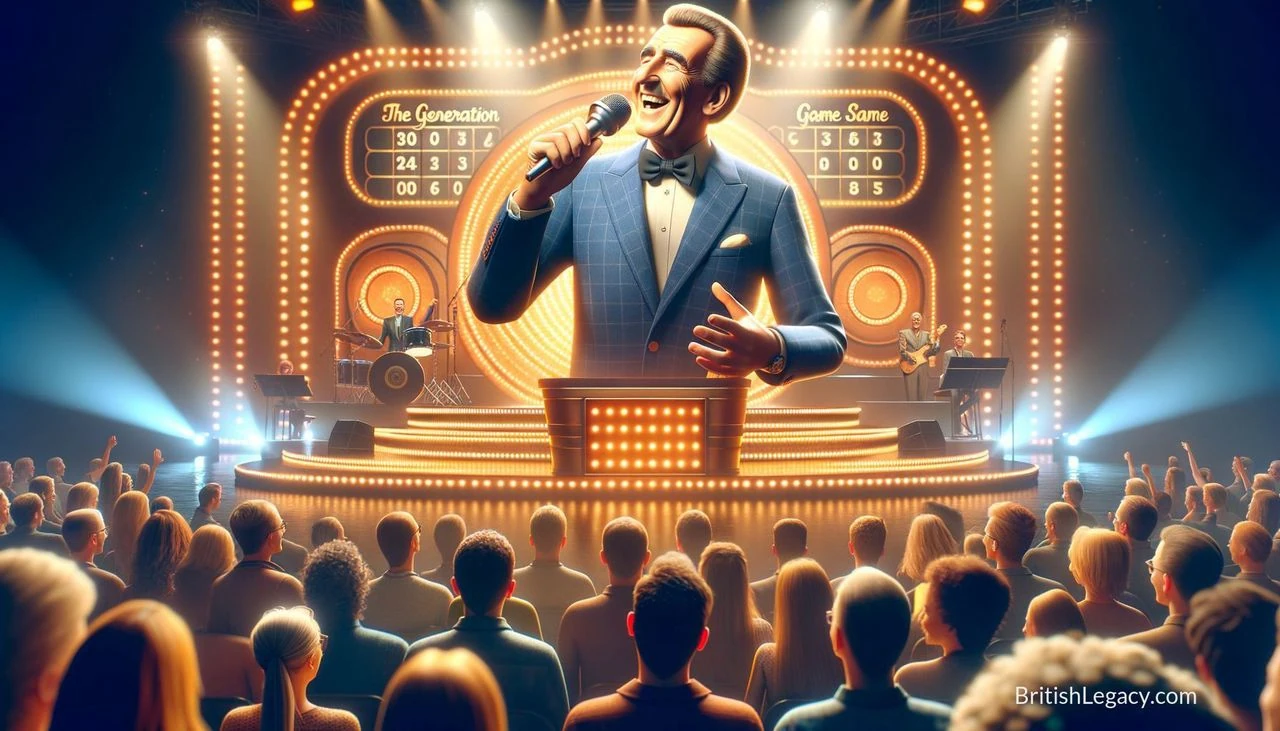
Bruce Forsyth’s television presence was built on skills learned long before the studio audience knew his name: dancing, singing, comic timing and the knack of holding a room. He began performing as a child, spent years travelling Britain’s theatres, circuses and summer seasons, and brought that live-show experience to some of the country’s best-known game shows. His career crossed from variety entertainment to television, with The Generation Game, Play Your Cards Right and Strictly Come Dancing among its defining programmes.
From Edmonton to the variety circuit
Bruce Joseph Forsyth-Johnson was born in Edmonton, Middlesex, on 22 February 1928, the son of Florence Ada Pocknell and John Thomas Forsyth-Johnson. His family owned a car-repair garage, and his parents, who belonged to the Salvation Army, played brass instruments; his mother also sang. After watching Fred Astaire in films when he was eight, Forsyth trained in dance in Tottenham and Brixton. He attended the Latymer School.
Forsyth made his television debut as a child in 1939, singing and dancing on the BBC talent programme Come and Be Televised. His live public performances began at 14, with a song, dance and accordion act billed as Boy Bruce, the Mighty Atom. His first appearance was at the Theatre Royal in Bilston. These beginnings fed into a demanding post-war apprenticeship: he worked on stage, travelling around the country for summer seasons, pantomimes and circus engagements, and became known for a strong-man act.
National service interrupted that stage career. Conscribed into the Royal Air Force at 19, he served in its Film Unit from 1947 to 1949. Forsyth later described the experience as teaching him respect and discipline. After leaving the RAF, he returned to performing and continued to work in live entertainment as television opportunities opened.
A variety-show host finds his television audience
In 1958, an appearance with comedian Dickie Henderson led to an offer to compère Val Parnell’s weekly television variety show, Sunday Night at the London Palladium. Forsyth hosted for two years, took a year away, then returned for another year. The role brought him before a large television audience, but his stage commitments continued through the 1960s and eventually made the presenting schedule impractical.
His work in this period extended beyond television presenting. He appeared in the London production of the musical Little Me in 1964 and played Arthur Lawrence, the father of Julie Andrews’s character, in the 1968 film Star!. He continued to appear on stage and on screen, drawing on the range of a performer trained in live entertainment rather than a single television format.
Forsyth’s move into game shows was already under way during his Palladium years: he presented the 15-minute game Beat the Clock as part of the variety programme. In 1971, he became host of The Generation Game. The BBC show returned with him from 1990 to 1994, after his first run from 1971 to 1977. Its family and contestant games gave his comic timing room to work, while a direct exchange with the studio audience became one of his most recognisable devices.
Catchphrases, poses and game-show craft
“It’s nice to see you, to see you...” became a call-and-response greeting: the audience supplied the emphatic “Nice!” Forsyth used it on later programmes, extending a greeting first associated with The Generation Game into a signature of his television persona. He also introduced “The Thinker” pose, appearing in silhouette after the show’s opening titles, and used it on other programmes. His on-screen manner drew on the same physical comedy and showmanship that had served him on stage.
After leaving The Generation Game in 1977, Forsyth took the lead in The Travelling Music Show, built around songs by Anthony Newley and Leslie Bricusse. It played in provincial theatres before moving to London, where it closed after four months in July 1978. Later that year he returned to television with Bruce Forsyth’s Big Night, an ITV Saturday-night entertainment programme that ran for one series.
Play Your Cards Right brought him a further long-running role. The British version of the American game show Card Sharks aired with Forsyth as host from 1980 to 1987, returned from 1994 to 1999, and had a shorter run from 2002 to 2003. In 1986 he also presented the American game show Bruce Forsyth’s Hot Streak, which ran for 65 episodes. Back in Britain, he hosted You Bet! from 1988 to 1990 and Bruce’s Price Is Right from 1995 to 2001. He also appeared in formats that did not last, including Takeover Bid and Hollywood or Bust: a long career encompassed failures as well as familiar hits.
A later generation meets Forsyth
In 2004, Forsyth joined Tess Daly as co-host of the BBC’s Strictly Come Dancing. He remained a regular presenter until 2013 and formally stepped down from the live show in 2014, with the change allowing him to reduce his workload and prepare for recorded specials. His return to a Saturday-night audience introduced his style to viewers who had not watched his earlier game shows. He made his last full television appearance on the Strictly Children in Need special in 2015.
His work beyond the studio included a sustained commitment to charity, particularly organisations supporting children, disabled people and animals. He became a patron of EveryChild in 2001 and, for his 80th birthday in 2008, asked for donations to the charity instead of presents. He supported Variety, which assists disabled and disadvantaged children, and helped the organisation provide specially adapted Sunshine Coaches. He also backed Caudwell Children and took part in fundraising events, including golf tournaments for children’s medical research.
Forsyth received an OBE in 1998 and a CBE in 2006 before being knighted in the 2011 Birthday Honours for services to entertainment and charity. Other recognition included the BAFTA Fellowship in 2008 and a Royal Television Society Lifetime Achievement Award in 2009. Guinness World Records recognised him in 2012 for the longest television career for a male entertainer.
Why Bruce Forsyth deserves a place in British Legacy
Forsyth’s place in British Legacy rests on more than a familiar catchphrase. He carried the craft of live variety performance into television, using song, dance, physical comedy and quick exchanges with contestants to make the presenter an active part of the entertainment. His time on The Generation Game helped establish a style of family game show in which ordinary contestants, not just the host or the rules, supplied the evening’s action. The audience’s answer to his greeting and his “Thinker” silhouette became recognisable television rituals, repeated beyond the programmes where they began.
His career also records the changing shape of British popular entertainment. He moved from theatres and circus engagements to the Palladium, then adapted to successive television formats and found a new audience with Strictly Come Dancing. That longevity was not simply a matter of returning to familiar material: his work crossed music, comedy, presenting and performance. Alongside it, his support for charities working with children, disabled people and animals gave his public profile a practical dimension beyond broadcasting. His honours recognised both entertainment and charitable service. Forsyth’s legacy is therefore specific: a performer who connected the variety stage with mass television, helped define enduring game-show formats, and continued to make that connection across generations of viewers.
Sources
Bruce Forsyth — revision 1376786439 · Bruce Forsyth
Adapted in part from Bruce Forsyth by Wikipedia contributors, under CC BY-SA 4.0. Text has been edited and combined with the existing article; this adapted text is shared under the same licence. Contributor history.