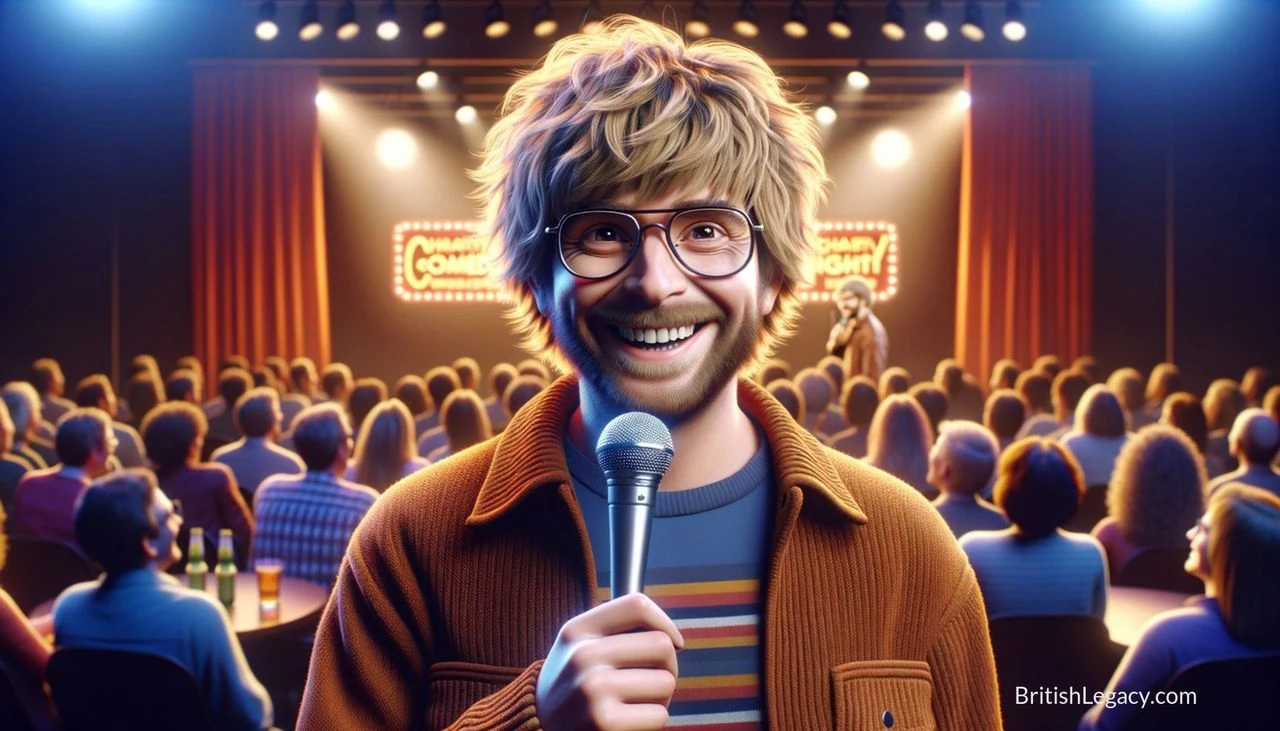
Alan Carr’s rise from the Manchester comedy circuit to the centre of British television began with two awards in 2001. His route was not simply from stage to screen: stand-up, radio, books and a succession of television formats have all formed part of a career built on performance and quick, informal conversation. The Friday Night Project introduced him to a broad television audience; Alan Carr: Chatty Man gave him a long-running platform of his own.
From Weymouth to the Manchester comedy circuit
Born Alan Graham Carr in Weymouth, Dorset, on 14 June 1976, he spent most of his childhood in Northampton. He attended Weston Favell Upper School and went on to study Drama and Theatre Studies at Middlesex University, graduating with a 2:1 BA (Hons). After completing his degree, he moved to Manchester hoping to become a comedian.
Getting established took time. Carr worked in a call centre for five years while performing on the comedy circuit in his spare time. He became a regular on Manchester’s stages and ran a monthly comedy and cabaret night, Alan Carr’s Ice Cream Sunday, at the Manchester Comedy Store. The city remained an important setting in his early career: it was where he developed as a live performer and met fellow comedians including Jason Manford, Justin Moorhouse and John Bishop.
In 2001, Carr won both City Life’s Best Newcomer of the Year and the BBC New Comedy Award. Those prizes marked an early breakthrough, but he continued to perform as his television work expanded. His stand-up career included appearances at Edinburgh and the Royal Variety Performance, a UK tour in 2007, and performances at the Hammersmith Apollo and on BBC One’s Live at the Apollo. He also appeared at festivals in Britain and abroad, including the Reading and Leeds Festivals, Latitude and Montreal’s Just for Laughs.
A familiar face on Channel 4
Carr’s first regular television work included a 2005 appearance on 8 Out of 10 Cats. He and Justin Lee Collins became co-presenters of The Friday Night Project from its second series in 2006. The Channel 4 comedy-variety show mixed celebrity guests, sketches and studio presentation; its follow-up, The Sunday Night Project, continued the format. Carr’s role gave his stand-up experience a different reach, making his exchanges with guests and his performance in a studio setting central to the programme.
He also hosted the entertainment show Alan Carr’s Celebrity Ding Dong, which ran for two series between 2007 and 2009. In 2009, he began presenting Alan Carr: Chatty Man. The chat show ran for 16 series from 2009 to 2016, followed by Christmas specials in 2016 and 2017. Its relaxed interview format placed Carr’s comic asides alongside conversations with guests from across entertainment. The series earned him a substantial run as a lead presenter, as well as recognition from television and comedy award bodies.
Across later programmes, Carr has moved between presenting, judging and performing. He was a team captain on 8 Out of 10 Cats Does Countdown, became a judge on RuPaul’s Drag Race UK, and presented Interior Design Masters with Alan Carr. Changing Ends, which began in 2023, brought him into a sitcom as a writer and executive producer as well as a performer. Other projects have included the series with Amanda Holden Amanda & Alan’s Italian Job, Amanda & Alan’s Spanish Job and Amanda and Alan’s Greek Job.
Radio, touring and books
Radio offered another outlet for Carr’s hosting. After early BBC Radio 2 appearances, he began presenting Going Out with Alan Carr in April 2009, with Emma Forbes and later Melanie Sykes as co-presenters. The Saturday evening programme ran until 2012, when Carr left to focus on Chatty Man. He returned to the station for later presenting work, including Summer Escapes with Sykes, which ran in annual instalments from 2017 to 2020.
Live comedy has remained a thread through his broadcasting career. Carr’s tours include Tooth Fairy, Spexy Beast, Yap, Yap, Yap!, Not Again, Alan! and Regional Trinket. The tours took his work back to the stage while television and radio made him familiar to audiences who might not have encountered his stand-up in a club.
In 2008, Carr published his autobiography, Look Who It Is!, recounting his early life and the road to television. His later book, Alanatomy: The Inside Story, extended his writing beyond the first account. Together, the books sit alongside the performance work as part of a career in which he has addressed audiences in several different forms.
Awards and a changing television career
Carr’s awards reflect several stages of that career. After the City Life and BBC prizes in 2001, he won British Comedy Awards for Best Live Stand-up in 2007 and Best Comedy Entertainment Personality in 2008. He later received National Television Awards for Best Chat Show Host in 2012 and 2015, and a BAFTA Television Award for Best Entertainment Performance in 2013. These honours recognised work across live comedy and television, rather than a single format.
His television work has continued to change in scale and kind: from co-presenting a weekly comedy show to hosting a long-running chat programme, judging a competition series and developing a sitcom. In 2025, he won the first series of The Celebrity Traitors and donated its £87,500 prize to Neuroblastoma UK, a charity he chose. The range of these roles shows a working career that has continued beyond the shows most closely associated with his name.
Why Alan Carr deserves a place in British Legacy
Alan Carr’s place in British Legacy rests on a sustained contribution to British comedy and broadcasting, rather than on one television credit alone. His early years on the Manchester circuit established the live performance skills that preceded his national profile. The Friday Night Project brought those skills to Channel 4’s comedy-variety format, while Chatty Man gave him room to develop a recognisable approach to celebrity interviews over 16 series. These programmes are specific milestones in the evolution of his career and in the work of British television entertainment.
His career also demonstrates the reach a comedian can build across different media without leaving live performance behind. Carr has toured, presented for BBC Radio 2, published books, judged television competitions and worked as a writer and executive producer on Changing Ends. His award record spans stand-up, comedy and television presentation; the prize money he donated after winning The Celebrity Traitors provides a concrete example of his work having a benefit beyond entertainment. Taken together, these achievements make Carr a significant contemporary British broadcasting personality: an entertainer whose working life connects comedy-club performance with television, radio and popular culture.
Sources
Adapted in part from Alan Carr by Wikipedia contributors, under CC BY-SA 4.0. Text has been edited and combined with the existing article; this adapted text is shared under the same licence. Contributor history.