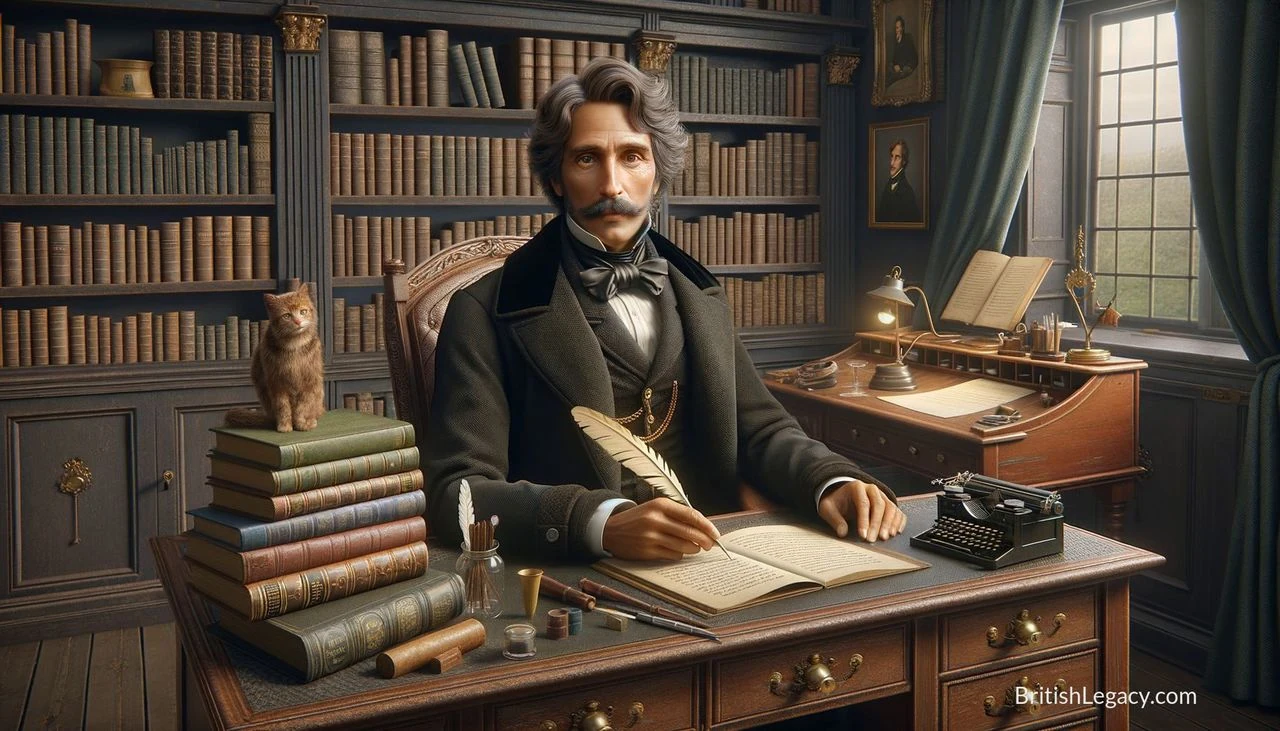
Oscar Wilde’s writing moved easily between the polished drawing room and the unsettling double life. In The Importance of Being Earnest, assumed identities expose the absurdities of respectable society; in The Picture of Dorian Gray, a portrait bears the consequences its subject escapes. Wilde became one of the most popular dramatists in early-1890s London, but in 1895 his prosecution for gross indecency brought imprisonment and the collapse of his public career in Britain.
Dublin beginnings, Oxford ideas
Wilde was born in Dublin on 16 October 1854, the son of Sir William Wilde, a surgeon, and Jane, Lady Wilde, a poet and Irish nationalist. His parents’ intellectual and cultural lives formed part of his early environment. He attended Portora Royal School in County Fermanagh before studying classics at Trinity College Dublin and Magdalen College, Oxford. At Trinity he won the Berkeley Gold Medal in Greek; at Oxford he graduated with a double first in 1878.
At Oxford, Wilde developed an interest in aestheticism, associated with Walter Pater and John Ruskin. Their views were not identical: Pater placed particular emphasis on refined experience of beauty, while Ruskin argued that art should contribute to moral and social improvement. Wilde took ideas from both, and made aestheticism part of his public identity. His long hair, striking clothes and conversational wit attracted attention as readily as his writing. He later put his ideas about art into essays and dialogues, including The Decay of Lying and The Critic as Artist, gathered in Intentions in 1891.
Wilde settled in London after university and made his name in literary and social circles. He published poems, lectured on aestheticism in North America in 1882 and worked as a journalist. From 1887 he edited The Woman’s World, broadening its coverage beyond fashion to include culture, politics and parenting. He left the magazine in 1889 as he turned towards longer prose and fiction.
Stories, a novel and the London stage
The Happy Prince and Other Tales, published in 1888, showed Wilde’s command of stories that could appeal to younger readers while carrying serious moral concerns. He followed it with collections including Lord Arthur Savile’s Crime and Other Stories and A House of Pomegranates. His only novel, The Picture of Dorian Gray, first appeared in a magazine in 1890 and was revised and published as a book in 1891. Its beautiful young subject remains outwardly unchanged as his portrait records the effects of his conduct. The novel’s treatment of beauty, duplicity and moral judgement provoked hostile criticism, to which Wilde responded publicly.
Wilde’s theatre career brought him success on a larger scale. Lady Windermere’s Fan opened in 1892, followed by A Woman of No Importance in 1893 and An Ideal Husband in 1895. Their polished dialogue and social comedy entertain while exposing the rules and hypocrisies that govern respectable life. He also wrote Salomé in French; its depiction of biblical characters meant it could not be licensed for the English stage at the time.
The Importance of Being Earnest, Wilde’s final play, opened at St James’s Theatre in London on 14 February 1895. Its protagonists use invented identities to evade social expectations, and its comedy depends on the distance between what characters say and what their circumstances reveal. The production was an immediate success. Wilde had reached the height of his theatrical reputation just as events outside the theatre were about to destroy it.
Trials, prison and exile
In 1895 Wilde brought a libel prosecution against the Marquess of Queensberry, the father of his lover, Lord Alfred Douglas. The case brought evidence of Wilde’s relationships with men into court and led to his own prosecution. He was convicted of gross indecency and sentenced to two years’ hard labour. His conviction reflected the criminalisation of homosexual acts in Victorian Britain; it ended his career on the London stage and left him imprisoned from 1895 to 1897.
Wilde’s prison writing included De Profundis, a long letter written during his final year in prison. After his release in May 1897, he left for France and did not return to Britain or Ireland. There he wrote The Ballad of Reading Gaol, published in 1898. Drawing on the prison experience and the execution of a fellow prisoner, the poem turns attention towards the shared harshness of confinement. Its success gave readers a work shaped by the punishment that had also forced Wilde into exile.
He spent his last years in France, often in poverty. Wilde died in Paris on 30 November 1900, aged 46, and was buried at Père Lachaise Cemetery. His works continued to circulate after his death, while his criminal conviction remained part of the public story of his life. In 2017 he was among those pardoned under legislation applying to historic convictions for homosexual acts that were no longer offences.
Why Oscar Wilde deserves a place in British Legacy
Wilde’s place in British Legacy rests not on a claim that he was English—he was Irish—but on the direct and lasting connection between his work and British literary and theatrical life. He became one of the most successful dramatists in late-Victorian London, writing comedies that made the conventions of that society their subject. Lady Windermere’s Fan, An Ideal Husband and especially The Importance of Being Earnest remain part of the theatrical repertoire because their verbal ingenuity is joined to close observation of status, marriage and public respectability. The plays offer more than memorable epigrams: they show how comedy can expose the rules a society takes for granted.
His legacy also includes a stark record of the consequences of criminalising same-sex relationships. Wilde’s 1895 conviction and imprisonment abruptly ended his British career; the writing that followed included De Profundis and The Ballad of Reading Gaol, works in which imprisonment became subject as well as circumstance. His later pardon underlines the distance between the laws that punished him and the present treatment of those historic offences. Remembering Wilde in a British context therefore means holding together artistic achievement and legal injustice, while recognising the Irish identity of the writer whose work helped shape London theatre and continues to be read and performed.
Sources
Oscar Wilde — supplied Wikipedia revision
Adapted in part from Oscar Wilde by Wikipedia contributors, under CC BY-SA 4.0. Text has been edited and combined with the existing article; this adapted text is shared under the same licence. Contributor history.