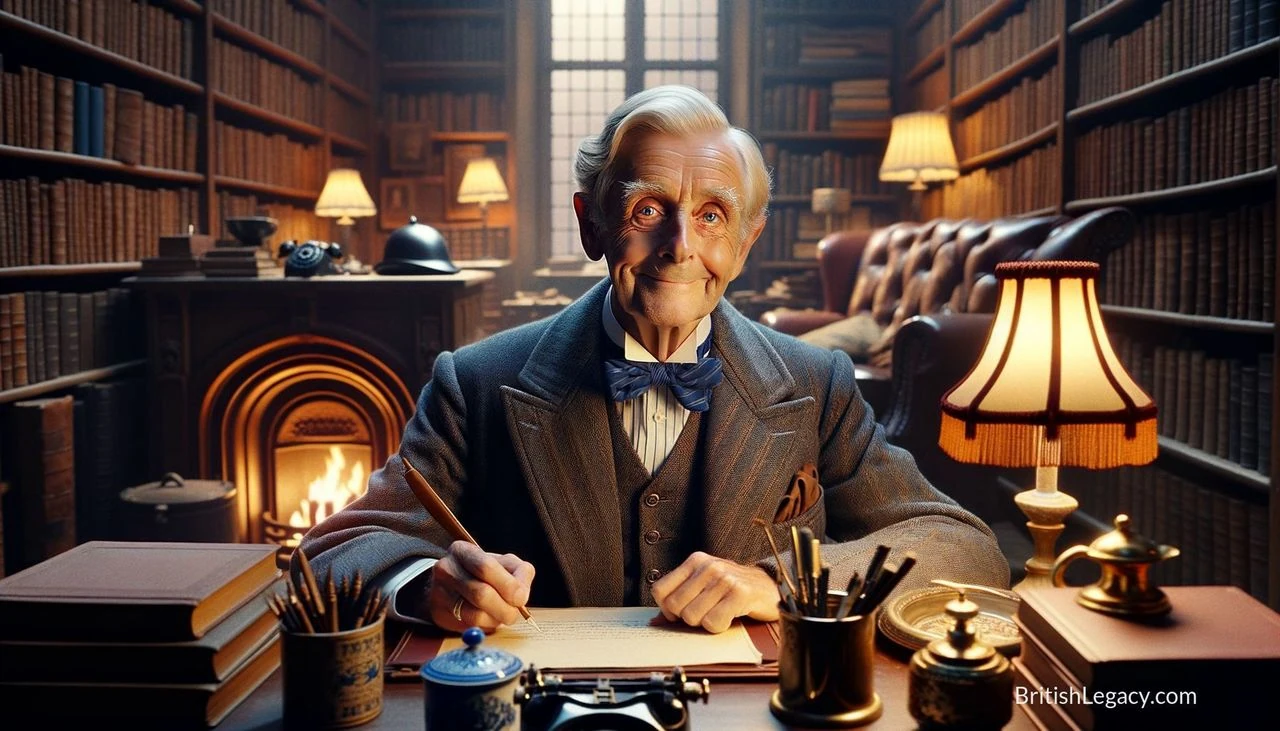
In P. G. Wodehouse’s fiction, a misplaced letter, an overbearing aunt or a social obligation could set an entire plot in motion. His comic world was carefully constructed: behind the apparent lightness lay intricate plotting, exacting work on prose and an ear for language that made his farce sound effortless. The characters who became his best-known creations, Bertie Wooster and his valet Jeeves, were only part of a body of work that also included Blandings Castle, Psmith, golf stories and Broadway musicals.
Guildford, Hong Kong and Dulwich
Pelham Grenville Wodehouse was born in Guildford, Surrey, on 15 October 1881. His father, Henry Ernest Wodehouse, was a magistrate in Hong Kong; his mother, Eleanor, was visiting her sister in England when he was born. Wodehouse and his brothers spent their early years largely apart from their parents. He was educated at a succession of schools before entering Dulwich College in 1894, aged 12. The school gave him a settled environment, and he remained devoted to it throughout his life. He played cricket, rugby and boxing, sang in school concerts and edited the school magazine.
After leaving school in 1900, he joined the London office of the Hongkong and Shanghai Bank. The work did not suit him. In his spare time he wrote, first contributing articles about school sport and then selling comic writing to magazines. A former Dulwich master helped him obtain a post with The Globe, where he wrote a popular column. His first novel, the school story The Pothunters, appeared in 1902. By then he was also writing for other publications and developing a career that soon made the bank a brief opening chapter rather than a lasting occupation.
Wodehouse’s first visit to New York came in 1904, and his work for American magazines established a lasting transatlantic connection. He also began writing for the stage. His lyrics for musical comedy brought him into partnership with the composer Jerome Kern; from 1915, he worked with Kern and the writer Guy Bolton on successful Broadway shows. The collaborations, including Oh, Boy! and Leave It to Jane, made a significant contribution to the development of American musical comedy. Wodehouse’s career was therefore not confined to novels about English country houses: he moved between British and American publishing and theatre, adapting his comic skills to different forms.
Building a comic world
Wodehouse’s best-known fictional partnership began in 1915, when the first story about Bertie Wooster and Jeeves appeared. Bertie is a well-meaning young man whose judgement repeatedly lands him in trouble; Jeeves, his resourceful valet, finds a way out. The comedy comes from the contrast between Bertie’s muddled view of events and Jeeves’s calm competence, as well as from the ingenuity of the plots that bring them together.
That same year, Wodehouse began the Blandings Castle novels with Something New, published in Britain as Something Fresh. The setting centres on the placid Lord Emsworth and the competing demands of family, visitors and life on his estate. Another recurring character, Psmith, had emerged in the school story Mike; Wodehouse returned to him in novels set in banking, journalism and at Blandings. His range also included Mr Mulliner’s tall tales and the Oldest Member’s golf stories. These groups of characters gave him several ways to stage comic misunderstandings and elaborate reversals, without relying on one recurring formula.
His fiction often inhabits an idealised, largely undated England, with country houses and London clubs serving as settings for social entanglements. Wodehouse also wrote about New York and Hollywood, drawing on the years he spent in the United States. His language combines Edwardian slang, literary allusion, puns and surprising comparisons. A joke might depend on a familiar phrase used in an unexpected way, or on a simile that makes an ordinary action suddenly absurd. Critics have described his prose as comic poetry; its apparent ease was the result of sustained attention to construction and revision.
Wodehouse took time to design his plots before writing the finished story. He might prepare hundreds of pages of notes, work out a detailed scenario and have more than one book in progress. He described the need to know where the comic situations would fall before beginning the prose. Across his career he published more than ninety books, as well as plays, short stories, lyrics and other writing. The scale of the output rested on a methodical approach: he built the machinery of the story first, then refined its language.
War, broadcasts and life in America
Wodehouse and his wife, Ethel, were living in France when German forces occupied the country in 1940. He was interned, first in northern France and Belgium and then at Tost, in what was then Germany. In 1941, after his release from internment, he made five comic broadcasts for American listeners from Berlin, describing his experiences as a prisoner. The broadcasts were transmitted on German radio and provoked anger in Britain, where many listeners regarded them as a serious error of judgement during wartime.
The controversy should not be reduced either to a charge of proven treason or to a claim that Wodehouse was formally exonerated of all fault. An MI5 investigation concluded that his conduct had been unwise and advised against further action; the Director of Public Prosecutions decided there was no evidence to justify prosecution. The episode damaged his reputation in Britain and remained part of the story of his life. Wodehouse later acknowledged that he ought to have understood the folly of broadcasting on German radio, even though he had intended the talks as harmless humour.
After the war, Wodehouse and Ethel settled in the United States. He never returned to England, although he remained a British subject after becoming an American citizen in 1955. He continued writing novels and stories, living on Long Island until his death. In 1975, aged 93, he died in Southampton, New York, a month after he was made a Knight Commander of the Order of the British Empire. The honour came after earlier proposed knighthoods had been blocked amid concern about the wartime broadcasts.
Reputation, readership and adaptation
Wodehouse’s reputation has never depended on universal critical agreement. Admirers have praised his verbal invention and the precision of his farce; other writers and critics have found the fiction too narrow or relentlessly light. His work drew readers from different walks of life, including former British prime ministers, and his characters and phrases became familiar beyond the books in which they first appeared. The balance between a stable fictional world and finely varied comic situations helped make the stories durable: readers could return to recognisable characters while discovering new complications in each plot.
The books have also travelled through performance and adaptation. Jeeves and Wooster have been dramatised for television, including in the series starring Stephen Fry and Hugh Laurie. The continuing existence of Wodehouse societies and the presence of his quotations in the Oxford English Dictionary offer further signs of an active readership and a lasting imprint on English-language expression. His work reached audiences in Britain and the United States during his lifetime and has continued to be read and adapted since his death.
Why P. G. Wodehouse deserves a place in British Legacy
Wodehouse belongs in British Legacy because his fiction made a particularly British social setting the starting point for comedy that crossed national boundaries. Dulwich College helped shape his early life, while his stories repeatedly turned country houses, London clubs, family hierarchies and the manners of the upper classes into stages for comic disorder. Jeeves and Wooster became his most familiar creation, but Blandings Castle, Psmith, Mr Mulliner and the Oldest Member show the breadth of his imaginative world. His achievement was not simply to invent memorable characters: it was to build plots around them with such care that misunderstandings, reversals and verbal jokes worked together as a whole.
His British legacy is also inseparable from an international career. Wodehouse wrote for British readers and settings, but his work in New York and on Broadway brought him into the development of American musical comedy, and his stories found readers on both sides of the Atlantic. The wartime broadcasts remain a troubling and necessary part of his biography: the authorities found no grounds for prosecution, but the decision not to prosecute does not erase the public controversy or Wodehouse’s own acknowledgement that broadcasting from Berlin was a mistake. Remembering both the literary craft and that difficult episode offers a fuller account of a British writer whose comic language continues to be performed, quoted and read.
Sources
P. G. Wodehouse — revision 1377314043
Adapted in part from P. G. Wodehouse by Wikipedia contributors, under CC BY-SA 4.0. Text has been edited and combined with the existing article; this adapted text is shared under the same licence. Contributor history.