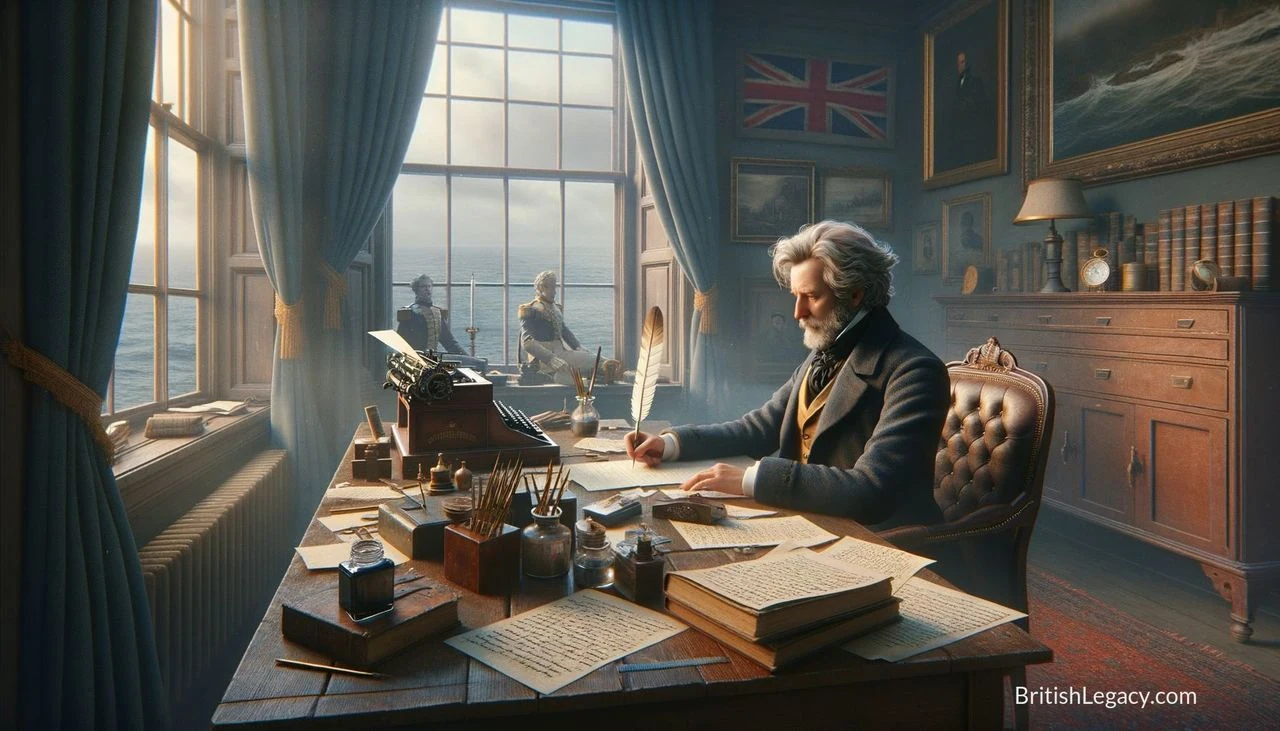
Patrick O’Brian’s most famous books take readers into the Royal Navy of the Napoleonic Wars, but their appeal rests on more than ships and battles. Across twenty completed novels, Captain Jack Aubrey and the physician and naturalist Stephen Maturin build a friendship while pursuing their lives at sea and on shore. O’Brian’s command of naval language and early nineteenth-century detail gave the series its distinctive texture. His own route to success was less direct: he had published fiction, short stories and translations for decades before the Aubrey–Maturin books brought him a much wider readership late in life.
Richard Patrick Russ becomes Patrick O’Brian
Born Richard Patrick Russ on 12 December 1914 in Chalfont St Peter, Buckinghamshire, O’Brian began writing young. His first novel, Caesar: The Life Story of a Panda-Leopard, was published in 1930, when he was fifteen. Animal stories followed, and Beasts Royal, a collection, appeared in 1934. In 1938 Oxford University Press published Hussein: An Entertainment, a novel set in India. These early books established a literary career under the name Russ, which he left behind when he changed his name in 1945.
His working life before the naval novels included service as an ambulance driver during the Second World War. O’Brian also said that he had worked in wartime intelligence connected with France; his account of that work has been disputed by his stepson, Nikolai Tolstoy. The difference matters because O’Brian guarded his personal history, and it is not a basis for presenting a more certain wartime story. He married Mary Wicksteed in 1945, the same year he took the name Patrick O’Brian.
After the war, he and Mary lived in rural Wales, in Cwm Croesor. The place and its people informed short stories and the novel Testimonies (1952). Other books included The Catalans (1953) and three novels for younger readers: The Road to Samarcand, The Golden Ocean and The Unknown Shore. Those last two drew on the voyage of George Anson and offer earlier examples of O’Brian’s interest in naval life. His writing in these years ranged well beyond historical sea fiction.
A working writer before the breakthrough
O’Brian and Mary moved to Collioure, in southern France, in 1949 and remained there together until her death in 1998. He continued to write fiction and became an established translator of French works into English. His translations included Henri Charrière’s Papillon and works by Simone de Beauvoir; he also translated a biography of Charles de Gaulle. His own non-fiction ranged from a history of the Royal Navy for younger readers to biographies of the naturalist Joseph Banks and the artist Pablo Picasso.
In 1969, O’Brian began Master and Commander, the first of the Aubrey–Maturin novels, at the suggestion of an American publisher. The series centres on two contrasting friends: Aubrey, an English naval captain, and Maturin, an Irish-Catalan physician and naturalist. O’Brian set their careers within the early nineteenth-century Royal Navy, weaving the characters into historical events without changing their outcomes, or adapting real events as patterns for the fiction.
The novels follow both men’s professional and domestic lives over time, so that the sequence can be read as one continuous story. Their ships and voyages provide the setting, but the books also attend to friendship, work, humour and the demands of life beyond a naval engagement. O’Brian’s use of specialist sailing terminology and period language is integral to that world. It can ask a great deal of the reader; the same precision gives the books their unusual density and sense of place.
Recognition came late
The Aubrey–Maturin novels were quietly popular in Britain at first. After the first four books, the series was not published in the United States for a period. A successful American relaunch in the early 1990s, led by the interest of editor Starling Lawrence at W. W. Norton, brought increased sales, critical attention and a larger public profile on both sides of the Atlantic. O’Brian’s greatest success as a novelist therefore came when he was in his seventies, after a long career in which he had also written stories, translations and books on subjects far removed from Aubrey’s command.
His recognition included the inaugural Heywood Hill Literary Prize in 1995, awarded for his lifetime’s writing, and an honorary doctorate from Trinity College Dublin. He was appointed a Commander of the Order of the British Empire in 1997. The books also drew attention from readers beyond Britain: they were translated into multiple languages, and the series’ later US success substantially widened its readership. O’Brian continued writing naval fiction until his death.
Peter Weir’s 2003 film Master and Commander: The Far Side of the World drew on the novel of that name and on incidents from other books in the series. The adaptation carried O’Brian’s naval world to cinema, although its story was not a direct rendering of a single novel. The Aubrey–Maturin sequence itself remained unfinished: O’Brian died while working on it, and the incomplete twenty-first book was published posthumously.
Privacy, biography and a life in France
O’Brian was notably protective of his private life and supplied little personal information for book jackets. For years, some readers and reviewers assumed he was Irish; he did not correct that impression. In 1998, a BBC documentary and a newspaper exposé made public details of his birth name, ancestry and first marriage. The revelations brought intense attention to a writer who had tried to keep his biography separate from his books, and caused distress to him and to some readers. Later accounts of his early life and relationships have not been uniform, so the novels should not be treated as a substitute for a settled account of the man.
Mary’s death in 1998 was a profound loss. O’Brian spent the winter of 1998–99 at Trinity College Dublin and died there on 2 January 2000. He was buried in Collioure beside his wife. His life connected an English birthplace and British literary recognition with many years of work in France; his subject, meanwhile, was the Royal Navy in an earlier period. Those distinctions help describe his legacy without confusing the setting of his fiction with the details of his own life.
Why Patrick O’Brian deserves a place in British Legacy
O’Brian deserves a place in British Legacy because the Aubrey–Maturin novels made a particular part of British history vivid through the habits and pressures of daily life. Their Royal Navy setting is not merely a backdrop for action: the technical language, shipboard routines and professional relationships help readers understand the world in which Aubrey and Maturin move. O’Brian also gives the sequence a longer human scale. Across twenty completed books, the reader follows the two friends through work, changing circumstances and life ashore, rather than encountering them only in isolated adventures.
That achievement grew from a broader and longer career. Before the series brought him international recognition, O’Brian had published fiction and short stories, translated French writing and produced biographies and historical non-fiction. His late success is part of the story too: it shows how a writer’s readership can expand well after years of sustained work, and how a series first modestly received in Britain could later find a much larger audience. The continuing life of the novels in translation and adaptation extends that reach. O’Brian’s contribution is not that his fiction serves as a complete historical record, but that it gives readers a richly particular literary route into Britain’s maritime past.
Sources
Patrick O’Brian — Wikipedia revision · Patrick O’Brian — Wikipedia
Adapted in part from Patrick O'Brian by Wikipedia contributors, under CC BY-SA 4.0. Text has been edited and combined with the existing article; this adapted text is shared under the same licence. Contributor history.