Percy Bysshe Shelley’s poetry could turn a natural force into a vehicle for political hope. In “Ode to the West Wind”, he asks the wind to scatter his words “among mankind”; elsewhere, he wrote against religious authority, political repression and inherited privilege. His radical views brought conflict and helped keep much of his work from publication during his lifetime. After his death at 29, poems such as “Ozymandias”, “To a Skylark” and “The Mask of Anarchy” reached readers in Britain and far beyond it.
From Sussex to Oxford
Shelley was born on 4 August 1792 at Field Place in Sussex, the eldest son of Sir Timothy Shelley and Elizabeth Pilfold. He entered Eton in 1804, where he later recalled being bullied, and went on to University College, Oxford, in 1810. He spent much of his time reading and pursuing scientific experiments rather than attending lectures. His interest in political and religious argument grew, and in 1811 he and fellow student Thomas Jefferson Hogg wrote The Necessity of Atheism.
The pamphlet reached Oxford’s college authorities. Shelley refused to answer their questions about its authorship and was expelled on 25 March 1811, alongside Hogg. The decision set a public marker on his break with convention, but it was not simply a literary gesture: his father opposed his views, and the expulsion sharpened a family dispute that affected his finances and prospects.
Shelley’s politics took him beyond the university. In 1812, he travelled to Ireland and distributed two tracts, including An Address, to the Irish People, which advocated Catholic emancipation and an end to the oppression of the Irish poor. He argued for political change while cautioning against violence. His writings and activities attracted the attention of the authorities. In 1813, Queen Mab, an ambitious poem accompanied by notes on atheism, free love and republicanism, appeared in a small private edition; fear of prosecution limited its initial circulation.
Writing against authority
Political commitment was central to Shelley’s writing, but it did not define its whole range. His work moves between lyrical poems, long narrative poems, verse drama, essays and fiction. Some works were published in expurgated form or withheld because of the risk of prosecution for political or religious libel. During his lifetime, most appeared in small editions and sold poorly; the mainstream press often attacked his opinions and personal life, even when acknowledging the force of his imagery.
In “Ozymandias”, written in 1818, the ruined statue of a self-declared king becomes an image of power outlasting itself only as a broken monument. “Ode to the West Wind”, composed in 1819 and published in 1820, turns to a different kind of change. Its speaker asks the wind to carry his thoughts across the world and help bring about a new beginning. The poem’s closing question, “If Winter comes, can Spring be far behind?”, joins its natural imagery to a hope for renewal.
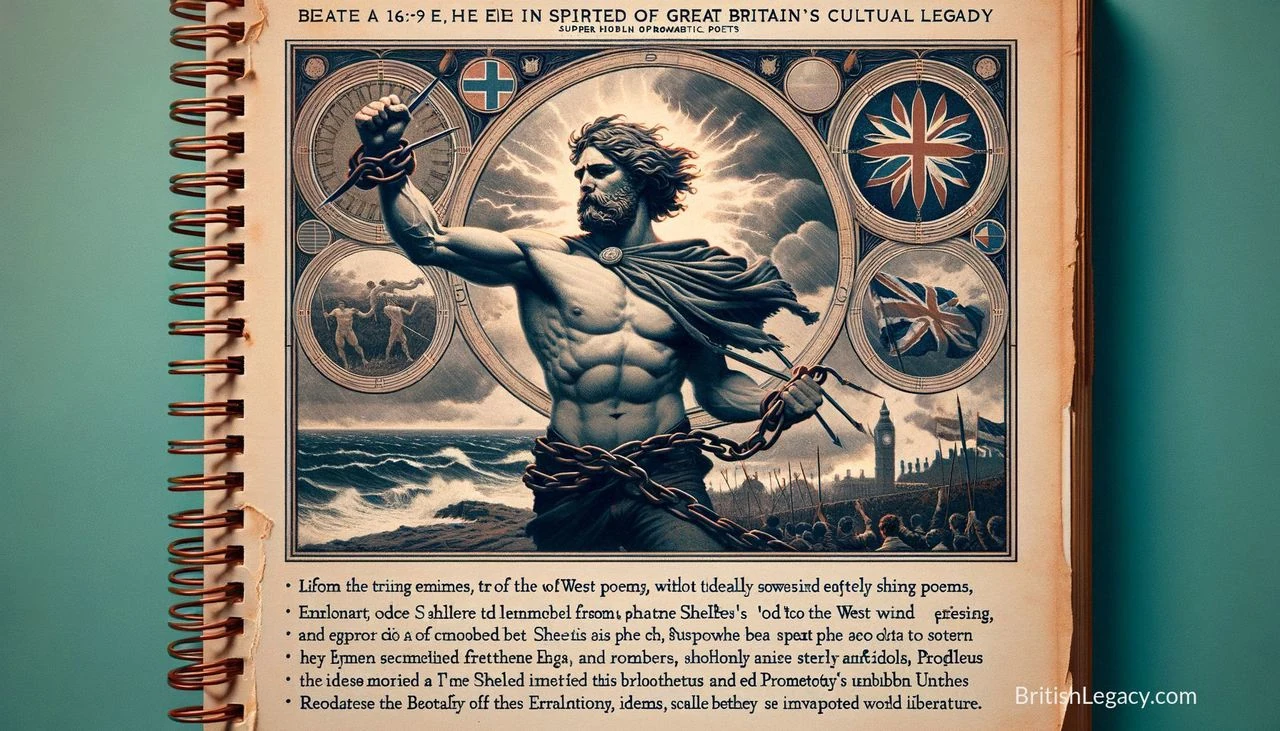
Prometheus Unbound, published in 1820, reworks the Prometheus story as a dramatic poem. Shelley uses the conflict with tyranny to imagine liberation through love and a changed moral order. His political poetry could be more direct: “The Mask of Anarchy”, written in response to the 1819 Peterloo Massacre, condemns violence against peaceful protesters and presents nonviolent resistance as a means of opposing oppression. It was not published until 1832, after his death.
Italy, later poems and an early death
In 1818, Shelley left England for Italy, where he lived for the remainder of his life. He produced major work there, including Prometheus Unbound, the verse drama The Cenci and “Adonais”, an elegy for John Keats. His writing continued to range across forms and subjects. “To a Skylark” and “The Cloud” give sustained attention to the natural world, while his unfinished final major poem, The Triumph of Life, turns towards darker questions of human experience.
On 8 July 1822, Shelley, Edward Williams and a boat boy set out from Livorno for Lerici in Shelley’s boat, the Don Juan. They were caught in a storm and drowned. Shelley’s body was identified after it came ashore near Viareggio; he was cremated on the beach, and his ashes were buried in the Protestant Cemetery in Rome.
Recognition after Shelley
Shelley was not widely read outside a relatively small circle during his lifetime. His reputation grew after his death as his poems and political writing reached new readers. Queen Mab became popular in Owenist and Chartist circles, while later poets including Robert Browning, Algernon Charles Swinburne, Thomas Hardy and W. B. Yeats were influenced by his work. His critical reputation has changed over time: twentieth-century critics could object to his ideas or style, while later critics highlighted his command of poetic forms and the complexity of his thought.
The long afterlife of his work has depended not only on readers and writers but also on the work of editors and literary organisations. Scholarly projects have produced editions of Shelley’s manuscripts, poetry and prose, helping readers approach writing that was sometimes left unfinished, unpublished or altered for print. The Shelley Society, founded in London in 1885, promoted his work through lectures and publications. The Keats–Shelley Memorial Association, founded in 1903, maintains his grave in Rome and supports a museum and library there devoted to Romantic writers with strong connections to Italy.
Why Percy Bysshe Shelley deserves a place in British Legacy
Shelley’s place in British literary history rests on the conjunction of poetic invention and a sustained challenge to authority. His writing ranges from the compressed image of “Ozymandias” to the sweeping movement of “Ode to the West Wind” and the dramatic argument of Prometheus Unbound. Those are not merely different forms: they show how a poet could use lyric, drama and political argument to examine power, change and the possibility of freedom. His work also records the cost of dissent in his own period. The expulsion from Oxford and the risks surrounding publication shaped what he could publish and how readers first encountered him.
His legacy continued through readers who found political purpose in his writing as well as through poets who learned from its forms and imagery. The circulation of Queen Mab among Owenists and Chartists, and the later influence of Shelley on writers such as Browning, Swinburne, Hardy and Yeats, demonstrate distinct ways in which his work travelled into British cultural life. The Shelley Society’s efforts to promote his poetry and the continuing editorial work on his manuscripts also show that this legacy has been actively preserved and reconsidered. Shelley deserves remembrance not as a simple emblem of rebellion, but as a writer whose arguments, formal range and unsettled reputation continue to invite serious reading.
Sources
Percy Bysshe Shelley — Wikipedia, revision 1373913629
Adapted in part from Percy Bysshe Shelley by Wikipedia contributors, under CC BY-SA 4.0. Text has been edited and combined with the existing article; this adapted text is shared under the same licence. Contributor history.