
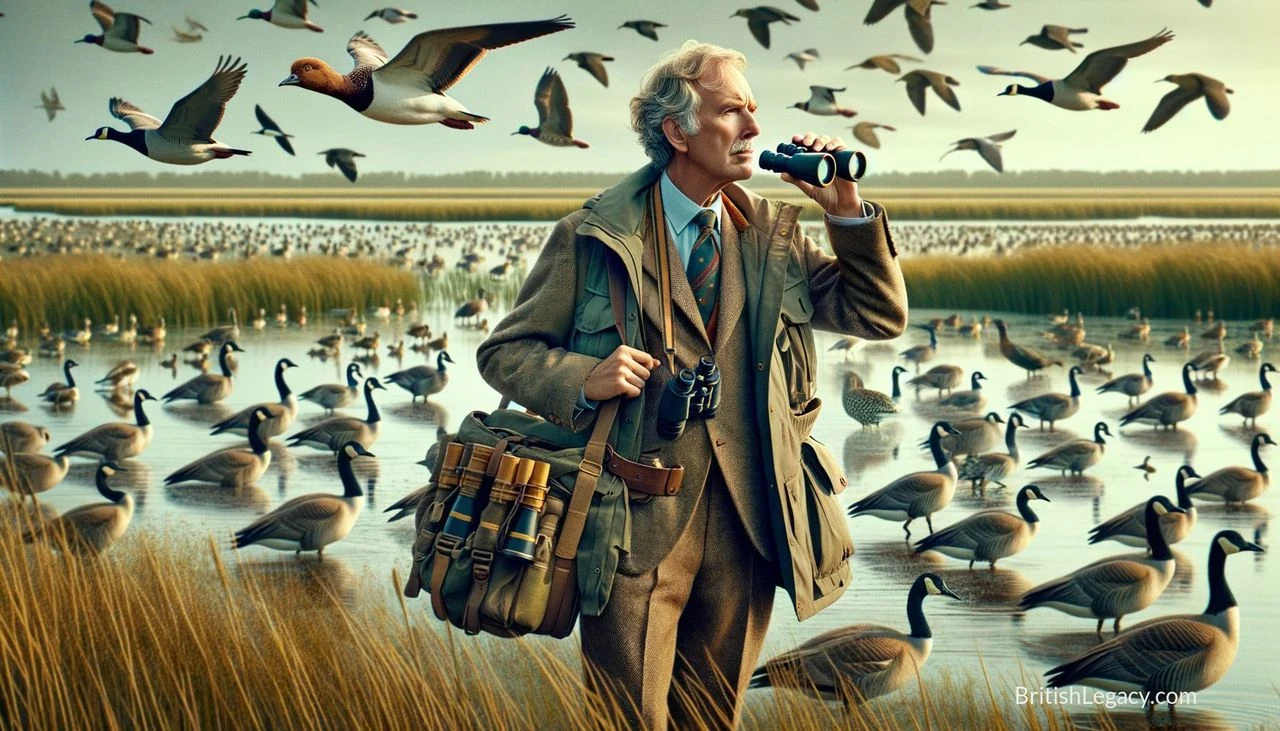
Peter Scott made conservation visible. At Slimbridge, he built a place where wildfowl could be protected and studied; on television, he invited audiences to look closely at birds and wetlands. An accomplished wildlife painter, Olympic sailor and wartime naval officer, he brought several parts of his life to bear on a lasting programme of practical conservation.
An artist drawn to wildfowl
Peter Markham Scott was born in London on 14 September 1909, the only child of Antarctic explorer Robert Falcon Scott and sculptor Kathleen Bruce. His father died during the Terra Nova expedition when Peter was two. Scott later studied Natural Sciences at Trinity College, Cambridge, but graduated in the History of Art in 1931. He went on to study art in Munich and at the Royal Academy Schools in London.
Wildlife, especially birds, became the subject of his painting. His first London exhibition was held in 1933. He was also an active sportsman: representing Great Britain and Northern Ireland in sailing at the 1936 Summer Olympics, he won a bronze medal in the O-Jolle monotype class. In 1938, competing in the Prince of Wales Cup, he and his crew used a modified wearable harness on their dinghy Thunder and Lightning. The device, now known as a trapeze, helped them win.
Scott’s interest in wildfowl went beyond observation and painting. He took up breeding birds, an experience that would inform the conservation work for which he became best known. Art remained part of that work: careful observation and the ability to communicate what he saw helped make wildlife a subject for a wide public, not only specialists.
War service, then a sanctuary at Slimbridge
During the Second World War, Scott served in the Royal Navy Volunteer Reserve. In June 1940, he went ashore at Saint-Valery-en-Caux during the evacuation of the 51st Highland Division to help evacuate wounded men. He later served in destroyers in the North Atlantic and commanded the First Steam Gun Boat Squadron in the English Channel.
He also worked on naval camouflage. In 1940, HMS Broke, the destroyer on which he was serving, was painted experimentally in different schemes on either side. Scott later argued that compromise was a mistake and that pale colours, intended to make ships less visible at night, should be the chief objective. By May 1941, ships in the Western Approaches had been ordered to use his scheme. His wartime service also brought several mentions in despatches, the Distinguished Service Cross and a bar to the DSC.
In 1946, Scott founded the Severn Wildfowl Trust at Slimbridge, Gloucestershire. The organisation, now the Wildfowl & Wetlands Trust, gave him a base for protecting and studying wildfowl. Its captive-breeding programme helped save the nene, or Hawaiian goose, from extinction in the 1950s. Scott also led ornithological expeditions around the world, while the trust’s work at Slimbridge combined the care of birds with public access and education.
Making wildlife part of public life
Scott’s broadcasting brought his subject into homes across Britain. His BBC natural-history series Look ran from 1955 to 1969. It helped popularise the study of wildfowl and wetlands, and made him a familiar television figure. In 1968, he narrated The Private Life of the Kingfisher, the first BBC natural-history film to be shown in colour. He had also appeared regularly on BBC radio’s Children’s Hour in the series Nature Parliament.
He continued to make and share work about wildlife through books and film. His autobiography, The Eye of the Wind, was published in 1961. He narrated the British Transport Films documentary Wild Wings (1966), which won the Academy Award for Best Short Subject in 1967. Scott founded the Society of Wildlife Artists and served as its first president; he also tutored artists, including Paul Karslake.
His conservation work reached beyond Slimbridge. As a member of the International Union for Conservation of Nature’s Species Survival Commission, Scott helped create its Red Data books, lists of endangered species. He was one of the founders of the World Wide Fund for Nature, then known as the World Wildlife Fund, and designed its panda logo. He also contributed to changes in policy at the International Whaling Commission and to the signing of the Antarctic Treaty. His interest in his father’s history brought him to the Antarctic, where a visit to Robert Falcon Scott’s base on Ross Island helped inspire his work around the treaty.
Honours and a broadening legacy
Scott’s recognition reflected both his public standing and his conservation work. He was appointed MBE in the military division in 1942 and CBE in 1953. In 1973, he was knighted for services to conservation and the environment. He became a Member of the Order of the Companions of Honour in 1987 and was elected a Fellow of the Royal Society that year. His later awards included the WWF Gold Medal and the J. Paul Getty Wildlife Conservation Prize, both received in 1986.
His interests were not confined to birds or broadcasting. Scott took up gliding in 1956, became British gliding champion in 1963 and chaired the British Gliding Association from 1968 for two years. He remained involved in sailing, skippering the yacht Sovereign in the 1964 America’s Cup challenge. From 1955 to 1969, he was president of the International Yacht Racing Union, now World Sailing. He was also Chancellor of the University of Birmingham from 1973 to 1983.
Scott died in Bristol on 29 August 1989, aged 79. The Peter Scott Walk follows the old sea bank along The Wash, from his lighthouse near Sutton Bridge in Lincolnshire towards King’s Lynn. His name also lives on in the Peter Scott Memorial Award, instituted by the British Naturalists’ Association after his death.
Why Peter Scott deserves a place in British Legacy
Peter Scott deserves a place in British Legacy because he helped turn conservation into something people could see, learn about and support. At Slimbridge, the Severn Wildfowl Trust joined the protection and study of birds with a place open to public understanding. Its captive-breeding work helped bring the nene back from the brink of extinction. His BBC series, books and films carried the lives of wildfowl and the importance of wetlands into public culture, making conservation a subject for viewers and readers as well as naturalists.
His influence also crossed borders. Scott helped establish the World Wide Fund for Nature and designed its panda emblem, a visual identity that connected an international organisation with the public. His work on endangered-species lists and his contributions to discussions around whaling and the Antarctic Treaty show conservation operating through evidence, institutions and policy as well as through the care of a reserve. Scott’s British legacy lies in that combination: a national institution at Slimbridge, popular broadcasting that widened interest in wildlife, and participation in international efforts to protect it. His career made art, science and public engagement work together in the service of conservation.
Sources
Peter Scott — Wikipedia revision 1364694623
Adapted in part from Peter Scott by Wikipedia contributors, under CC BY-SA 4.0. Text has been edited and combined with the existing article; this adapted text is shared under the same licence. Contributor history.
.jpg)