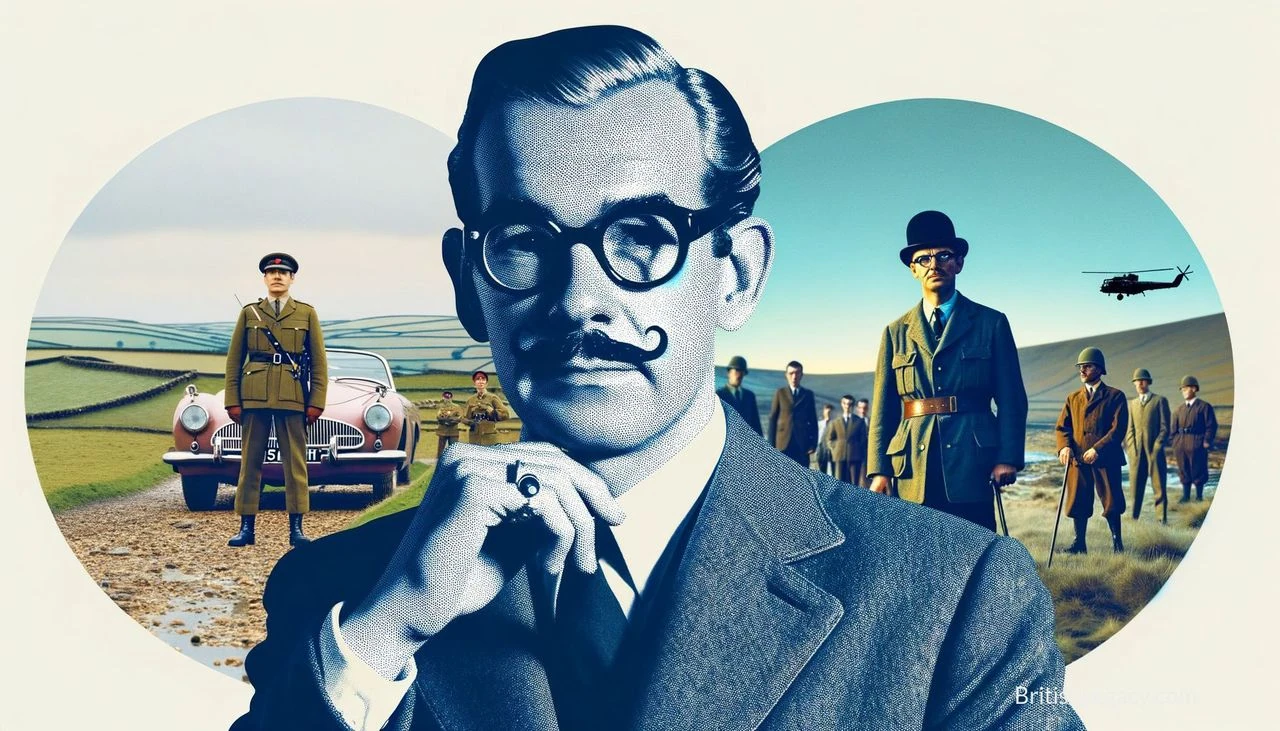
Peter Sellers could turn a voice into a whole character. On BBC radio, in films and on stage, he shifted accents, mannerisms and comic temperaments with startling speed. The Goon Show first brought him a national audience; Inspector Clouseau made him an international star. Yet his career ranged well beyond the Pink Panther films, reaching from Ealing comedy to Stanley Kubrick’s satire and the quiet, finely judged performance of his final major success, Being There.
A performer shaped by the variety stage
Sellers was born Richard Henry Sellers in Southsea on 8 September 1925. His parents, William and Agnes Doreen Sellers, were variety entertainers, and the family’s work meant that he grew up close to the stage. He was called Peter after an elder brother who had been stillborn. As an infant he was carried on stage at the Kings Theatre in Southsea; later, the family’s touring life offered him an early view of performance as both work and family business.
His formal schooling ended at fourteen. During the war, Sellers worked backstage at a theatre in Ilfracombe, learning the practical business of entertainment while developing a stage act with his friend Derek Altman. He practised the drums, played with touring bands and performed for the Entertainments National Service Association, which provided shows for British forces and factory workers. In 1943 he joined the Royal Air Force and toured with the RAF Gang Show. His impressions of military officers and his experience of performance on the road would feed into the comic work that followed.
After the war, steady work did not arrive at once. Sellers drummed, performed in variety and began appearing on radio and television. His ability to imitate voices helped him find a place at the BBC. In 1951 he joined Spike Milligan, Harry Secombe and Michael Bentine in The Goon Show. The programme’s inventive, often surreal comedy depended on its performers’ ability to create a crowd of distinct characters. Sellers played several recurring roles as well as numerous smaller parts, making vocal transformation central to his craft. The series ran until 1960 and reached a large British audience.
From British comedies to the Pink Panther
Sellers’s film career began in the 1950s, first in smaller parts and then in roles that showed how much he could do with precise physical characterisation. In Alexander Mackendrick’s The Ladykillers (1955), he played Harry Robinson opposite Alec Guinness. The Smallest Show on Earth (1957) gave him an elderly projectionist to play, while The Mouse That Roared (1959) asked him to take on three contrasting leading roles. In John and Roy Boulting’s I’m All Right Jack (1959), his performance as the trade-union shop steward Fred Kite earned him a BAFTA Award for Best British Actor.
That early run established a pattern: Sellers could build a character from an accent, a walk or a small physical habit, and he was often at his best when playing pomposity without stripping the character of dignity. He also worked in radio and records. His first comedy album, The Best of Sellers, included the sketch “Balham – Gateway to the South” and reached number three in the UK Albums Chart.
Blake Edwards cast Sellers as Inspector Jacques Clouseau after Peter Ustinov withdrew from the project. The Pink Panther was released in 1964, following production in 1963. David Niven had the principal role, but Sellers’s accident-prone detective proved the film’s defining comic creation. Sellers helped shape Clouseau’s costume, make-up, moustache and accent, then played each mishap as a blow to a man’s unshaken belief in his own detective brilliance. That contrast—physical chaos set against unwavering self-respect—gave the character more than a string of pratfalls.
The film’s success led to further appearances as Clouseau, including A Shot in the Dark (1964), The Return of the Pink Panther (1975), The Pink Panther Strikes Again (1976) and Revenge of the Pink Panther (1978). The role revived his film career in the mid-1970s after a less successful period. Sellers nevertheless grew tired of Clouseau, saying after Revenge of the Pink Panther that he had nothing more to give the character.
Multiple roles, different kinds of comedy
Clouseau was only one part of Sellers’s range. In Stanley Kubrick’s Dr. Strangelove or: How I Learned to Stop Worrying and Love the Bomb (1964), he played three sharply different characters: President Merkin Muffley, Group Captain Lionel Mandrake and the titular Dr Strangelove. He had initially been asked to play a fourth role, Major T. J. “King” Kong, but an ankle injury prevented him from filming the scenes. The performances that remained showed how voice and bearing could distinguish characters within the same film, from Mandrake’s composed Englishness to Strangelove’s unsettling manner.
Sellers was nominated for an Academy Award for Best Actor for Dr. Strangelove. He had already worked with Kubrick on Lolita (1962), playing Clare Quilty, and the two films demonstrate how his comic technique could serve both farce and darker satire. Other films carried his range in different directions: he appeared in The Millionairess (1960), What’s New Pussycat? (1965), Casino Royale (1967) and Blake Edwards’s The Party (1968), in which he played the accident-prone Indian actor Hrundi V. Bakshi.
His late performance as Chance, a sheltered gardener mistaken for a sage in Hal Ashby’s Being There (1979), relied on restraint rather than a rapid succession of comic voices. Sellers played Chance with careful stillness and plain delivery, allowing other characters to read wisdom into words he meant literally. The role brought him a Golden Globe for Best Actor in a Motion Picture – Musical or Comedy and nominations for both the Academy Award and BAFTA leading-actor awards.
The work behind the characters
Sellers described beginning with a character’s voice, then working out appearance and movement. He used drawings, studied voices on tape and treated the way a character walked as part of the performance. This approach helps explain why his transformations were more than changes of accent: the sound, posture and physical rhythm belonged together. In the films, even a foolish or clumsy figure could retain a sense of self-importance or dignity, and that tension made the comedy work.
His record also included work beyond feature films. Sellers’s short film with Spike Milligan, Mario Fabrizi, Leo McKern and Richard Lester, The Running Jumping & Standing Still Film (1959), received an Academy Award nomination for Best Live Action Short Film. He won the BAFTA Award for Best Actor in a Leading Role for I’m All Right Jack, and his career brought further nominations for films including Only Two Can Play, The Pink Panther and Being There. In 1966 he was appointed a Commander of the Order of the British Empire.
His working life was not consistently smooth. The account of his career includes periods of poor health, strained professional relationships and personal difficulties. He experienced serious heart problems, including a heart attack in 1964 and another in 1977. Sellers died in London on 24 July 1980, aged 54, after a heart attack. His final film was The Fiendish Plot of Dr. Fu Manchu (1980).
Why Peter Sellers deserves a place in British Legacy
Peter Sellers belongs in British Legacy because he helped shape British comedy in two distinct arenas. On radio, The Goon Show made character voices and comic invention central to a hugely popular form. In cinema, his performances carried that skill into memorable British films such as The Ladykillers and I’m All Right Jack, while his success in the Pink Panther films took a character created for a British actor into international popular culture. His career linked the variety tradition, BBC radio comedy and film, showing how performance could move between media without losing its local roots.
His influence lies not simply in the number of roles he played, but in the method that connected them. Sellers used voice, gesture and movement to make characters distinct, and he found comedy in the gap between how a person sees himself and how the world sees him. Clouseau’s dignity amid disorder and Chance’s untroubled literalness are very different achievements, but both depend on exact control rather than generalised clowning. His work helped establish character performance and vocal transformation as central possibilities in modern comedy. Remembering Sellers means recognising an artist whose best-known international roles grew from a career built in British performance culture—and whose films continue to make that craft visible.
Sources
Adapted in part from Peter Sellers by Wikipedia contributors, under CC BY-SA 4.0. Text has been edited and combined with the existing article; this adapted text is shared under the same licence. Contributor history.