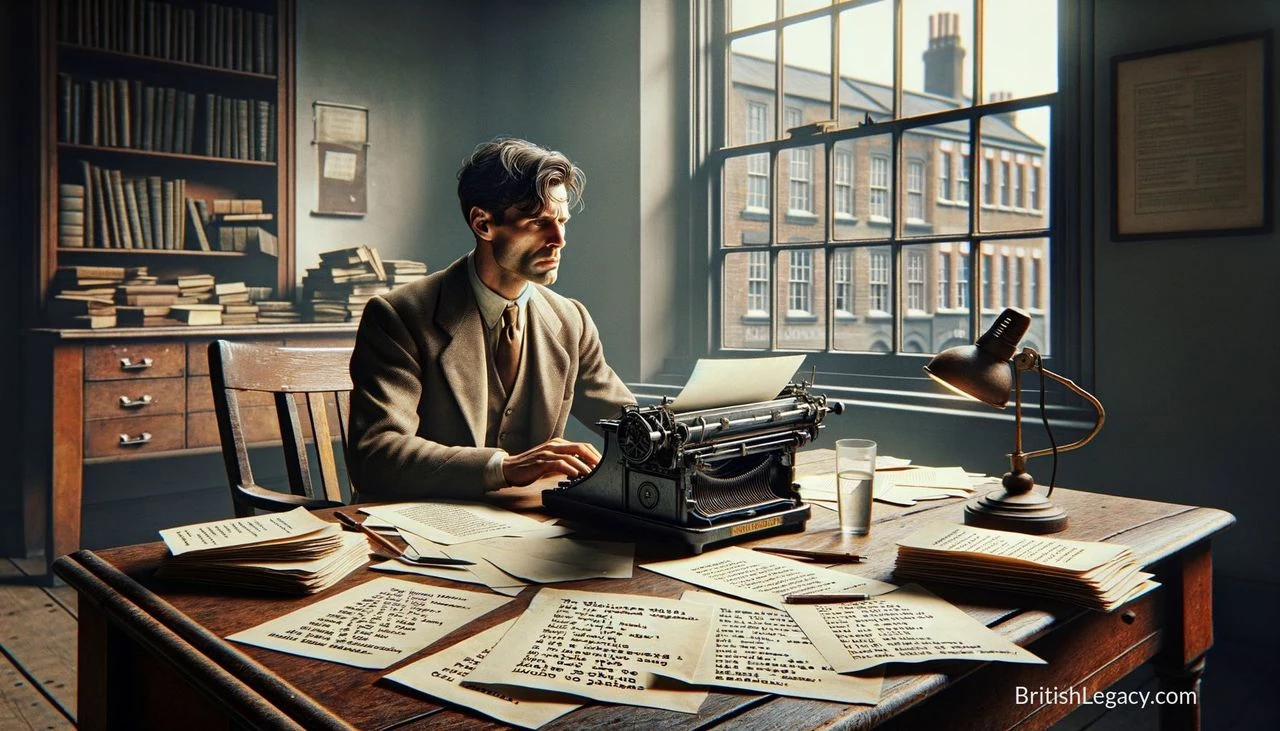
Philip Larkin made ordinary lives and places carry extraordinary weight. In poems shaped by precise observation, measured forms and a wary humour, train journeys, courtships, family life and the approach of death became material for a distinctly post-war poetry. His reputation rests above all on The Whitsun Weddings and High Windows, but it also belongs to a working life in libraries, most notably at the University of Hull, where he spent three decades.
Coventry, Oxford and the first books
Larkin was born Philip Arthur Larkin in Coventry on 9 August 1922, the only son of Sydney and Eva Larkin. He was educated at home until he was eight, then attended King Henry VIII School in the city. Although he did not do well in his first school examinations, he later gained distinctions in English and history and went on to St John's College, Oxford. He graduated with first-class honours in English in 1943.
At Oxford he formed friendships that lasted, including one with Kingsley Amis, and developed his interests in poetry and jazz. His first published poem appeared in The Listener while he was a student. After graduating, Larkin worked as a librarian, first at the public library in Wellington, Shropshire, then at University College, Leicester. His early books showed more than one side of his writing: the poetry collection The North Ship appeared in 1945, followed by the novels Jill and A Girl in Winter in 1946 and 1947.
Larkin moved to Belfast in 1950 to take up a post at Queen's University. The five years there brought a period of growing confidence as a poet. Much of the work in The Less Deceived, published in 1955, was written during that time. The collection established his reputation through poems that joined colloquial directness to careful construction. His voice was not simply gloomy: its dry wit and attention to the particulars of a scene complicate the bleakness for which he became known.
Hull: a library and a body of work
In 1955 Larkin became university librarian at the University of Hull, a post he held until his death. He was closely involved in the planning and development of the university's new library, later named the Brynmor Jones Library. He worked on its plans, and, after the building was completed, turned to other projects, including editing The Oxford Book of Twentieth Century English Verse, published in 1973. He also helped the library modernise: it became the first in Europe to install a Geac computer system for automated circulation. During his tenure, its stock and budget grew substantially.
Hull was not just the setting for Larkin's employment. It became the place from which he observed the country around him. His second major collection, The Whitsun Weddings, appeared in 1964. Its title poem follows a train journey on a Whitsun Saturday, noticing wedding parties at stations and the lives glimpsed from the carriage. The poem's movement across the landscape allows intimate scenes to accumulate into a portrait of a changing society. Other poems in the collection, including “An Arundel Tomb”, likewise set private feeling against time and history.
High Windows, his final collection published in his lifetime, followed in 1974. It includes “This Be The Verse”, “Annus Mirabilis” and the title poem. The collection's plain-spoken language could be comic, confrontational or meditative; its subjects include changing sexual conventions and mortality. “Aubade”, his major later poem about death, appeared in 1977. Larkin wrote little poetry after it. His work was highly structured but flexible in form, and its alertness to commonplace experience helped make it accessible without making it simple.
Beyond the poems
Larkin also wrote fiction, criticism and journalism. He was jazz critic for The Daily Telegraph from 1961 to 1971, and his reviews were collected in All What Jazz. His work as an editor, critic and librarian sat alongside his poetry rather than outside it: each role involved judgement, selection and close attention to how writing reaches readers.
He disliked the public demands of literary fame, yet recognition followed. He received the Queen's Gold Medal for Poetry and other honours, and was elected a Fellow of the Royal Society of Literature. Offered the position of Poet Laureate after the death of John Betjeman, he declined in 1984. Larkin died in Hull on 2 December 1985, aged 63, and was buried at Cottingham municipal cemetery.
His standing has never been free from argument. The posthumous publication of his letters and a biography brought attention to racist language and right-wing views expressed in private correspondence, as well as to the gap between his public image and private life. These disclosures have shaped debate about what his work represents and how it should be read. His poetry continues to be taught and discussed, while the Philip Larkin Society, formed in 1995, promotes his work and memory.
A poet remembered in places
Larkin's association with Hull is marked in the city as well as in its university. A bronze statue by Martin Jennings was unveiled at Hull Paragon Interchange in 2010, and a memorial stone bearing lines from “An Arundel Tomb” was unveiled at Poets' Corner in Westminster Abbey in 2016. These commemorations place a poet who resisted public ceremony within the shared landscape of British literary memory.
His work has also travelled through recordings, performances and the classroom. Larkin recorded readings of his collections, and his poems have appeared in school literature syllabuses. That continuing presence is not a settled verdict on the man: it keeps both the achievement of the poems and the controversies surrounding their author available for scrutiny.
Why Philip Larkin deserves a place in British Legacy
Larkin deserves a place in British Legacy because his poems made the textures of post-war life matter without disguising their limits. In The Whitsun Weddings, a train journey becomes a way to notice people, ceremony and social change; in High Windows and “Aubade”, wit and formal precision meet questions of freedom, loss and death. His language is often direct, but the poems do not offer easy conclusions. Their careful forms hold competing feelings in view, giving readers room to recognise both the comedy and the unease in ordinary experience.
His British legacy is also rooted in work beyond the page. At Hull, Larkin served as a university librarian for 30 years, contributing to the development of the Brynmor Jones Library and its modernisation. As a poet, editor and jazz critic, he helped shape several parts of the country's literary culture; as a subject of continuing debate, he reminds readers that artistic achievement and personal views cannot always be separated neatly. Hull's statue, Westminster Abbey's memorial stone, the work of the Philip Larkin Society and the continuing study of his poems keep that complex inheritance visible. His place in British literary history rests not on uncomplicated admiration, but on writing that continues to reward attention and argument.
Sources
Adapted in part from Philip Larkin by Wikipedia contributors, under CC BY-SA 4.0. Text has been edited and combined with the existing article; this adapted text is shared under the same licence. Contributor history.