
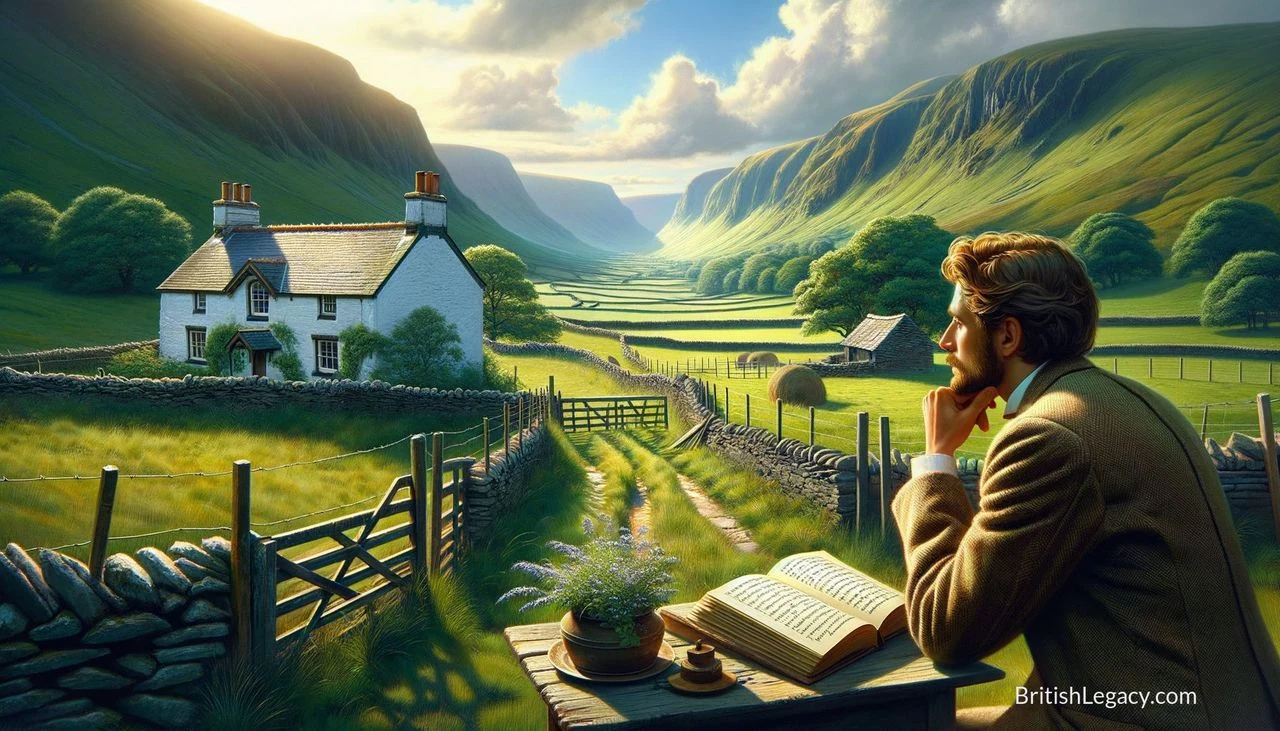
R. S. Thomas wrote about Welsh farms without turning rural hardship into pastoral comfort. His poems attend to the work, poverty and isolation of country life, while asking what faith means when God seems distant. The same landscape carries both meanings: it is home to a particular Welsh community and a setting for questions that reach beyond it. Thomas’s career as a parish priest shaped that searching poetry, but his writing also challenged easy accounts of Wales and of the people who lived there.
A priest in rural Wales
Ronald Stuart Thomas was born in Cardiff on 29 March 1913, the only child of Margaret Davies and Thomas Hubert Thomas. In 1918 the family moved to Holyhead, where his father worked in the Merchant Navy. Thomas studied Latin at the University College of North Wales, having received a bursary in 1932, and completed theological training at St Michael’s College, Llandaff. He was ordained a deacon in 1936 and a priest in 1937 in the Church in Wales.
His early appointments took him through parish communities in north-east Wales. From 1936 to 1940 he was curate of Chirk, where he met the artist Mildred “Elsi” Eldridge. They married in 1940. He served at Tallarn Green and Hanmer from 1940 to 1942, then became rector of St Michael’s Church, Manafon, near Welshpool. He remained there from 1942 to 1954. The parish and its farming community gave him close knowledge of the people and conditions that would become central to his early poems.
Thomas began learning Welsh in his thirties. He later said he had started too late to write poetry in the language, but his engagement with Welsh identity became increasingly important. In the 1960s he served in a predominantly Welsh-speaking community and wrote prose in Welsh, including Neb, an ironic autobiography told in the third person, and Blwyddyn yn Llŷn. He was vicar of St Hywyn’s Church in Aberdaron from 1967 to 1978, at the western end of the Llŷn Peninsula.
Fields, labour and the limits of pastoral poetry
Thomas’s first three poetry collections appeared during his years at Manafon: The Stones of the Field (1946), An Acre of Land (1952) and The Minister (1953). Their subject is not a softened countryside. Farm workers and their families appear in conditions of low pay, repetitive labour and isolation; the landscape’s beauty does not cancel out the difficulty of their lives. This directness unsettles the familiar pastoral picture of country life as an uncomplicated refuge from modernity.
The publication of Song at the Year’s Turning in 1955, which gathered work from his first three books, brought a wider readership. John Betjeman introduced the volume, and Thomas received the Royal Society of Literature’s Heinemann Award. In poems such as “Evans”, a visit to a farm becomes an encounter with sickness and loneliness. The poem’s spare description makes suffering present without pretending that scenery can redeem it.
Thomas’s poetry was often severe towards the community it portrayed. His writing about Wales carries political as well as spiritual weight, and he could criticise Welsh people rather than simply celebrate them. He opposed the anglicisation of Wales and objected to English people buying homes and property there. His idea of “the true Wales of my imagination” centred on a Welsh-speaking community connected to the natural world. That ideal was bound up with his resistance to materialism, which he represented through the recurring figure of the “Machine”.
Doubt, belief and a changing poetic voice
Religion was not a settled answer in Thomas’s poems. They return to the difficulty of finding God, and to the possibility of divine presence within an ordinary landscape. His attention to doubt did not end his life in the church: he served as a parish priest throughout his working life and retired from the ministry in 1978. The tension between clerical vocation and spiritual uncertainty gives the poetry its persistent questioning rather than a simple message of reassurance.
His later collections shifted towards metaphysical and more experimental work. Laboratories of the Spirit (1975) signals the change in its title and its use of scientific imagery. Thomas described his project as an exploration of the “adult geometry of the mind”. He was trying to make spiritually minded poetry speak in a world shaped by science and industry, even as he questioned the values associated with modern technology and consumption.
Thomas’s political commitments were forceful and not always comfortable. He supported Welsh independence and was a committed Welsh nationalist, though he did not support Plaid Cymru, which he considered insufficiently opposed to England. He also supported nuclear disarmament and described himself as a pacifist. His support for the nationalist group Meibion Glyndŵr, which carried out arson attacks on English-owned holiday cottages, sits in sharp tension with that description. He was also active in wildlife preservation, working with the RSPB and Welsh volunteer organisations to protect the red kite, before resigning from the RSPB over plans to introduce non-native kites.
Recognition and final years
Thomas received the Queen’s Gold Medal for Poetry in 1964 and the Lannan Literary Award for Lifetime Achievement in 1996. He was nominated for the Nobel Prize in Literature that year. His reputation rested on work that could be both rooted in particular Welsh lives and open to larger arguments about language, faith, political power and what a poem can say in a changing society.
He retired as a clergyman in 1978 and lived with Eldridge at Y Rhiw in a small, unheated cottage. She died in 1991. Thomas later married Elizabeth Vernon. He died at his home in Pentrefelin, near Criccieth, on 25 September 2000, aged 87. A memorial event at Westminster Abbey included readings by Seamus Heaney, Andrew Motion, Gillian Clarke and John Burnside. His ashes were buried near the door of St John’s Church in Porthmadog.
Why R. S. Thomas deserves a place in British Legacy
Thomas deserves a place in British Legacy because his poetry makes Welsh rural life visible without turning it into scenery or sentiment. The farms and villages in his work are places where people labour, grow old, fall ill and confront material hardship. By refusing to treat the countryside as an easy pastoral ideal, he preserved its difficult realities in poems that also question how a community is represented. His work connects the particular history and language of Wales with wider questions about work, poverty, belonging and political power.
His contribution also lies in the sustained dialogue between poetry and faith. Thomas’s priesthood did not produce poems of simple certainty: his writing repeatedly tests the distance between human beings and God, and asks whether belief can endure in a society increasingly shaped by science and consumption. That tension helped give his poetry its distinctive intellectual and spiritual range. His interest in Welsh-language writing, his opposition to the anglicisation of Wales and his engagement with the Welsh landscape make his cultural connection specific, not generic. British Legacy can remember him as a poet who brought those experiences into English-language literature while resisting the claim that rural life, national identity or religious belief can be reduced to comforting answers.
Sources
R. S. Thomas — Wikipedia revision 1379738285
Adapted in part from R. S. Thomas by Wikipedia contributors, under CC BY-SA 4.0. Text has been edited and combined with the existing article; this adapted text is shared under the same licence. Contributor history.
.jpg)