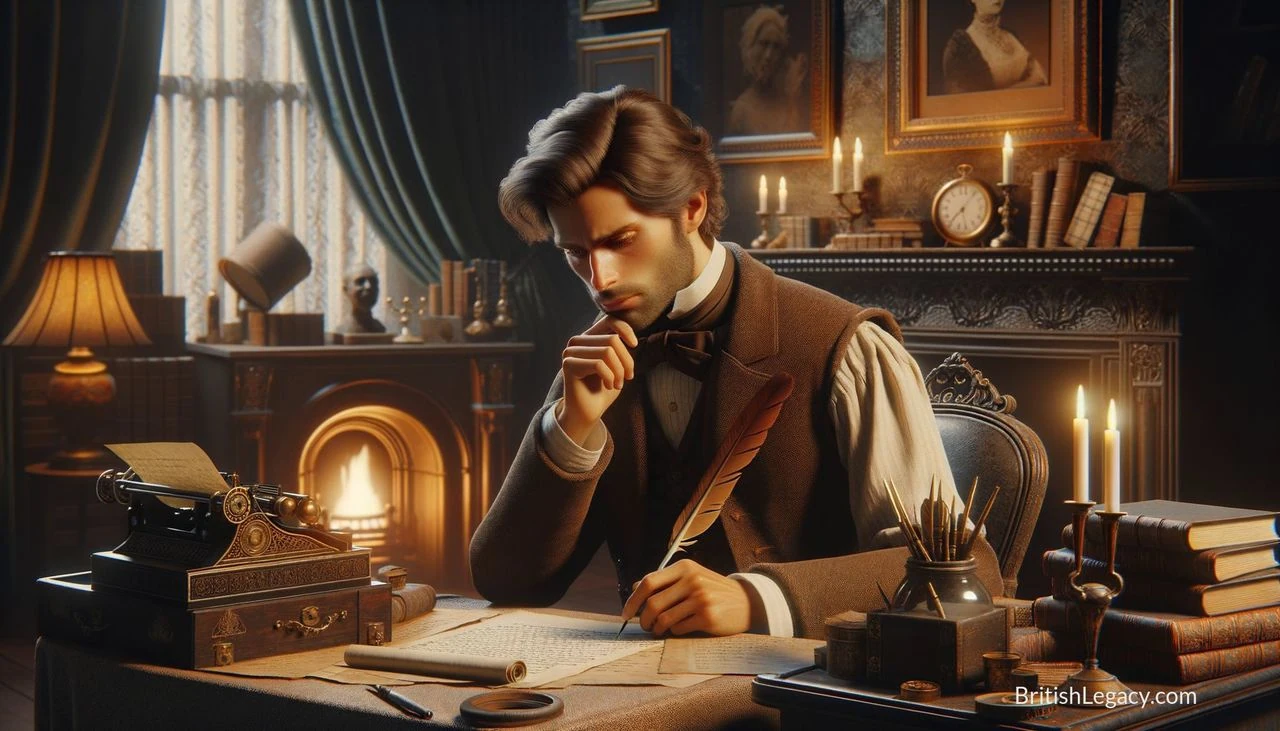
Robert Browning made poetry sound like speech while turning a speaker’s words into evidence against him. In “My Last Duchess”, a duke’s polished account of his late wife reveals his possessiveness; in “Porphyria’s Lover”, a calm voice recounts murder as an attempt to preserve a perfect moment. Browning’s dramatic monologues invite readers to listen closely, not simply to what a character says, but to what that character unintentionally discloses.
A London beginning and an uncertain reception
Browning was born on 7 May 1812 in Walworth, in the parish of Camberwell, Surrey, an area now within south London. His father, a clerk at the Bank of England, collected books, and Browning grew up with access to a substantial family library. Educated largely at home, he briefly studied Greek at University College London before leaving. Rather than pursue a formal career, he committed himself to writing poetry.
His first book, Pauline: A Fragment of a Confession, appeared anonymously in 1833. It attracted some favourable notice but sold no copies. Paracelsus, published in 1835, brought greater critical and commercial attention and helped him enter London’s literary circles. Browning also wrote for the stage: his play Strafford was performed five times. His reputation suffered, however, after Sordello appeared in 1840. The long poem’s difficulty became a target for mockery, and it took years for his standing to recover.
From 1841 to 1846, Browning published a sequence of pamphlets under the title Bells and Pomegranates. Although initially conceived as a home for his plays, the series also included dramatic lyrics that helped establish the direction of his poetry. “My Last Duchess”, “Porphyria’s Lover” and “The Pied Piper of Hamelin” appeared in its pages. Browning’s characteristic method was taking shape: a voice speaks to an implied listener, recounting events while revealing more about its own motives than it intends.
Marriage, Italy and a change in fortune
Browning met the poet Elizabeth Barrett in 1845. They married in 1846 and moved to Italy, living first in Pisa and then in Florence. Their son, Robert Wiedemann Barrett Browning, known as Pen, was born in 1849. Browning later described Italy as his university; its art and atmosphere became important to him. His wife’s death in Florence in 1861 ended their life together there. Browning returned to London with their son the following year.
While living in Florence, Browning wrote much of Men and Women, published in 1855. The collection did not initially bring the success he hoped for. His reputation rose more decisively after Dramatis Personae in 1864 and, above all, The Ring and the Book. Published in four parts between 1868 and 1869, the long poem reworks a murder case from 1690s Rome through a series of accounts by different characters. Its competing perspectives make the reader weigh not only what happened, but how interest, memory and self-justification shape each version.
The work proved both a critical and a commercial success, after decades in which Browning’s poetry had often been dismissed. In 1881, the Robert Browning Society was formed. By then, his writing had become recognised as part of the British literary canon, though its length and difficulty continued to challenge readers.
What a speaker gives away
Browning’s monologues are not straightforward expressions of the poet’s own beliefs. Their speakers may be persuasive, evasive or self-deceiving; the reader must infer a more complicated truth from the details of their speech. In “My Last Duchess”, the duke’s controlled manner and casual account of his former wife expose a desire for control. “Porphyria’s Lover” likewise puts an extreme act of possession into the speaker’s own explanation of it. These poems make the gap between a character’s account and a reader’s judgement central to the drama.
The method also shaped Browning’s longer work. The Ring and the Book gives several narrators a chance to present their view of one case, rather than offering a single authoritative account. His interest in character, irony and the limits of personal testimony therefore operates at several scales, from a short lyric to a book-length poem. It is a demanding approach: Browning’s syntax and vocabulary can be challenging, and Sordello became notorious for its obscurity. But the difficulty is part of a body of work that asks readers to interpret voices rather than accept them at face value.
Browning continued to write and travel in later life. Among his later works were Parleyings with Certain People of Importance in Their Day, published in 1887, and Asolando, published in 1889. He died in Venice on 12 December 1889 and was buried in Poets’ Corner at Westminster Abbey. His final volume appeared on the day of his death.
Why Robert Browning deserves a place in British Legacy
Browning’s place in British literary history rests on a specific achievement: he made the speaking voice a means of dramatic discovery. In poems such as “My Last Duchess” and “Porphyria’s Lover”, readers hear characters justify themselves, then have to recognise the moral and psychological facts their speakers betray. The form joins characterisation to interpretation. Rather than explaining a person from the outside, Browning lets that person speak and makes the reader assess the account.
He extended that experiment in The Ring and the Book, where multiple speakers revisit a real murder case and produce conflicting versions of events. The poem’s scale gives a sustained form to questions of truth, perspective and self-interest. Browning’s work was not universally easy or popular in his lifetime; Sordello’s reception and the slow arrival of wider recognition are part of the record too. Yet the eventual success of The Ring and the Book, the formation of a society devoted to his work, and his enduring place in the literary canon show how firmly his poetic method took hold. His legacy is not simply that he wrote about psychology and morality, but that he devised a distinctive poetic way to make readers test both.
Sources
Robert Browning — Wikipedia, revision 1374853364 · Robert Browning — Wikipedia
Adapted in part from Robert Browning by Wikipedia contributors, under CC BY-SA 4.0. Text has been edited and combined with the existing article; this adapted text is shared under the same licence. Contributor history.