Robert Owen’s social programme began with a practical proposition: working conditions, education and the surroundings in which children grew up could be changed. At New Lanark, the Welsh mill-owner put that proposition to the test, combining a commercially successful cotton business with reforms to workers’ lives and education. He later tried to build a co-operative community in the United States and spent decades campaigning for social change in Britain.
From Newtown to the cotton mills
Owen was born in Newtown, Montgomeryshire, on 14 May 1771, the sixth of seven children. His father was a saddler, ironmonger and local postmaster; his mother came from a farming family. Owen received little formal education and left school at ten to become an apprentice draper in Stamford. He later worked in London drapery shops before moving to Manchester at about eighteen, where he entered the textile trade.
In Manchester, Owen progressed from working in drapery to managing mills and forming business partnerships. In 1792, mill-owner Peter Drinkwater appointed him manager of the Piccadilly Mill. Owen later left that business and became involved in the Chorlton Twist Mills. He also joined the Manchester Literary and Philosophical Society and the Manchester Board of Health, whose work included seeking better health and working conditions for factory employees.
Owen married Ann, also known as Anne, Caroline Dale, in 1799. Her father, David Dale, was a Glasgow philanthropist and proprietor of New Lanark Mills. Owen and his partners bought the mill in July that year, and Owen became its manager in January 1800. Their move to New Lanark brought his business experience together with his interest in how industrial communities were run.
New Lanark: reform within a working mill
New Lanark had been established by David Dale and Richard Arkwright in 1785. Water from the River Clyde powered its cotton-spinning operation, which employed about 2,000 people, including 500 children. Some children had been brought from poorhouses and charities in Edinburgh and Glasgow. Although Dale had made efforts to treat them well, residents faced long working hours, crowded housing, poor sanitation and limited education.
Owen wanted the mill to be managed on principles that went beyond commercial return. His approach included a store that sold goods at prices only slightly above wholesale, passing on savings from bulk buying. Unlike the truck shops that paid workers partly or wholly in tokens usable only at the employer’s shop, Owen’s store accepted ordinary money. He also placed alcohol sales under strict supervision.
He used a coloured, four-sided block above each worker’s station as a silent monitor of the quality and quantity of work. The device was meant to influence conduct without corporal punishment. Owen also pressed for shorter working hours: he called for an eight-hour day in 1810 and, by 1817, had formulated the slogan “eight hours labour, eight hours recreation, eight hours rest”. His reforms did not remove the restrictions of factory life, but New Lanark showed how changes to management and provision could operate within an industrial business.
The mill’s reputation drew visitors, including social reformers, statesmen and royalty, who came to observe its methods. Owen’s success there helped give him a platform for arguing that better treatment of workers and efficient production need not be incompatible.
Education and the formation of character
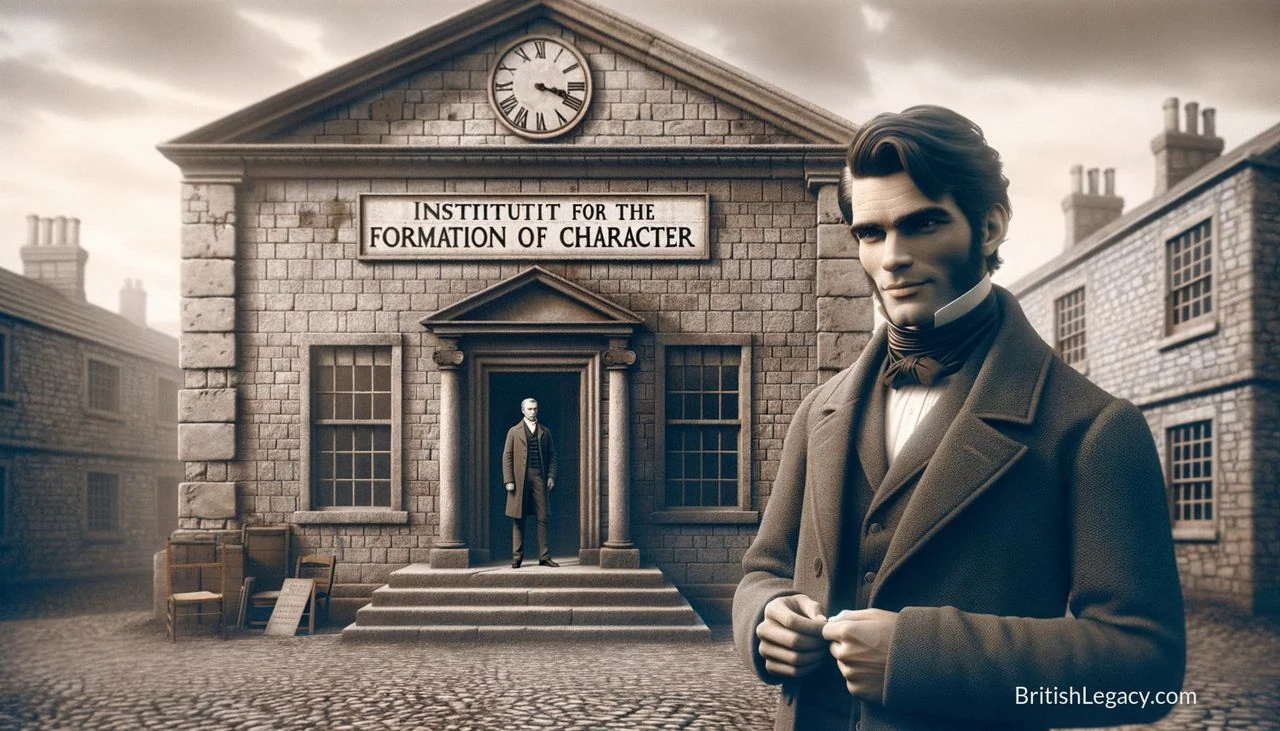
Owen’s educational ideas followed from his view that people’s characters were shaped by circumstances and early influences. He argued that a more humane society required attention to the physical, moral and social conditions in which people grew up. At New Lanark, the Institute for the Formation of Character and its school for children offered education from infancy to adulthood, rather than restricting learning to preparation for a job.
The Institute was established in 1818. Owen’s educational work gave particular attention to young children and early care, and offered a different model from the authoritarian methods common in education at the time. His ideas linked schooling to the wider conditions of community life: children’s learning, workers’ welfare and the organisation of industry were parts of one reform programme.
Owen also supported legislation on factory work. His advocacy contributed to the campaign for the Cotton Mills and Factories Act of 1819. He wanted to extend improvements beyond New Lanark, arguing for child-labour restrictions, free education and better living conditions in factory towns.
New Harmony and a return to Britain
In 1824, Owen went to the United States to pursue an experiment in communal living. He bought the settlement of Harmony in Indiana, renamed it New Harmony, and intended it as a preliminary model for a co-operative society. The venture attracted educators, scientists, artists and other reform-minded residents, but disagreements and economic difficulties undermined it. The community dissolved in 1827, after about two years. Owen had committed much of his fortune to the project.
London became the centre of his work from 1828. He continued to lecture and publish, advocating industrial equality, education and improved living conditions. In 1832 he opened the National Equitable Labour Exchange, where goods could be exchanged using labour notes rather than the usual system of money and middlemen. The London exchange operated until 1833; a Birmingham branch lasted only a few months. Owen also took a leading role in the Grand National Consolidated Trade Union, which collapsed in 1834.
He continued to promote co-operation and social reform through public meetings, pamphlets and periodicals. The co-operative movement proved the most lasting result of this campaigning. Owen published his memoirs in 1857. He died in his native Newtown on 17 November 1858, aged 87, and was buried there.
Why Robert Owen deserves a place in British Legacy
Owen’s place in British history rests on the connection he made between ideas about society and experiments in everyday life. At New Lanark, he applied that thinking to a working mill: its store offered goods at near-wholesale prices, its silent monitor sought to replace corporal punishment, and his campaign for shorter hours gave a clear expression to the demand for time beyond work. The community’s reputation brought visitors to see the model in operation. It did not prove that every part of Owen’s programme could be reproduced, but it made industrial management and workers’ welfare subjects for public discussion.
His educational work was equally grounded in practice. The Institute for the Formation of Character and its school extended learning from early childhood onwards, reflecting Owen’s belief that circumstances and early influences shaped a person’s character. Beyond New Lanark, his support for factory legislation, free education, co-operation and trade unionism carried those concerns into public campaigns. New Harmony, the labour exchange and his union leadership had mixed or short-lived results; recognising that matters as much as celebrating his ambitions. Together, these efforts show a reformer testing how work, education and shared provision might be organised differently. Owen’s British legacy is therefore not a claim that his schemes solved industrial inequality, but the documented record of a Welsh-born reformer who made such questions central to public debate and practical experiment.
Sources
Adapted in part from Robert Owen by Wikipedia contributors, under CC BY-SA 4.0. Text has been edited and combined with the existing article; this adapted text is shared under the same licence. Contributor history.