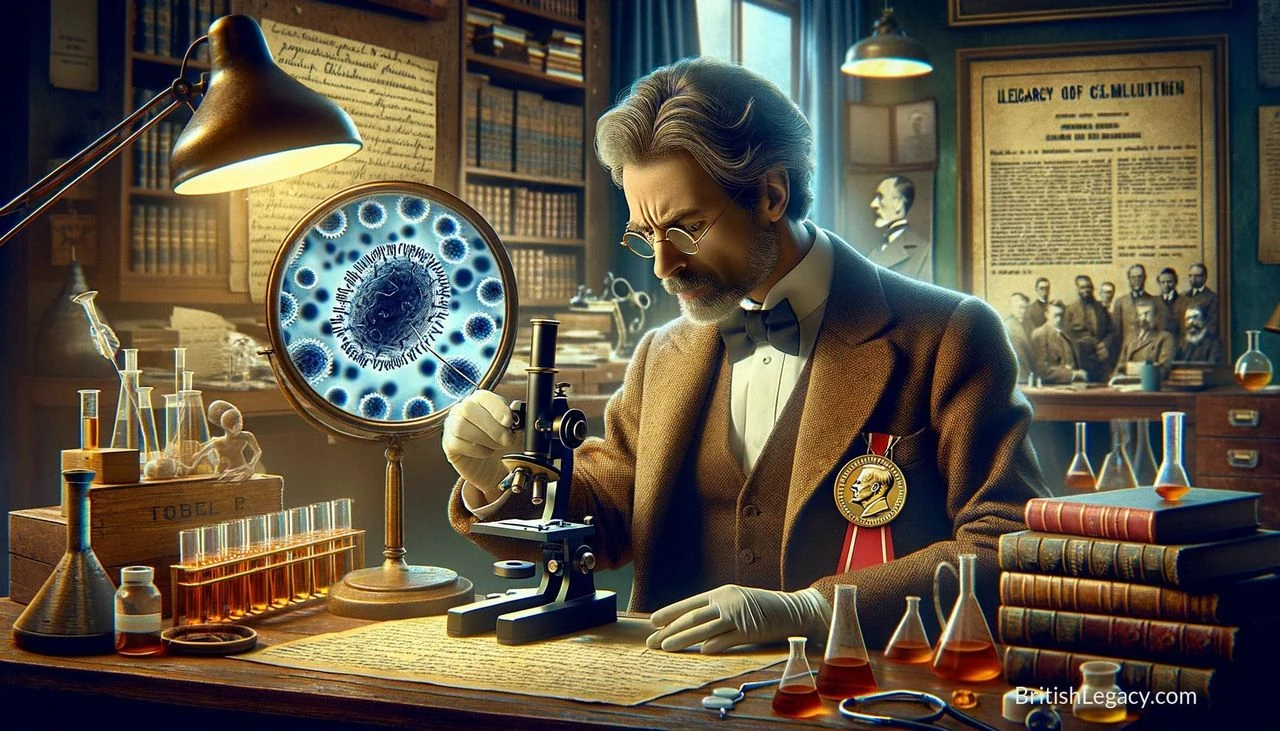
On 20 August 1897, after two years of interrupted research, Ronald Ross found malaria parasites in the gut of a mosquito he had fed on an infected patient. The observation was a decisive step towards understanding how malaria spreads. It did not, by itself, establish the complete transmission cycle of human malaria: Ross’s subsequent demonstration traced the parasite through birds, while Italian researchers established important stages of the human malaria cycle. The distinction matters to the science, and to a fair account of Ross’s achievement.
From Almora to medical training in London
Ross was born on 13 May 1857 in Almora, in what was then the North-Western Provinces of British India. He was the eldest of ten children of Sir Campbell Claye Grant Ross, a general in the British Indian Army, and Matilda Charlotte Elderton. At eight he was sent to England to live with an aunt and uncle on the Isle of Wight. He went to primary school in Ryde and later attended a boarding school near Southampton.
As a boy, Ross was drawn to poetry, music, literature and mathematics. He won a mathematics prize at 14 and placed first in a local examination in drawing the following year. His own preference was to become a writer, but his father arranged for him to study medicine at St Bartholomew’s Hospital Medical College in London. Ross was not wholly committed to the course: alongside his studies, he wrote poems and plays and composed music.
He left St Bartholomew’s in 1880. Having passed the Royal College of Surgeons examination in 1879, he worked as a ship’s surgeon while completing further medical qualifications. In 1881, after training at the Army Medical School, he entered the Indian Medical Service. His postings took him to several places across India and Burma. In Bangalore, in 1883, he noticed that restricting mosquitoes’ access to water might help control them. It was an early indication of the practical questions that would shape his later work.
The mosquito and the malaria parasite
Ross’s malaria research developed after his 1894 meeting with Patrick Manson, who became his mentor. Returning to India in 1895, Ross began examining blood samples from malaria patients. He saw early stages of the parasite in a mosquito that year, but postings and the availability of suitable cases repeatedly interrupted his work. In 1897, after moving to Secunderabad, he bred mosquitoes from collected larvae and fed them on a patient with malaria.
On 20 August, he identified malaria parasites in the mosquito’s gut; the next day, he confirmed that they had developed there. He had called the insect a “dappled-winged” mosquito, but the species he was studying belonged to the genus Anopheles. He published his findings in the Indian Medical Gazette and subsequently in the British Medical Journal. The work showed that mosquitoes could carry the malarial parasite and gave researchers a basis for investigating transmission.
Ross’s next major advance came in 1898, after he was transferred to Calcutta and could not make progress using human malaria cases. He turned to birds, whose malaria parasites were suitable for study. Working with infected sparrows, he established the role of Culex mosquitoes in avian malaria, identified the salivary glands as a site where the parasites were stored, and demonstrated transmission to healthy birds through mosquito bites. That work completed the life cycle he had traced in birds. It was distinct from the work on human malaria by Giovanni Battista Grassi and colleagues, who described the life cycles of several human malaria parasites in anopheline mosquitoes.
Research, teaching and public health in Britain
Ross left the Indian Medical Service in 1899 and joined the Liverpool School of Tropical Medicine. He continued to investigate malaria prevention in different parts of the world and helped establish anti-malaria organisations in India and Sri Lanka. Appointed professor and chair of tropical medicine at Liverpool in 1902, he held the post until 1912. He later worked at King’s College Hospital in London and advised the British War Office on malaria. From 1918 to 1926 he was a consultant on malaria to the Ministry of Pensions and National Insurance.
His contribution was not limited to laboratory observation. Ross developed mathematical models for studying malaria epidemiology, first applying them in a report on Mauritius in 1908. He expanded this work in The Prevention of Malaria, published in 1910, and in later papers, including work developed with the mathematician Hilda Hudson. His interest in mathematics also reached beyond epidemiology, into pure and applied mathematics. The book combined scientific argument with practical concern for prevention, and Ross continued to write about malaria control and public instruction.
The 1902 Nobel Prize in Physiology or Medicine recognised Ross’s work on malaria. His award came amid a dispute over credit with Grassi: Ross accused him of fraud, and the committee ultimately awarded the prize to Ross alone. The award’s citation described Ross’s work as showing how malaria enters the organism and laying the foundation for research and methods of combating the disease. Ross was elected a Fellow of the Royal Society in 1901, became its vice-president from 1911 to 1913, and was appointed a Knight Commander of the Order of the Bath in 1911.
A complicated career and a lasting institution
Ross’s professional life included both scientific achievement and recurring friction with colleagues and administrators. The account of his career records disputes at Liverpool and his dissatisfaction with government support for medical research. In 1928, he advertised papers for sale to raise financial support for his family. Lady Houston bought them and offered them to the British Museum, which declined them; the papers are now preserved by the London School of Hygiene and Tropical Medicine and the Royal College of Physicians and Surgeons of Glasgow.
In 1926, the Ross Institute and Hospital for Tropical Diseases was established at Bath House on Putney Heath. Ross became its director-in-chief and remained in the role until his death. He died in London on 16 September 1932, after a long illness and an asthma attack, and was buried at Putney Vale Cemetery beside his wife, Rosa Bessie Bloxam, who had died the previous year. They had four children. Their son Ronald was killed in the First World War; their daughter Sylvia also died before her father.
Why Ronald Ross deserves a place in British Legacy
Ross deserves a place in British Legacy because his work connects a discovery made during service in India with a long career in British medicine and public health. His 1897 observation of malaria parasites in a mosquito’s gut helped establish a route for investigating transmission. The bird experiments that followed showed how the parasite developed and moved through a mosquito to a host. Keeping that achievement distinct from the work of Grassi and his colleagues gives credit without overstating what Ross proved about human malaria.
His legacy also lies in the methods and institutions built around the research. Ross applied mathematical modelling to malaria epidemiology and used writing on prevention to connect scientific study with practical control. At Liverpool and later through the Ross Institute and Hospital for Tropical Diseases, he held roles that made tropical medicine and malaria research part of Britain’s medical life. The London School of Hygiene and Tropical Medicine commemorates him among the public-health pioneers on its frieze, and marks 20 August as World Mosquito Day. These remembrances point to a specific contribution: not a solitary solution to malaria, but a research foundation that helped others investigate how to combat it.
Sources
Ronald Ross — supplied Wikipedia revision
Adapted in part from Ronald Ross by Wikipedia contributors, under CC BY-SA 4.0. Text has been edited and combined with the existing article; this adapted text is shared under the same licence. Contributor history.