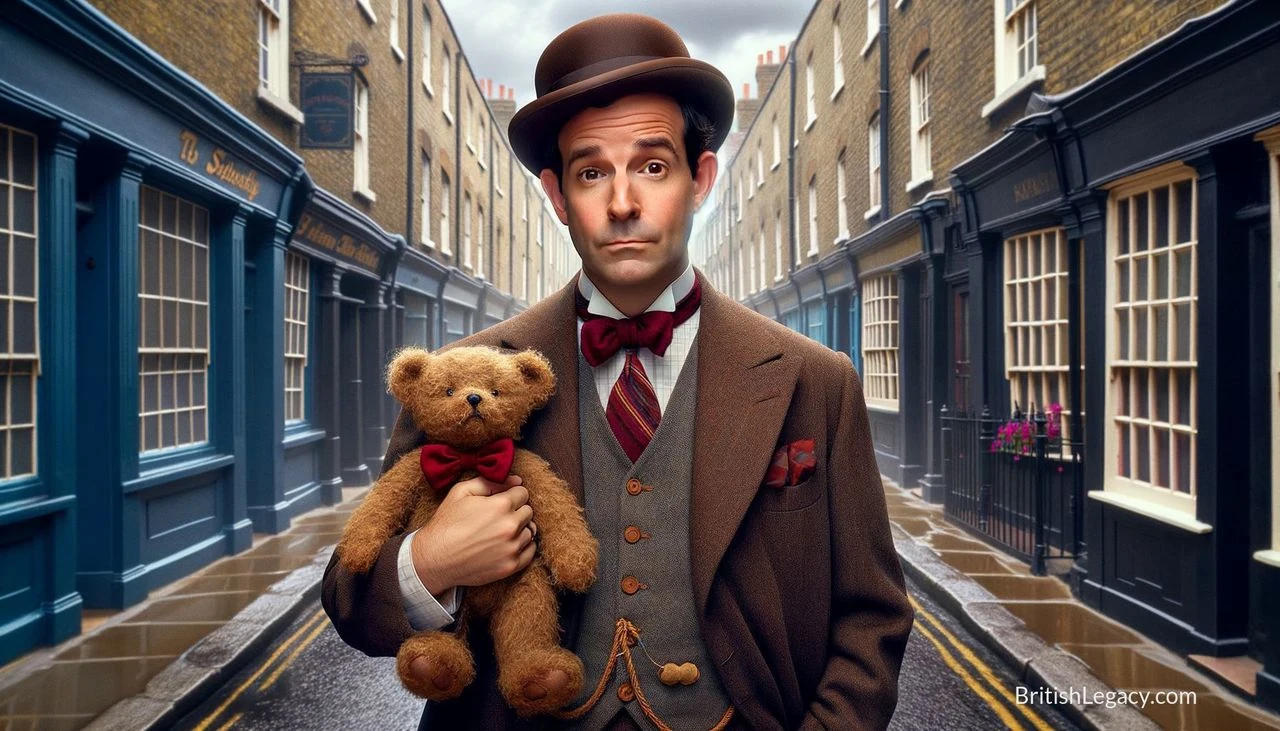
Rowan Atkinson’s comedy can turn on a change of expression, a perfectly timed pause or a sentence delivered with absolute seriousness. As Edmund Blackadder, he made the cutting retort an instrument of survival; as Mr Bean, he built comedy from physical action and very little dialogue. The contrast between those characters is central to his career: one depends on language and historical satire, the other on visual precision. Both began with an interest in performance that grew alongside, rather than instead of, his engineering education.
From engineering to the stage
Atkinson was born on 6 January 1955 and grew up in Consett, County Durham. He studied electrical and electronic engineering at Newcastle University, graduating in 1975, then pursued postgraduate study at The Queen’s College, Oxford. He completed an MSc in electrical engineering after briefly beginning doctoral study. His time at Oxford also brought him into the university’s performance world: he wrote and performed sketches, took part in the Oxford Revue at the Edinburgh Festival Fringe in 1976, and met Richard Curtis and composer Howard Goodall. Curtis and Goodall would become recurring collaborators.
Atkinson’s first national success came not with Blackadder but with the BBC sketch programme Not the Nine O’Clock News, which ran from 1979 to 1982. He joined in 1979, performed alongside Griff Rhys Jones, Mel Smith and Pamela Stephenson, and was one of the principal sketch writers. The programme established his ability to move between characters and comic forms, while his stage work developed in parallel. In 1981 he won a British Academy Television Award for his performance on the show and an Olivier Award for Rowan Atkinson in Revue.
His early stage career included live performances for The Secret Policeman’s Ball, a benefit for Amnesty International, and a four-month UK tour in 1980. He later appeared in the West End production of The Nerd and in The Sneeze and Other Stories, adapted from Anton Chekhov. These performances belong to a career that has never been limited to television, even though television gave its most familiar characters a home.
Blackadder’s changing fortunes
The first series of The Black Adder, co-written by Atkinson and Curtis, placed its title character in the medieval period as an unintelligent, naïve figure. The programme’s later versions shifted both historical setting and personality. In Blackadder II, set in the Elizabethan era and written by Curtis and Ben Elton, Atkinson’s character became a devious, sharp-tongued anti-hero. The subsequent series moved to the Regency period and then to the First World War in Blackadder Goes Forth.
That changing structure gave Atkinson room to remake the character rather than simply repeat a successful performance. His Blackadder is alert to rank and danger, and his verbal attacks often land on people who fail to understand them. Tony Robinson’s Baldrick, alongside performances by Tim McInnerny, Stephen Fry and Hugh Laurie, helped establish the ensemble around him. The series became one of the BBC’s best-known sitcoms. Atkinson won a second BAFTA for his work on Blackadder Goes Forth in 1990.
Atkinson returned to the character for later specials, including Blackadder’s Christmas Carol and Blackadder: The Cavalier Years. In 2012 he performed new Blackadder material at a comedy gala for The Prince’s Trust, with Robinson again appearing as Baldrick. This time the characters were recast in a sketch about a banking crisis inquiry, a reminder that the series’ mock-historical settings could also frame contemporary targets.
Mr Bean and comedy without borders
Mr Bean first appeared in a half-hour television special on New Year’s Day in 1990. Atkinson and Curtis developed the character with Robin Driscoll: an adult whose self-interest and limited awareness of other people generate trouble, often without the need for dialogue. The performance calls for careful control of gesture, timing and facial expression. Atkinson has described Jacques Tati’s Monsieur Hulot as a major influence, placing the character in a tradition of visual comedy rather than treating his silence as a gimmick.
The original television series ran through 1995, and the character continued in two feature films: Bean (1997) and Mr. Bean’s Holiday (2007). The imported account reports that the 15-episode series was sold to more than 190 countries and reached an estimated audience of over 18 million. The character also moved into animation, with Atkinson providing the voice for Mr. Bean: The Animated Series. The format’s reliance on physical action made it readily legible to audiences beyond the English-speaking world, while the distinctive character remained recognisable across television, film and online video.
Atkinson’s work outside these two characters has been varied. He played Inspector Raymond Fowler in the police-station sitcom The Thin Blue Line, and later took the title role in ITV’s Maigret television films. His film appearances include Four Weddings and a Funeral, Love Actually and the Johnny English series. He voiced Zazu in Disney’s animated film The Lion King. These parts range from supporting comic roles to a more restrained dramatic performance, widening the picture of a performer often identified chiefly with Bean and Blackadder.
Stage, screen and public recognition
Atkinson returned to the West End in 2009 as Fagin in the musical Oliver!, based on Charles Dickens’s Oliver Twist. The performance received favourable reviews and an Olivier Award nomination. In 2013 he took the title role in Simon Gray’s play Quartermaine’s Terms, directed by Richard Eyre. His stage work has therefore extended from revue and sketch comedy to musical theatre and a contemporary play.
His public performances have also included conspicuous one-off appearances. At the London 2012 Olympic Games opening ceremony, he appeared as Mr Bean in a comic sequence set to music from Chariots of Fire. In 1999, he played the Doctor in The Curse of Fatal Death, a Doctor Who special made for Comic Relief. The range of settings—from charity performance to a global sporting ceremony—shows how readily his established characters could be placed in formats beyond their original series.
Atkinson was appointed Commander of the Order of the British Empire in the 2013 Birthday Honours for services to drama and charity. His honours also include two BAFTA television awards for performance and an Olivier Award for revue. They recognise work across forms, but the reach of his comedy rests just as much on the craft visible in it: the measured delivery of a line, the exactness of a physical reaction and the ability to make a character’s limitations drive the scene.
Why Rowan Atkinson deserves a place in British Legacy
Rowan Atkinson deserves a place in British Legacy because his career connects several important strands of British performance. Not the Nine O’Clock News established him as a sketch performer and writer; Blackadder made historical settings a vehicle for sharp character comedy; and Mr Bean demonstrated how a carefully constructed visual performance could travel internationally without relying on language. These are distinct achievements, not variations on a single role. Their continuing presence in television, film, animation and live performance reflects the range of forms through which British comedy reaches audiences.
His path also carries a particularly British cultural connection in the institutions and stages that shaped it: engineering study at Newcastle and Oxford, university revue, the Edinburgh Festival Fringe, BBC television, West End theatre and national honours for drama and charity. Atkinson’s engineering education is part of that story, but so is his work with writers and performers, especially Richard Curtis, Howard Goodall and the ensemble around Blackadder. Together, those collaborations produced characters whose humour depends on exact construction, whether through a verbal insult or a wordless mishap. His legacy is therefore not simply the popularity of Mr Bean or Blackadder; it is the evidence of how different comic techniques can be sustained, adapted and shared with audiences at home and abroad.
Sources
Rowan Atkinson — Wikipedia revision 1379157693 · Rowan Atkinson — Wikipedia
Adapted in part from Rowan Atkinson by Wikipedia contributors, under CC BY-SA 4.0. Text has been edited and combined with the existing article; this adapted text is shared under the same licence. Contributor history.